 flip
flipCoffee and Streuselkuchen — The Afternoon Break
Coffee and Streuselkuchen — The Afternoon Break
Why this dish? Kaffee und Kuchen—black coffee accompanied by a cake—is the German social afternoon ritual, which was found in Stieglitz's German-American household. It was also the time for conversations: and Stieglitz, tireless, would remake modern art over a cup, at Gallery 291 as well as on the veranda at Lake George.
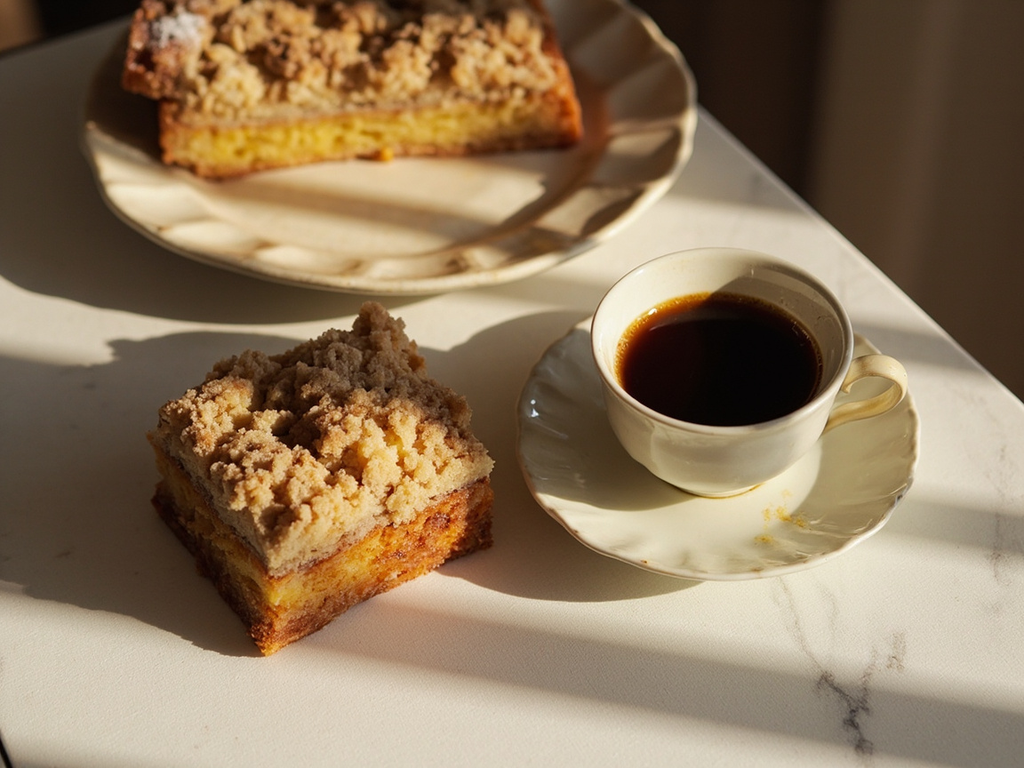
A strong black coffee served with Streuselkuchen, a yeasted cake topped with a thick buttery crumble of sugar and cinnamon. The bitterness of the coffee answers the sweet crunch: it is the afternoon's breathing space.
In the afternoon, you see, one does not discuss art on an empty stomach or with a dry mouth. You make a good black coffee, strong—not that American lukewarm water—and you cut a generous slice of Streuselkuchen, that cake crowned with crumbs of sugar and butter that crackle under the tooth. At 291, that is how we remade the world: a steaming cup, a slice of cake, and the ideas came of their own accord. Dip the corner of the cake into the coffee, if you like—I will not tell anyone.
- •Ground coffee — for a full pot (bitter drink)
- •Flour — enough for a yeasted dough (cake base)
- •Baker's yeast — a little (leavening)
- •Milk — a bowl (dough liquid)
- •Butter — generously (crumble)
- •Sugar — as needed (crumble and dough)
- •Cinnamon — a pinch (crumble flavor)
Coffee and Streuselkuchen — The Afternoon Break
A strong black coffee served with Streuselkuchen, a yeasted cake topped with a thick buttery crumble of sugar and cinnamon. The bitterness of the coffee answers the sweet crunch: it is the afternoon's breathing space.
Why this dish? Kaffee und Kuchen—black coffee accompanied by a cake—is the German social afternoon ritual, which was found in Stieglitz's German-American household. It was also the time for conversations: and Stieglitz, tireless, would remake modern art over a cup, at Gallery 291 as well as on the veranda at Lake George.
In the afternoon, you see, one does not discuss art on an empty stomach or with a dry mouth. You make a good black coffee, strong—not that American lukewarm water—and you cut a generous slice of Streuselkuchen, that cake crowned with crumbs of sugar and butter that crackle under the tooth. At 291, that is how we remade the world: a steaming cup, a slice of cake, and the ideas came of their own accord. Dip the corner of the cake into the coffee, if you like—I will not tell anyone.
Ingredients (period version)
- Ground coffee — for a full pot (bitter drink)
- Flour — enough for a yeasted dough (cake base)
- Baker's yeast — a little (leavening)
- Milk — a bowl (dough liquid)
- Butter — generously (crumble)
- Sugar — as needed (crumble and dough)
- Cinnamon — a pinch (crumble flavor)
Ingredients
- Strong filter coffee — 1 large pot (bitter drink)
- Flour (dough) — 300 g (cake base)
- Active dry yeast — 1 packet (7 g) (leavening)
- Warm milk — 150 ml (dough liquid)
- Sugar (dough) — 50 g (dough)
- Soft butter (dough) — 50 g (dough)
- Egg — 1 (dough)
- Flour (streusel) — 150 g (crumble)
- Cold butter (streusel) — 100 g (crumble)
- Sugar (streusel) — 100 g (crumble)
- Cinnamon — 1 tsp (crumble flavor)
Method
- Dough: dissolve yeast in warm milk, add flour, sugar, egg, and soft butter; knead and let rise for 1 hour under a cloth.
- Roll out the dough into a buttered pan.
- Streusel: with your fingertips, rub together flour, cold butter, sugar, and cinnamon until coarse crumbs form.
- Generously sprinkle the streusel over the dough and let rest for 20 minutes.
- Bake at 180°C for about 30 minutes, until the crumbs are golden.
- Prepare a strong black coffee and serve the cake warm, in large slices.
How it was made : Kaffee und Kuchen spread among the German bourgeoisie from the 18th century onward, when coffee became accessible. Streuselkuchen, originally from Silesia, is one of the most popular coffee cakes, brought to the United States by German immigration under the name "streusel cake" or "coffee cake."
The contemporary twist : Add apple or plum wedges under the streusel for an *Apfel-* or *Pflaumenstreuselkuchen*, perfect for summer afternoons by the lake.
Alfred Stieglitz · Charactorium