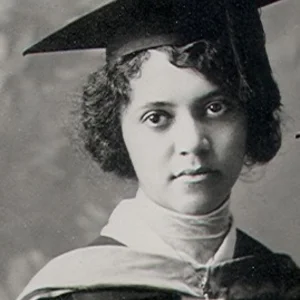

Alice Ball was an African American chemist known for developing an injectable treatment for leprosy made from chaulmoogra oil. She died at just 24, and her pioneering work was not recognized until decades later.
Alice Ball(1892 — 1916)
Alice Ball
États-Unis
6 min read
Frequently asked questions
Key Facts
- Born on July 24, 1892, in Seattle (Washington), in the United States.
- In 1915, she became the first woman and the first African American person to earn a master's degree in chemistry from the University of Hawaii.
- Around 1915–1916, she developed the “Ball Method,” an injectable form of chaulmoogra oil effective against leprosy.
- She died prematurely on December 31, 1916, at the age of 24.
- Her work, long attributed to a colleague, was not truly recognized until the late 20th century.
Works & Achievements
A process isolating the ethyl esters of the fatty acids in chaulmoogra, making the treatment injectable. It remained the leading therapy against leprosy until the 1940s.
A study of the chemical constituents of the awa (kava) root, capping her studies in Hawaii.
A pioneering achievement in a segregated America, opening a path for women and African Americans in the sciences.
She taught chemistry while pursuing her research, a rare feat for a woman and unprecedented for an African American woman at this university.
Anecdotes
At just 23, Alice Ball solved a problem that had stumped doctors for centuries: making chaulmoogra oil injectable. By isolating the ethyl esters of its fatty acids, she transformed a sticky, foul-smelling oil into a remedy the body could finally absorb, relieving thousands of people suffering from leprosy.
In 1915, she became the first woman and the first African American to earn a master's degree in chemistry from the College of Hawaii, and then its first chemistry instructor. A double first in an America where segregation closed nearly every university door to Black people and to women.
After her death at 24, the college president, Arthur Dean, carried on her research and published it without crediting her, naming the technique the “Dean method.” It was not until 1922 that Dr. Harry Hollmann set the record straight in a scientific paper and restored her name to the “Ball method.”
Her grandfather, James Presley Ball, was one of the first celebrated African American photographers and a pioneer of the daguerreotype. Young Alice thus grew up in a family already at home with science and the craft of imagery.
Recognition came nearly a century late: only in 2000 did the University of Hawaii place a commemorative plaque at the foot of a chaulmoogra tree, and February 29 was declared “Alice Ball Day.”
Primary Sources
Dr. Hollmann explicitly credits the process to Alice Ball, writing that he sees no possible improvement over the original technique developed by “Miss Ball”.
Research on the chemical constituents of the awa root (kava), demonstrating her analytical skills before her work on chaulmoogra.
Articles describing the production of injectable esters under the name “Dean method”, without any mention of Alice Ball's initial role — a concrete illustration of the erasure of her contribution.
Key Places
Alice Ball's hometown, where she returned ill and died at the age of 24 in late 1916.
Where she earned her degrees in pharmaceutical chemistry (1912) and then pharmacy (1914).
Where she obtained her master's degree in 1915 and became the institution's first female chemistry instructor.
A care center for leprosy patients where Dr. Hollmann worked; he asked Alice Ball to solve the chaulmoogra problem.
A chaulmoogra tree planted behind Bachman Hall has borne a plaque honoring Alice Ball's memory since 2000.
Typical Objects

Oil extracted from the seeds of the chaulmoogra tree, used for centuries in Asia against leprosy. Too thick, bitter, and nausea-inducing, it was nearly unusable before the work of Alice Ball.

An instrument for injecting a medication into the body. It was thanks to Alice Ball's process that chaulmoogra oil could finally be administered by injection.

Test tubes, flasks, and beakers used to mix, heat, and separate substances. The chemist's everyday tools for isolating the esters in the oil.

An assembly of glassware used to separate the components of a mixture by heating. Essential to the work of purifying the fatty acids of chaulmoogra.

A balance capable of weighing very small quantities, indispensable for measuring out the exact amounts of reagents in a chemistry experiment.

A notebook in which the researcher recorded protocols, measurements, and results. A written trace of scientific reasoning, sadly not enough to protect her from being forgotten after her death.
School Curriculum
Vocabulary & Tags
Key Vocabulary
Tags
Daily Life
Morning
Early in the morning, Alice would head to her university laboratory in Honolulu. She prepared her glassware, weighed her reagents on the precision balance and resumed her experiments on the fatty acids of chaulmoogra.
Afternoon
The afternoon blended teaching and research: she supervised chemistry students and then returned to her distillations. She also exchanged ideas with Doctor Hollmann about the results at the Kalihi hospital.
Evening
In the evening, she recorded the day's measurements in her notebook and read scientific journals. A studious young woman, torn between her duties as a teacher and her passion for research.
Food
In early-twentieth-century Hawaii, the diet combined imported American products with local resources: fish, rice, and tropical fruits such as bananas and pineapples. The meals of a university scholar remained simple and frugal.
Clothing
She wore the understated attire of educated women of the time: a long dress with a fitted waist, a high-collared blouse and her hair pinned up. In the laboratory, a lab coat protected her clothes from the chemicals.
Housing
Living near the Honolulu campus, she occupied a modest dwelling suited to the tropical climate, airy and on a single level. Her family, originally from Seattle, had themselves stayed in Hawaii for a time.
Historical Timeline
Period Vocabulary
Liens externes & ressources
Références
Œuvres
La « méthode Ball » : huile de chaulmoogra injectable
1915
Thèse de master « The Chemical Constituents of Piper Methysticum »
1915
Premier master de chimie au College of Hawaii pour une femme afro-américaine
1915
Première enseignante de chimie de l'Université d'Hawaï
1915-1916