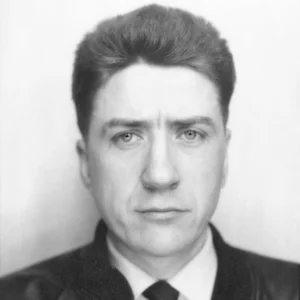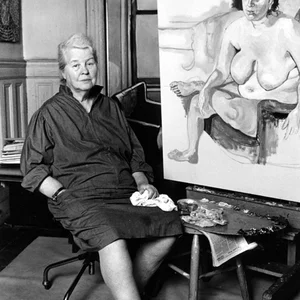

Alice Neel (1900-1984) was an American painter known for her expressive, uncompromising portraits. A feminist and committed leftist, she spent decades painting the people of New York, from intellectuals to anonymous figures.
Alice Neel(1900 — 1984)
Alice Neel
États-Unis
5 min read
Frequently asked questions
Key Facts
- Born in 1900 in Merion Square (Pennsylvania), she studied at the Philadelphia School of Design for Women
- In the 1930s, she worked for the Works Progress Administration (WPA) during the Great Depression
- She set up her studio in Spanish Harlem and later in the Upper West Side, painting her neighbors and the New York community
- In 1974, the Whitney Museum of American Art devoted a retrospective to her that brought her belated recognition
- She died in 1984 in New York, leaving behind a major body of figurative portraiture
Works & Achievements
Portrait of a young man from Harlem suffering from tuberculosis, an emblematic work of her socially conscious and compassionate vision.
Portrait of the feminist activist who appeared on the cover of Time magazine, a symbol of her entry into the iconography of feminism.
Striking portrait of the bare-chested pop artist, revealing his scars after the 1968 assassination attempt.
Nude of a pregnant woman, a subject then taboo that Neel confronts head-on and without idealization.
Family portrait revealing the psychological tensions beneath an appearance of unity.
Nude self-portrait painted at the age of 80, a manifesto of clarity and freedom in the face of old age and the female body.
Anecdotes
In the late 1960s and early 1970s, Alice Neel finally won recognition after decades in obscurity. In 1974, the Whitney Museum in New York devoted a retrospective to her: she was 74 and had been painting for half a century.
In 1970, the feminist magazine asked her for a portrait of Kate Millett for its cover. Neel painted it without having met the activist, working from photographs, which annoyed Millett but propelled the artist onto the feminist scene.
During the Great Depression, Alice Neel was employed by the Works Progress Administration, the public program that paid artists to paint. This allowed her to keep working while living in great poverty in New York.
In 1980, at the age of 80, Alice Neel painted herself nude in a striped armchair, glasses on her nose and brush in hand. This unflinching self-portrait of an elderly woman, rare in the history of art, has become one of her most famous works.
Neel herself called her portraits “collectors of souls.” She painted celebrated intellectuals and artists just as readily as her neighbors in Spanish Harlem, refusing any hierarchy between prestigious and anonymous sitters.
Primary Sources
“For me, people come first. I have tried to capture life as it goes by, right under my eyes.”
Oil on canvas depicting the artist in old age, nude, seated in a striped armchair, brush and rag in hand, her gaze frontal and clear-eyed.
The first major institutional retrospective devoted to Alice Neel, bringing together decades of New York portraits.
Key Places
Town near Philadelphia where Alice Neel was born in 1900 into a modest family.
Philadelphia art school where Neel trained in painting from 1921, now the Moore College of Art and Design.
Latino neighborhood in northern Manhattan where Neel lived and painted from 1938, immortalizing her anonymous neighbors.
Neighborhood where Neel later set up her apartment-studio and received her famous sitters during her years of recognition.
Museum that gave Neel her first major retrospective in 1974, marking her institutional recognition.
Typical Objects

The painter's basic tools, which she is shown holding in her 1980 self-portrait. She worked in oil with a nervous line and characteristic blue contours.

The wooden support on which Neel set her large canvases in her New York apartment-studio. Her models sat facing it for long posing sessions.

The taut surface on which Neel painted her life-size portraits. She often left areas unfinished, sketched in outline.

The striped seat in her studio where her models posed and where she depicted herself in her self-portrait. It became a recurring motif in her work.

The colorful raw material of her work, bought despite her poverty. Neel favored oil for its richness and its ability to render flesh.
School Curriculum
Vocabulary & Tags
Key Vocabulary
Tags
Daily Life
Morning
In the morning, Alice Neel often stays at home, in her New York apartment turned studio. She prepares her canvases and her paints, and waits for her models to arrive — people she loves to chat with at length before getting started.
Afternoon
The afternoon is devoted to long sitting sessions. Neel watches her model intently, talking to put them at ease, then paints with a quick stroke, sometimes leaving parts of the canvas unfinished.
Evening
In the evening, surrounded by her sons and her family, she also moves in New York's intellectual and left-wing activist circles. These encounters provided her with many of her future models.
Food
During the years of poverty and the Depression, her diet was modest and frugal, sometimes relying on public assistance. Later, she shared simple meals with her models and loved ones in her apartment.
Clothing
Neel dressed with no concern for fashion, in the practical, comfortable clothes of an artist at work, often stained with paint. Her modest appearance contrasted with the fame of some of her models.
Housing
She long lived in modest apartments, first in Greenwich Village and then mainly in Spanish Harlem, before the Upper West Side. Her home served as both living space and studio, where canvases piled up.
Historical Timeline
Period Vocabulary
Liens externes & ressources
Références
Œuvres
T.B. Harlem
1940
Kate Millett
1970
Andy Warhol
1970
Pregnant Woman
1971
The Family (John Gruen, Jane Wilson and Julia)
1970
Self-Portrait
1980