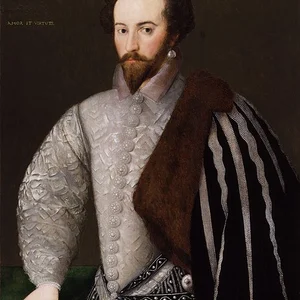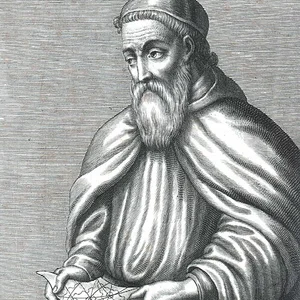

Florentine navigator and explorer (1454–1512), Amerigo Vespucci made several voyages to the New World between 1499 and 1504. He was the first to understand that the lands discovered by Christopher Columbus formed an unknown continent, which was named after him: America.
Amerigo Vespucci(1454 — 1512)
Amerigo Vespucci
République florentine, couronne de Castille
8 min read
Frequently asked questions
Key Facts
- Born in Florence in 1454 into a cultured merchant family with close ties to the Medici
- First voyage to the New World in 1499, in service of Spain, along the coasts of South America
- During his second voyage (1501–1502), he recognized that the discovered lands formed a continent distinct from Asia
- His travel letters, including the famous Mundus Novus (1503), were circulated throughout Europe thanks to the printing press
- In 1507, cartographer Martin Waldseemüller named the new continent 'America' in his honor
Works & Achievements
A Latin letter describing Vespucci's second voyage to Brazil, asserting for the first time that the lands discovered constituted a 'New World'. Translated into several languages and reprinted many times, it made Vespucci a celebrity across Europe.
A lengthy letter addressed to Piero Soderini, Gonfaloniere of Florence, describing four voyages to the New World. This foundational text established Vespucci's reputation as the discoverer of the American continent.
As Piloto Mayor, Vespucci was tasked with maintaining Spain's secret official map of all discovered lands. Though little known to the general public, this state cartographic work was a major contribution to the geography of the era.
Vespucci recorded unprecedented observations of constellations in the southern hemisphere, unknown to Europeans at the time. His measurements of the Southern Cross and other austral stars helped renew the field of celestial cartography.
Anecdotes
Amerigo Vespucci was not a sailor by training: before taking to the sea, he worked as a commercial agent for the Medici family in Seville, responsible for supplying expeditions with food and equipment. It was through this work that he came into contact with the world of exploration and decided, past the age of forty, to set sail himself.
It was through his letters published across Europe — most notably the famous account 'Mundus Novus' (1503) — that Amerigo Vespucci became renowned. These texts, translated into several languages, caused a sensation by describing peoples, animals, and landscapes entirely unknown to Europeans, in a vivid and detailed style.
In 1507, German cartographer Martin Waldseemüller proposed naming the new continent 'America' in honor of Amerigo Vespucci, on his large world map printed in Saint-Dié-des-Vosges. Waldseemüller later regretted this choice and attempted to revert to other names, but the term 'America' had already entered common usage.
Vespucci was among the first to use the positions of southern stars to calculate longitude at sea, an astronomical method of remarkable precision for the time. His calculations allowed him to estimate the circumference of the Earth with a surprisingly small margin of error.
In 1508, King Ferdinand II of Spain created for Vespucci the position of 'Chief Pilot' (Piloto Mayor), tasked with training navigators and maintaining the official Spanish map of discovered territories, the Padrón Real. Vespucci held this post until his death in 1512.
Primary Sources
The inhabitants of these regions have neither king nor lord, know nothing of obedience, and each lives as he pleases. They have no lands of their own, for all things are held in common.
I have concluded that these lands constitute a New World, for none of our ancestors had any knowledge of them, and what I have seen there surpasses everything they ever wrote.
We sailed along this coast for about two thousand leagues, always pressing onward in discovery, and never did we find a passage toward the Eastern Sea.
Since Americus Vespucius made its discovery, we see no reason why it could not be called Amerige — that is, the Land of Americus — or America.
Key Places
Vespucci's birthplace and the intellectual and artistic heart of the Renaissance. It was here that he received his humanist education and forged his ties with the Medici family, connections that would shape his entire career.
The main departure port for expeditions to the New World, and the city where Vespucci settled from 1492 onward. He held the position of Piloto Mayor there until his death in 1512.
The regions explored by Vespucci during his voyages from 1499 to 1504. It was by sailing along thousands of kilometers of these coastlines that he realized these lands formed a continent distinct from Asia.
The town where cartographer Waldseemüller published in 1507 the map on which the name 'America' appeared for the very first time. This place symbolizes the posthumous recognition of Vespucci's role in mapping the world.
The easternmost point of northeastern Brazil, a landmark during the 1501 voyage. Vespucci conducted astronomical observations there that allowed him to estimate longitude with exceptional accuracy for the time.
Typical Objects

An instrument for measuring the altitude of celestial bodies, the astrolabe allowed Vespucci to calculate his latitude at sea. He used it for astronomical observations that gave him remarkable accuracy in his position readings.

These detailed coastal charts, showing rhumb lines and ports, were indispensable to Renaissance navigators. Vespucci consulted them and helped enrich them with newly discovered coastlines from his voyages.

A fundamental tool for open-sea navigation, the compass allowed sailors to maintain their heading far from any visible coastline. Vespucci used it alongside his astronomical observations to determine his position.

Every day, Vespucci recorded his observations about nature, the peoples he encountered, the stars, and the distances traveled. These notes formed the basis of his famous letters published throughout Europe.

Used to measure time at sea, the hourglass allowed sailors to calculate the ship's speed using a chip log (a knotted rope). Vespucci relied on it to estimate the distances covered during his ocean crossings.

The type of vessel used during the great expeditions of the era, prized for its maneuverability and ability to sail into the wind. Vespucci traveled aboard this type of ship during his explorations of the American coastlines.
School Curriculum
Vocabulary & Tags
Key Vocabulary
Daily Life
Morning
In Seville, Vespucci rose early to study maps and reports from captains returning from the New World. As Piloto Mayor, he met with navigators and reviewed their logbooks to update the Padrón Real. He kept up regular correspondence with Italian merchants and scholars.
Afternoon
His afternoons were devoted to training future pilots at the Casa de Contratación, the royal institution overseeing trade and navigation with the Americas. He taught the use of navigational instruments, celestial navigation, and the reading of nautical charts.
Evening
In the evenings, Vespucci recorded his astronomical observations and wrote letters — in Latin or Italian — to his Florentine correspondents and to intellectual circles across Europe. A true humanist, he read the ancient classics — Ptolemy, Pliny, Strabo — comparing them against his own discoveries.
Food
In Seville, Vespucci dined at the table of a wealthy merchant, with meats, fish, white bread, and Andalusian wines. At sea, meals were reduced to hardtack, salted or dried meat, dried legumes, and water stored in barrels — sometimes spoiled during the long ocean crossings.
Clothing
On land, Vespucci wore the attire of a prosperous Florentine burgher: a doublet of wool or silk cloth, colorful hose, a cloak, and a broad-brimmed hat. At sea, he favored more practical garments of coarse wool, suited to withstand the dampness and winds of the Atlantic.
Housing
In Seville, Vespucci lived in a merchant's house near the port district, furnished with a library, navigational instruments, and charts hung on the walls. The house included a study where he received his colleagues, as well as an inner courtyard typical of Andalusian architecture.
Historical Timeline
Period Vocabulary
Visual Style
Le style visuel de l'univers de Vespucci oscille entre la sophistication des intérieurs Renaissance florentins et la rudesse des ports atlantiques, avec une palette dominée par les bleus profonds de l'océan, les ors des cartes marines et les verts luxuriants des côtes tropicales découvertes.
Sound Ambience
L'univers sonore de Vespucci mêle l'effervescence des ports méditerranéens et atlantiques, le grondement de l'océan en pleine traversée, et les voix mêlées de marins espagnols, portugais et italiens dans l'agitation des grandes expéditions de découverte.
Liens externes & ressources
Références
Œuvres
Mundus Novus
1503
Lettera a Soderini (Quatuor Navigationes)
1504
Contributions au Padrón Real
1508-1512
Observations astronomiques des étoiles australes
1499-1504