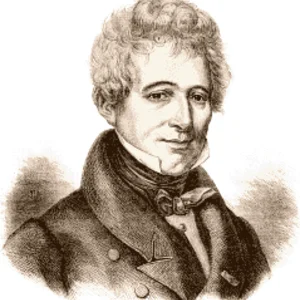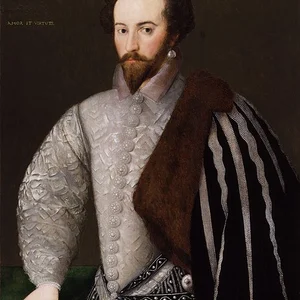

English explorer, poet, and courtier (1552–1618), a favourite of Queen Elizabeth I. He organised several expeditions to North America and searched for El Dorado in South America. Imprisoned and later executed under James I, he remains an iconic figure of English expansion.
Walter Raleigh(1552 — 1618)
Walter Raleigh
royaume d'Angleterre
9 min read
Frequently asked questions
Famous Quotes
« O eloquent, just, and mighty Death!»
« Truth is the daughter of Time, not of Authority.»
Key Facts
- 1585: organises the first English attempt at colonising North America at Roanoke (present-day North Carolina)
- 1595: expedition to Guiana in search of El Dorado, recounted in *The Discovery of Guiana*
- 1603: imprisoned in the Tower of London under James I on charges of alleged conspiracy
- 1616: released to lead a second expedition to Guiana
- 1618: executed in London following the failure of his Guiana expedition
Works & Achievements
Account of his expedition to Guiana in search of El Dorado, blending geographical observation with colonial propaganda. The work was widely read across Europe and fueled fascination with the riches of South America.
An ambitious universal history written during his imprisonment in the Tower of London, spanning from the Creation to ancient Macedonia. It reflects his providentialist vision of history and achieved great publishing success despite initially being seized by the authorities.
Raleigh was a celebrated poet of his time, author of elegiac verses addressed to Queen Elizabeth ('Cynthia') and ironic responses to the poems of his contemporaries such as Marlowe. His poetic output, partly lost, embodies the ideal of the learned courtier of the English Renaissance.
Raleigh financed and organized several expeditions to the east coast of North America, naming the region 'Virginia' in honor of Elizabeth I. These colonization attempts, though ultimately unsuccessful, paved the way for England's future permanent colonies.
Raleigh played a decisive military role in the English expedition against the Spanish port of Cádiz, helping to destroy a large part of the Spanish fleet. This victory earned him immense popularity among his fellow countrymen.
Anecdotes
In 1592, Walter Raleigh secretly married Elizabeth Throckmorton, one of Queen Elizabeth I's ladies-in-waiting, without seeking the Queen's royal permission. Furious at this betrayal of trust, the Queen had both spouses imprisoned in the Tower of London. Raleigh had to wait several months before being released, but he never truly regained the Queen's favor.
Convinced he had found the trail to El Dorado, Raleigh sailed up the Orinoco River in 1595 with a small fleet, pushing deep into the jungles of present-day Venezuela. He returned without gold but with an epic account published under the title 'The Discovery of Guiana', in which he described an inland golden lake — Lake Parime — that was never found. His obsession with El Dorado never left him.
During his twelve years of imprisonment in the Tower of London (1603–1616), Raleigh did not remain idle: he wrote a monumental 'History of the World' covering Antiquity up to the 2nd century BC. The work was published in 1614 and became a bestseller of the era, despite — or because of — its incarcerated author. The young Prince Charles, future Charles I, made it one of his bedside books.
On 29 October 1618, led to the scaffold in front of the Palace of Westminster, Raleigh asked to feel the blade of the executioner's axe. He reportedly declared with remarkable composure: “This is a sharp medicine, but it is a sure cure for all diseases.” He was beheaded at around the age of 65, a victim of the hatred King James I had harbored toward him since his accession to the throne fifteen years earlier.
Raleigh was one of the great promoters of tobacco in England at the end of the 16th century, following his contacts with the Native American peoples of Virginia. Legend has it that a servant, seeing him smoke his pipe for the first time, doused him with water thinking he was on fire. Whether true or invented, this anecdote reflects just how utterly foreign tobacco was to Europeans of the time.
Primary Sources
I never saw a more beautiful country, nor more lively prospects, hills so raised here and there over the valleys, the river winding into divers branches, the plains adjoining without bush or stubble, all fair green grass.
O eloquent, just, and mighty Death! Whom none could advise, thou hast persuaded; what none hath dared, thou hast done; and whom all the world hath flattered, thou only hast cast out of the world.
You shall now receive my dear wife my last words in these my last lines. My love I send you that you may keep it when I am dead, and my counsel that you may remember it when I am no more.
Sufficeth it to you, my joys interred, / In simple words that I my woes complain; / You that then died when first my fancy erred, / Joy's under dust that never live again.
I am persuaded that Guiana cannot fail to enrich your majesty's kingdom if the attempt be made with sufficient force and supplies. The mines of gold are there in abundance, as I have been assured by those who have seen them.
Key Places
A Devon manor where Raleigh was born around 1552, into a family of minor Protestant gentry. He later attempted to buy back this ancestral home, without success.
A property granted to Raleigh by Queen Elizabeth, where he lived with his family during the golden years of his career. He had a new manor built adjacent to the old medieval fortress.
Raleigh was imprisoned here twice: in 1592 for his secret marriage, then from 1603 to 1616 on charges of treason. It was within these walls that he wrote his *History of the World*.
The island where Raleigh financed the establishment of the first English colonies in North America (1585–1587). The "Lost Colony" of 1587 remains one of the greatest mysteries in colonial history.
Raleigh sailed up this great river in 1595 during his expedition in search of El Dorado, the legendary golden empire of the Muisca. He returned in 1617 on his final and fatal expedition.
It was in the courtyard of the Old Palace (Old Palace Yard) that Raleigh was beheaded on **29 October 1618**, on the orders of James I, under diplomatic pressure from Spain.
Liens externes & ressources
Références
Œuvres
The Discovery of the Large, Rich, and Beautiful Empire of Guiana
1595
The History of the World
1614
Poèmes (dont 'The Nymph's Reply to the Shepherd' et 'The Ocean to Cynthia')
vers 1580-1603
Expédition et colonisation de la Virginie (1584-1590)
1584-1590
Participation à la prise de Cadix
1596