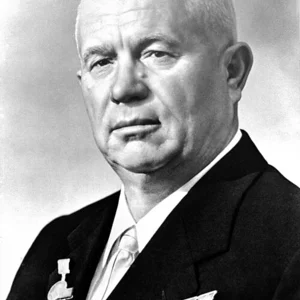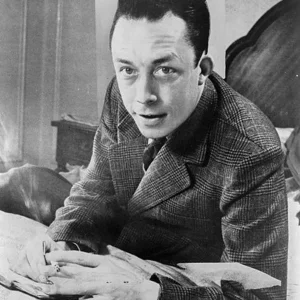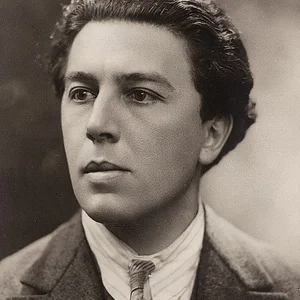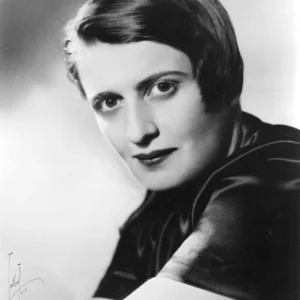

An American philosopher, novelist, and screenwriter of Russian origin, Ayn Rand is the founder of Objectivism, a philosophy championing reason, individualism, and capitalism. Her bestselling novels, including 'The Fountainhead' and 'Atlas Shrugged,' have had a lasting influence on American libertarian thought.
Ayn Rand(1905 — 1982)
Ayn Rand
États-Unis, république socialiste fédérative soviétique de Russie, Union soviétique, Empire russe, République russe, apatride
8 min read
Frequently asked questions
Famous Quotes
« I swear by my life and my love of it that I will never live for the sake of another man, nor ask another man to live for mine.»
« The question isn't who is going to let me; it's who is going to stop me.»
Key Facts
- 1905: born in Saint Petersburg as Alissa Zinovievna Rosenbaum
- 1926: emigrated to the United States to escape the Soviet regime
- 1943: publication of 'The Fountainhead,' a worldwide bestseller
- 1957: publication of 'Atlas Shrugged,' her major philosophical work
- 1982: died in New York, leaving behind a philosophical movement (Objectivism) that remains influential to this day
Works & Achievements
Her first novel published in the United States, semi-autobiographical, depicting life under the Soviet regime. Her first literary testimony to her visceral opposition to collectivism.
A short dystopian novella set in a totalitarian society where the word 'I' is forbidden. The first condensed formulation of her individualist philosophy, influenced by Zamyatin and Huxley.
Her landmark novel featuring Howard Roark, a visionary architect who refuses all creative compromise. A bestseller that brought her worldwide fame and laid the foundations of Objectivism.
Rand's masterpiece, a 1,200-page epic novel in which the world's creators and producers 'go on strike' against collectivism. One of the best-selling and most influential books of the 20th century in the United States.
A collection of philosophical essays presenting the synthesis of Objectivism and its program for renewing American intellectual culture.
A collection of essays developing Objectivist ethics, arguing for 'rational selfishness' as a moral foundation. A central philosophical work of her thought.
A philosophical and economic defense of laissez-faire capitalism, with contributions from Alan Greenspan. A manifesto for Rand's radical libertarian vision.
Anecdotes
Born Alissa Zinovievna Rosenbaum in Saint Petersburg in 1905, Ayn Rand witnessed the Bolshevik Revolution of 1917 as a child, which ruined her father's pharmacy. This traumatic experience of Soviet collectivism would shape her for life and directly inspire her philosophy of radical individualism.
Having arrived in the United States in 1926 on a tourist visa, she never returned to the USSR. In Hollywood, she landed a job as an extra thanks to Cecil B. DeMille, who noticed her by chance at the studio entrance. This chance encounter opened the doors of American cinema to her.
Her novel 'Atlas Shrugged' (1957), rejected by twelve publishers, was eventually published and became a worldwide bestseller. Rand spent twelve years writing it. According to a 1991 Library of Congress survey, the book was named the most influential in the United States after the Bible.
Ayn Rand hosted an intellectual circle at her New York home, ironically nicknamed 'The Collective,' which brought together her closest disciples, including future Federal Reserve Chairman Alan Greenspan. The group studied and debated the foundations of her Objectivist philosophy.
A heavy smoker, Rand wore a dollar sign brooch that she displayed proudly as a symbol of capitalism. Diagnosed with lung cancer in 1974, she nonetheless continued to write and lecture until the end of her life, dying in New York in 1982.
Primary Sources
I do not recognize anyone's right to one minute of my life. Nor to any part of my energy. Nor to any achievement of mine. No matter who makes the claim, how large their number or how great their need.
I swear by my life and my love of it that I will never live for the sake of another man, nor ask another man to live for mine.
The choice is not self-sacrifice or domination. The choice is independence or dependence. The code of the creator or the code of the second-hander.
The title of this book may evoke the kind of question that I hear occasionally: 'Why do you use the word 'selfishness' to denote virtuous qualities of character, when that word antagonizes so many people to whom the idea is repugnant?'
The most important thing in my book is the portrayal of a positive ideal. Not to show what must be destroyed, but what we want to build.
Key Places
Ayn Rand's birthplace, where she lived through the Bolshevik Revolution of 1917 and completed her university studies. Her firsthand experience of the Soviet regime became the foundation of her entire philosophy.
Rand moved here in 1926 and worked as a screenwriter for film studios. It was here that she began writing her first plays and developed her ideas through her immersion in American cultural life.
Rand settled permanently in New York in 1951, in an apartment on East 36th Street that became the hub of her intellectual circle known as 'The Collective.' It was here that she wrote Atlas Shrugged and developed Objectivism.
Rand drew inspiration from the celebrated architect Frank Lloyd Wright when creating the character of Howard Roark in The Fountainhead. She visited his buildings and corresponded with him, though their relationship was an ambiguous one.
Rand testified before the U.S. Congress in 1947 during the HUAC hearings on Communist infiltration in Hollywood. Throughout her life she remained an influential figure in American conservative and libertarian political circles.
Typical Objects

Rand wrote her novels and philosophical essays on a manual typewriter, often working through the night. For her, the typewriter symbolized the tool of individual intellectual creation.

Ayn Rand proudly wore a metal brooch shaped like the dollar sign, displaying it as an emblem of her pro-capitalist philosophy and the value she placed on economic productivity.

A lifelong smoker, Rand used a long cigarette holder and smoked heavily. She even defended cigarettes as a symbol of humanity's mastery over nature.

Rand kept dense journals and working notebooks where she developed her philosophical ideas before incorporating them into her works. Her journals from 1934–1942 were published posthumously.

Her library contained annotated editions of Aristotle, whom she considered the only philosopher to have genuinely influenced her. She rejected Plato and Kant as sources of intellectual collectivism.

Deeply attached to what she saw as America's founding values — individual freedom and capitalism — Rand held a strong symbolic connection to representations of the United States, the country she had chosen out of conviction.
School Curriculum
Vocabulary & Tags
Key Vocabulary
Tags
Daily Life
Morning
Rand woke up late, often after 10 a.m., due to her long working nights. She had a light breakfast — black coffee and toast — while going through the American press, paying close attention to political and economic news, which she commented on at length.
Afternoon
Her afternoons were devoted to intensive writing at her typewriter or to philosophical work sessions with members of her circle known as 'The Collective.' She regularly received her disciples for in-depth discussions on Objectivism, annotating books and essays as conversation unfolded.
Evening
A passionate cinephile, Rand often spent her evenings watching films — an activity she considered a major art form. She also attended lectures or gave them herself, smoking heavily during long late-night discussions that sometimes stretched until dawn.
Food
Rand had a simple, unpretentious diet with no particular interest in fine food. She consumed black coffee in large quantities, toast, and functional meals rather than gastronomic ones. Food was, for her, simply fuel for intellectual activity.
Clothing
Rand wore tailored, elegant suits, usually in dark colors — black or navy — reflecting her austere and determined personality. She invariably sported her famous dollar-sign brooch and used a long cigarette holder. Her style was neat but free of extravagance.
Housing
In New York, Rand lived in a functional but well-located Manhattan apartment whose walls were lined with bookshelves. Her desk, cluttered with manuscripts and annotated books, was the heart of her existence. The apartment also served as an intellectual salon for gatherings of 'The Collective.'
Historical Timeline
Period Vocabulary
Visual Style
Style visuel alliant le modernisme architectural Art Déco new-yorkais aux influences constructivistes soviétiques de sa jeunesse, avec une esthétique photographique contrastée noir et blanc des années 1940-1950.
Sound Ambience
L'atmosphère sonore d'un appartement new-yorkais des années 1950 : machine à écrire nocturne, bruits de la ville, musique classique en fond, débats philosophiques passionnés entre intellectuels.
Liens externes & ressources
Références
Œuvres
We the Living (Nous les vivants)
1936
Anthem (Hymne)
1938
The Fountainhead (La Source vive)
1943
Atlas Shrugged (La Grève)
1957
For the New Intellectual
1961
The Virtue of Selfishness (La Vertu de l'égoïsme)
1964
Capitalism: The Unknown Ideal
1966