 flip
flipFura — spiced millet balls for the rider
Fura — spiced millet balls for the rider
Why this dish? Amina spent, oral tradition says, most of her reign on campaign. Fura — cooked, dried, spiced millet balls — is the quintessential nomadic ration of the Sahel: carried hard in the saddlebag, crushed into soured milk at bivouac.
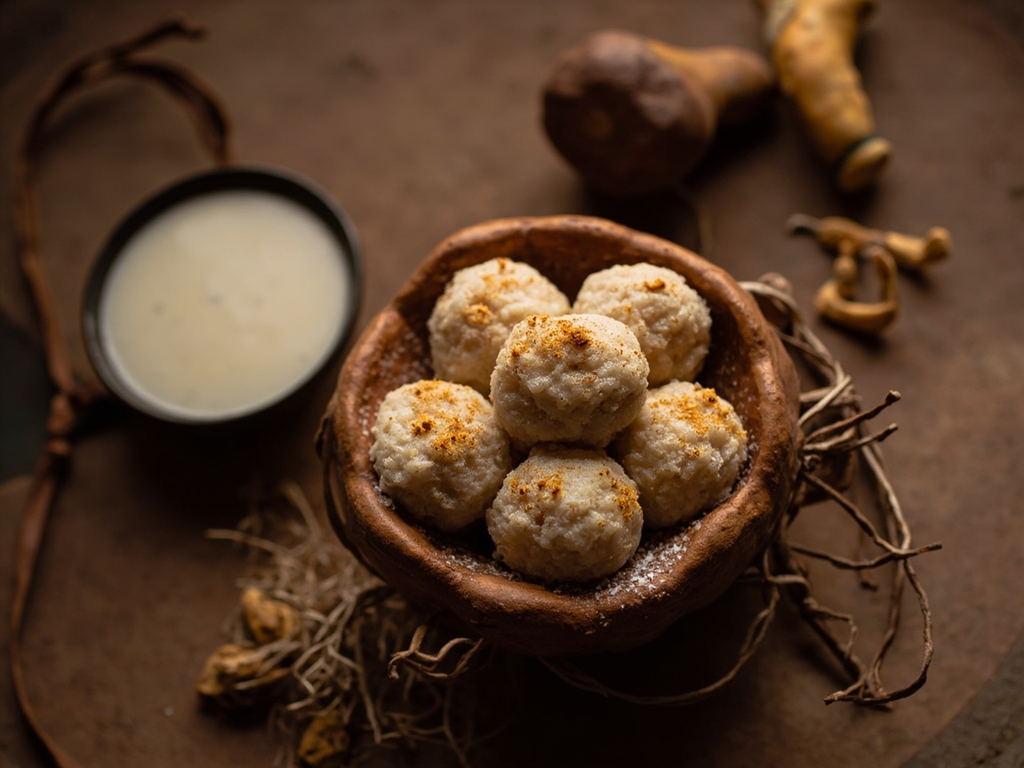
Balls of boiled millet dough, flavored with ginger, clove, and grains of paradise, shaped by hand. Dry, they travel; crumbled into fermented milk (nono), they become a complete, refreshing meal.
When we ride toward Kano or into Nupe country, we do not stop to light three fires. You slip the fura into the saddlebag, hard as a pebble, and in the evening you crush it between your fingers in a calabash of soured milk. Add ginger and grains of paradise to the dough, generously: that is what warms the warrior's belly under the harmattan wind. This is how a queen feeds her cavalry without slowing the march.
- •Milled millet (gero) — several handfuls (base)
- •Fresh ginger (citta) — a piece (warming aromatic)
- •Clove (kanumfari) — a few (fragrance)
- •Grains of paradise (citta mai yatsa) — a pinch (heat)
- •Soured milk (nono) — a calabash (serving, acidic ferment)
Fura — spiced millet balls for the rider
Balls of boiled millet dough, flavored with ginger, clove, and grains of paradise, shaped by hand. Dry, they travel; crumbled into fermented milk (nono), they become a complete, refreshing meal.
Why this dish? Amina spent, oral tradition says, most of her reign on campaign. Fura — cooked, dried, spiced millet balls — is the quintessential nomadic ration of the Sahel: carried hard in the saddlebag, crushed into soured milk at bivouac.
When we ride toward Kano or into Nupe country, we do not stop to light three fires. You slip the fura into the saddlebag, hard as a pebble, and in the evening you crush it between your fingers in a calabash of soured milk. Add ginger and grains of paradise to the dough, generously: that is what warms the warrior's belly under the harmattan wind. This is how a queen feeds her cavalry without slowing the march.
Ingredients (period version)
- Milled millet (gero) — several handfuls (base)
- Fresh ginger (citta) — a piece (warming aromatic)
- Clove (kanumfari) — a few (fragrance)
- Grains of paradise (citta mai yatsa) — a pinch (heat)
- Soured milk (nono) — a calabash (serving, acidic ferment)
Ingredients
- Millet flour — 300 g (base)
- Ground ginger — 1 tsp (aromatic)
- Ground cloves — 1/4 tsp (fragrance)
- Ground grains of paradise (maniguette) — 1/4 tsp (heat)
- Water — as needed (binding)
- Fermented milk / nono (or plain drinking yogurt) — to serve (acidic accompaniment)
Method
- Mix the millet flour with ginger, clove, and grains of paradise.
- Take one third of the flour, cook it in a little boiling water to obtain a thick paste, let cool.
- Incorporate the remaining dry flour and a drizzle of water, knead into a firm dough.
- Shape into fist-sized balls and poach for 10 min in simmering water, then pound/mash to smooth and re-form the balls.
- For travel: let the balls air-dry. To serve: crumble a ball into a bowl of fermented milk, mash by hand, and drink-eat fresh.
How it was made : Fura da nono remains today the iconic snack of Hausa and Fulani herders and travelers. Before refined sugar, it was barely sweetened — the acidity of soured milk and the heat of spices carried the flavor. Its dual nature (dry for transport, rehydrated for the meal) made it the ideal military ration of the Sahel.
The contemporary twist : Serve bowl-style: chilled nono, crumbled fura balls, a dusting of grated ginger, and a few toasted sesame seeds — the smoothie-bowl version of a five-hundred-year-old provision.
Amina of Zazzau · Charactorium