 flip
flipPenniless Poet's Pain Perdu
Penniless Poet's Pain Perdu
Why this dish? Breton knew years of material hardship in Montmartre, where nothing was thrown away. Pain perdu—stale bread revived in egg, milk, and sugar—is the quintessential poor man's dessert-snack, a small improvised treat that transforms leftovers into a feast, an almost surrealist gesture.
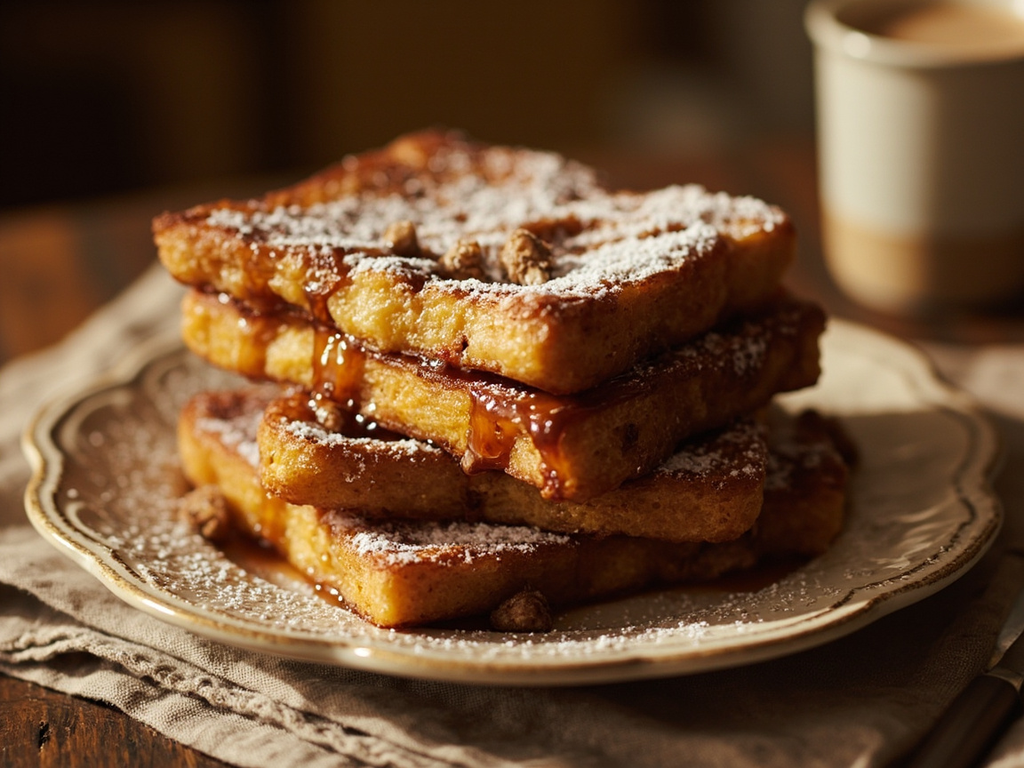
Slices of stale bread soaked in a mixture of egg, milk, and sugar, pan-fried in butter until golden, and dusted with sugar. Warm, soft, and caramelized: the thrifty sweetness of lean weeks.
They called it lost bread, but nothing is truly lost for those who know how to look: the hardest crust still holds a feast. In our lean years, I soaked those forgotten slices in milk and egg, and the pan returned them to me golden, transfigured—is that not the humblest of marvels? Eat them warm, under a veil of sugar, at that uncertain hour when you no longer hunger for dinner but the night is beginning.
- •Stale bread — the remaining slices (reclaimed base)
- •Eggs — one or two (binder)
- •Milk — a bowl (soaking)
- •Sugar — to taste (sweetness)
- •Butter — a knob (golden cooking)
Penniless Poet's Pain Perdu
Slices of stale bread soaked in a mixture of egg, milk, and sugar, pan-fried in butter until golden, and dusted with sugar. Warm, soft, and caramelized: the thrifty sweetness of lean weeks.
Why this dish? Breton knew years of material hardship in Montmartre, where nothing was thrown away. Pain perdu—stale bread revived in egg, milk, and sugar—is the quintessential poor man's dessert-snack, a small improvised treat that transforms leftovers into a feast, an almost surrealist gesture.
They called it lost bread, but nothing is truly lost for those who know how to look: the hardest crust still holds a feast. In our lean years, I soaked those forgotten slices in milk and egg, and the pan returned them to me golden, transfigured—is that not the humblest of marvels? Eat them warm, under a veil of sugar, at that uncertain hour when you no longer hunger for dinner but the night is beginning.
Ingredients (period version)
- Stale bread — the remaining slices (reclaimed base)
- Eggs — one or two (binder)
- Milk — a bowl (soaking)
- Sugar — to taste (sweetness)
- Butter — a knob (golden cooking)
Ingredients
- Stale bread (baguette or brioche) — 8 slices (reclaimed base)
- Eggs — 2 (binder)
- Milk — 25 cl (soaking)
- Sugar — 3 tbsp (+ for dusting) (sweetness)
- Butter — 30 g (golden cooking)
- Vanilla or cinnamon — optional, a pinch (flavor)
Method
- Beat the eggs with milk, sugar, and optionally vanilla.
- Soak each slice of stale bread in the mixture until absorbed but not falling apart.
- Melt the butter in a hot pan.
- Brown the slices for 2-3 minutes per side until nicely caramelized.
- Dust with sugar and serve warm.
How it was made : Pain perdu is an age-old economy dish: bread, a near-sacred staple, was never thrown away. Cooked in butter or lard on the corner of the stove, it served as an afternoon snack for children or an impromptu dessert in modest households.
The contemporary twist : Presented as small stacked bites, drizzled with honey—a sweet exquisite corpse to share around the table.
André Breton · Charactorium