 flip
Хуплу (Khuplu) — the great Chuvash wedding pie
Хуплу (Khuplu) — the great Chuvash wedding pie
Why this dish? Born in 1929 in Shorshely, in the Chuvash countryside, Nikolaiev grew up at a table where khuplu appeared only at weddings and great feasts. When he married Valentina Tereshkova in 1963 at the Kremlin Wedding Palace — the first wedding of two cosmonauts — it was this village wedding dish from his childhood that would have had its place on the long table of yesteryear.
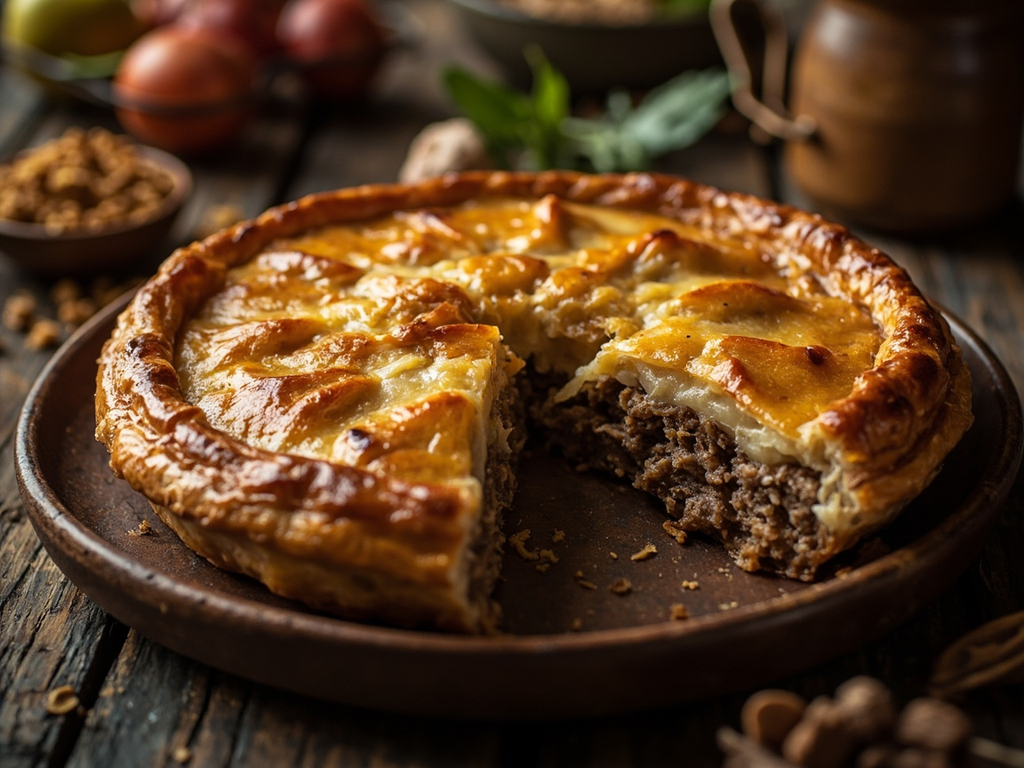
A round, generous pie with a golden crust, filled with layers of meat, onion, and potatoes bound with fat, cut into wedges at the center of the table. The dough "lid" is often opened to pour broth over the filling before serving.
Comrade, listen: at home in Shorshely, we didn't see meat every day, so khuplu was the celebration, the wedding, the return of the harvest. My mother would roll out her dough wide as the moon, lay down the meat, the onion, and close the lid tightly pinched to keep all the juice inside. We took it out of the oven burning hot, pierced the crust, and the steam rose straight up — like a rocket, I'd say today. The first to receive his portion bowed his head and thanked the earth, because such a pie is not to be wasted.
- •Rye and wheat flour — enough for a large flatbread (base dough)
- •Mutton or beef, minced with a knife — a good portion (noble filling)
- •Onions — several (softness and flavor)
- •Potatoes — a few (nourishing filling)
- •Mutton fat (tail) or melted butter — as needed (binding and tenderness)
- •Meat broth — one bowl (to pour into the pie)
Хуплу (Khuplu) — the great Chuvash wedding pie
A round, generous pie with a golden crust, filled with layers of meat, onion, and potatoes bound with fat, cut into wedges at the center of the table. The dough "lid" is often opened to pour broth over the filling before serving.
Why this dish? Born in 1929 in Shorshely, in the Chuvash countryside, Nikolaiev grew up at a table where khuplu appeared only at weddings and great feasts. When he married Valentina Tereshkova in 1963 at the Kremlin Wedding Palace — the first wedding of two cosmonauts — it was this village wedding dish from his childhood that would have had its place on the long table of yesteryear.
Comrade, listen: at home in Shorshely, we didn't see meat every day, so khuplu was the celebration, the wedding, the return of the harvest. My mother would roll out her dough wide as the moon, lay down the meat, the onion, and close the lid tightly pinched to keep all the juice inside. We took it out of the oven burning hot, pierced the crust, and the steam rose straight up — like a rocket, I'd say today. The first to receive his portion bowed his head and thanked the earth, because such a pie is not to be wasted.
Ingredients (period version)
- Rye and wheat flour — enough for a large flatbread (base dough)
- Mutton or beef, minced with a knife — a good portion (noble filling)
- Onions — several (softness and flavor)
- Potatoes — a few (nourishing filling)
- Mutton fat (tail) or melted butter — as needed (binding and tenderness)
- Meat broth — one bowl (to pour into the pie)
Ingredients
- Wheat flour (T65) — 400 g (dough)
- Rye flour — 100 g (Chuvash rusticity)
- Butter — 120 g (shortcrust pastry)
- Warm water — 150 ml (bind the dough)
- Lamb shoulder or beef — 500 g, small dice (filling)
- Potatoes — 400 g, thinly sliced (filling)
- Onions — 3 large, sliced (softness)
- Meat broth — 150 ml (to pour at end of baking)
- Salt, pepper, a little melted butter — to taste (seasoning)
Method
- Mix the two flours, salt, cold butter in pieces, and warm water; knead a supple dough, let rest 30 min under a cloth.
- Cut the meat into small dice, slice the onions, thinly slice the potatoes; season generously with salt and pepper.
- Divide the dough into two-thirds / one-third. Roll out the larger piece and line a buttered round mold, with overhanging edges.
- Layer: potatoes, meat, onions, a knob of butter, finishing with potatoes.
- Cover with the second dough disc, seal the edges by pinching into a cord, pierce a small hole in the center.
- Bake 1 hour at 180 °C. Halfway through, pour hot broth through the center hole to keep the filling juicy.
- Let rest 10 min, cut into wedges from the center and serve piping hot.
How it was made : In Chuvash villages, khuplu was baked in the great Russian oven (печь) after the bread batch, in the falling heat. The dough was often rye, the filling varied by season and household wealth: crushed grains and onion in lean years, meat and potatoes on wedding days. It was carried whole to the table, a sign of abundance and hospitality.
The contemporary twist : Serve a slice with a dash of clear broth poured in front of the guest "at liftoff," as steam still escapes from the center hole.
Andriyan Nikolayev · Charactorium