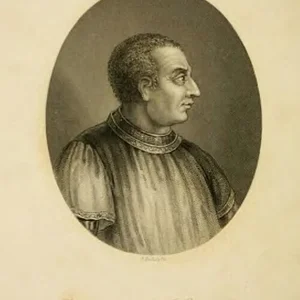

Bertrand du Guesclin (c. 1320-1380) was a Breton knight who became Constable of France under Charles V. A skilled strategist of the Hundred Years' War, he reconquered much of French territory from the English through guerrilla warfare and harassment tactics.
Bertrand du Guesclin(1320 — 1380)
Bertrand du Guesclin
France
5 min read
Frequently asked questions
Key Facts
- Born around 1320 at La Motte-Broons, in Brittany, into the minor nobility
- Distinguished himself during the defense of Rennes (1356-1357) against the English
- Appointed Constable of France by Charles V in 1370, the highest military office in the kingdom
- Led the reconquest of English-held territories through harassment tactics rather than pitched battle
- Died in 1380 during the siege of Châteauneuf-de-Randon; buried at Saint-Denis among the kings
Works & Achievements
Organization of the victorious resistance against the English siege, which reveals his talent for harassment warfare.
Defeat of the troops of Charles the Bad, which consolidates the authority of the new king Charles V.
Leading the Great Companies into Spain to place Henry of Trastámara on the throne, removing these mercenary bands from the kingdom of France.
Rise to the highest military office in the kingdom, commander-in-chief of the royal armies.
Methodical campaigns reclaiming from the English most of the territories ceded under the Treaty of Brétigny.
A great mounted raid that brings the duchy back into the orbit of the king of France against English ambitions.
Anecdotes
Born into a minor Breton noble family near Dinan, Bertrand du Guesclin was said to have been so ugly as a child that his own parents largely neglected him. He preferred brawls and improvised tournaments to lessons, and according to legend he took part in a tournament in Rennes around the age of sixteen, unhorsing several opponents before his identity was discovered.
In 1357, during the English siege of Rennes, du Guesclin organized the city's defense through raids and harassing night sorties. This strategy of attrition — rather than pitched battles — became his trademark throughout his career.
In 1364, at the Battle of Cocherel, du Guesclin won a decisive victory over the forces of Charles the Bad, King of Navarre. The triumph consolidated the power of the newly crowned King Charles V and earned the Breton knight a meteoric rise.
Captured several times by the English, du Guesclin had to be ransomed each time. Legend has it that at Nájera in 1367, taken prisoner by the Black Prince, he set his own ransom at an extraordinarily high sum to prove his worth, daring his captor not to let him go.
Du Guesclin died in 1380 during the siege of Châteauneuf-de-Randon, in the Lozère. Tradition holds that the English captain holding the fortress, having promised to surrender, came to lay the keys on the coffin of the dead constable. Charles V honored him with burial at Saint-Denis, among the kings of France.
Primary Sources
A verse narrative by the trouvère Cuvelier celebrating the exploits of the Constable, portrayed as the “tenth Worthy,” the equal of the great heroes of chivalry.
Froissart describes du Guesclin as a shrewd captain who waged war through ambushes and harassment rather than great pitched battles, reconquering town after town from the English.
The official chronicle of the reign of Charles V, mentioning du Guesclin's appointment as Constable of France and his campaigns of reconquest.
Key Places
Presumed birthplace region of Bertrand du Guesclin, in Brittany, around 1320. Cradle of his family of minor nobility.
Capital of Brittany where du Guesclin distinguished himself during the siege of 1356-1357 by harassing the besieging English forces.
Site of the 1364 victory against the Navarrese troops, which launched du Guesclin's career in the service of Charles V.
Battlefield of 1367 where du Guesclin, fighting in Castile, was captured by the Black Prince of England.
Stronghold of the Gévaudan whose siege du Guesclin was leading when he died in July 1380.
Necropolis of the kings of France where Charles V had his constable buried, an exceptional honor for a man of minor nobility.
Typical Objects

Long double-edged sword, the main weapon of the warrior on foot as well as on horseback. A symbol of the status of a dubbed knight.

Metal protection covering the body, which became widespread in the 14th century as a complement to chain mail. It made the knight almost invulnerable to arrows.

Long polearm used by the mounted knight for the charge. It was also used in tournaments.

Shield bearing the coat of arms of the du Guesclin family (a silver double-headed eagle). It protected him in combat and identified the knight.

Ceremonial sword handed to the Constable, supreme commander of the king's armies. It embodied the military authority delegated by the sovereign.

A powerful and trained battle horse, the knight's prized mount. Its loss or capture represented a heavy financial hardship.

Standard carried at the head of the troops to rally the fighters in the heart of the fray. Its fall could mean a rout.
School Curriculum
Vocabulary & Tags
Key Vocabulary
Daily Life
Morning
On campaign, du Guesclin would rise early to inspect the camp, have the horses saddled, and hold council with his captains. The morning was used to organize marches, ambushes, or the scouting of enemy terrain.
Afternoon
The afternoon might be devoted to military operations: skirmishes, sieges, or surrender negotiations. In peacetime, the knight trained in the handling of weapons and took part in tournaments.
Evening
In the evening, gathered around a shared meal, the men listened to tales of battles and planned the next day's raids. These evening gatherings strengthened the loyalty between the commander and his men-at-arms.
Food
The warrior's diet relied on bread, meats (pork, game, poultry), soups, and wine, all plentiful at the table of a great captain. On campaign, food depended on supply lines and on the plundering of the regions they passed through.
Clothing
In battle, du Guesclin wore chain mail and steel plates, topped with a great helm. Out of war, he donned woolen garments and cloaks befitting his rank as Constable.
Housing
Itinerant by necessity, he lodged in fortified castles, military camps under canvas, or fortified manors. His life as a soldier left him little time for a permanent residence.
Historical Timeline
Period Vocabulary
Liens externes & ressources
Références
Œuvres
Défense de Rennes
1356-1357
Victoire de Cocherel
1364
Expédition de Castille
1366-1369
Nomination comme connétable de France
1370
Reconquête de l'Ouest et du Poitou
1370-1374
Campagne de Bretagne
1373