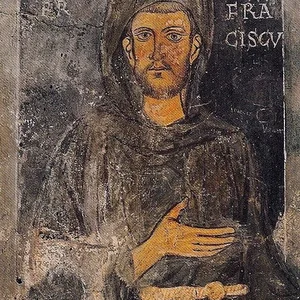

Born in Assisi in 1182, Francis renounced his family's wealth to live in evangelical poverty. He founded the Order of Friars Minor (Franciscans) and championed a form of Christianity rooted in closeness to the poor and to nature. Canonized as early as 1228, he is one of the most influential spiritual figures of the Middle Ages.
Francis of Assisi(1182 — 1226)
Francis of Assisi
7 min read
Frequently asked questions
Famous Quotes
« Lord, make me an instrument of your peace.»
« Start by doing what is necessary, then what is possible, and suddenly you will be doing the impossible.»
Key Facts
- 1182: born in Assisi into a wealthy merchant family
- 1205–1206: conversion and renunciation of his fortune following a vision
- 1209: founding of the Order of Friars Minor, verbally approved by Pope Innocent III
- 1224: reception of the stigmata on Mount La Verna
- 1226: death in Assisi; canonized in 1228 by Pope Gregory IX
Works & Achievements
A lyric poem written in the Umbrian vernacular, considered the first major literary text in Italian, celebrating all creatures as brothers and sisters. It reflects a spirituality of nature unique in the Middle Ages.
The founding text of the Franciscan Order, approved by Pope Honorius III. It establishes the principles of absolute poverty, obedience, and itinerancy for the preaching friars.
Dictated shortly before his death, this spiritual autobiography recounts his conversion and reaffirms the ideal of radical poverty. An invaluable document for understanding his authentic thought.
By gathering his first companions and obtaining the oral approval of Pope Innocent III, Francis created one of the most influential mendicant orders in the history of the Church.
At Greccio, Francis organized the first living reenactment of the Nativity to make the mystery of the Incarnation tangible to ordinary people. This tradition spread throughout Catholic Christendom.
A prayer composed after receiving the stigmata, written in the hand of Brother Leo on a parchment preserved in Assisi. A spiritual testament from the final period of his life.
Anecdotes
One day, Francis encountered a leper on the road to Assisi. Overcoming his revulsion, he dismounted from his horse, embraced the man, and gave him money. This episode marked a decisive turning point for him: he saw in it Christ himself in the face of the most wretched.
Around 1224, during a retreat on Mount Alverna, Francis received according to tradition the stigmata — the five wounds of Christ — on his hands, his feet, and his side. This is the first attested case of stigmatization in Christian history.
Francis loved nature so deeply that he preached to the birds near Bevagna, asking them to praise God. This scene, recounted by his brothers and painted by Giotto, illustrates his conviction that every creature shares in divine brotherhood.
While the West was at war during the Fifth Crusade, Francis crossed enemy lines in 1219 to meet Sultan Malik al-Kamil in Egypt. The sultan, impressed by his sincerity, received him courteously — though without converting.
To fund the restoration of the chapel of San Damiano, Francis sold cloth from the family business without permission. His father, Pietro di Bernardone, furious, dragged him before the Bishop of Assisi. Francis then removed his clothing and handed it back to his father, declaring he had no other father but God.
Primary Sources
Praised be You, my Lord, with all Your creatures, especially Sir Brother Sun, who is the day and through whom You give us light. And he is beautiful and radiant with great splendor; and bears a likeness of You, Most High.
This is the rule and life of the Lesser Brothers: to observe the Holy Gospel of Our Lord Jesus Christ by living in obedience, without anything of one's own, and in chastity.
The Lord granted me, Brother Francis, to begin to do penance in this way: while I was in sin, it seemed very bitter to me to see lepers. And the Lord himself led me among them, and I had mercy on them.
Brother Leo, your lamb, Brother Francis wishes you health and peace. I say to you, my son, as a mother would: all the words we spoke on the road, I sum up in this one piece of advice.
Key Places
Francis's birthplace and the cradle of the Franciscan movement. The Basilica of Saint Francis, built after his canonization, is a world pilgrimage site and UNESCO World Heritage landmark.
A small chapel near Assisi where Francis founded his order in 1208 and where he died in 1226. It is now enshrined within a vast basilica built in the 16th century.
A secluded mountainous site in Tuscany given to Francis by a local nobleman. It was here that he received the stigmata in 1224 during a spiritual retreat.
An Egyptian port besieged during the Fifth Crusade, where Francis traveled in 1219 to meet Sultan al-Kamil, seeking conversion through dialogue rather than combat.
A humble, crumbling chapel where Francis heard the voice of Christ calling him to rebuild His Church. He restored it with his own hands, and Clare of Assisi later established her convent there.
Typical Objects

The iconic habit of the Franciscans, cut from coarse cloth to signify contempt for worldly wealth. Francis adopted it after his conversion and made it the official garment of his order.

Francis and his brothers traveled on foot across Italy and Europe to preach, with no horse or mount. The staff symbolized their condition as wandering poor men following in the footsteps of the apostles.

The Franciscan rule of life was built on a literal reading of the Gospel, especially the passage where Jesus sends his disciples out with neither money nor satchel. Francis often carried a copy with him.

It was before a crucifix in this small, dilapidated chapel that a voice commanded Francis to 'repair the house of God.' He restored it with his own hands before understanding the spiritual meaning of the message.

In 1223, Francis created the first living Christmas nativity scene at Greccio, complete with real people and animals, to make the birth of Christ accessible to ordinary people. The practice then spread throughout Christendom.

The sole source of light during nightly prayer vigils, it was used in the simple Franciscan hermitages — often little more than huts or caves.
School Curriculum
Vocabulary & Tags
Key Vocabulary
Daily Life
Morning
Francis and his brothers rose before dawn for Matins, chanting psalms together in their small chapel or in the open air. After prayer, they set out on foot to preach in nearby villages, without shoes or satchel, relying on the hospitality of peasants.
Afternoon
The afternoon was devoted to manual work — repairing chapels, helping in the fields, or caring for the sick and lepers in hospitals. Francis insisted that his brothers earn their bread through labor rather than begging whenever possible.
Evening
In the evening, the brothers gathered for Vespers and Compline, then shared a frugal meal of bread, vegetables, and water. Francis loved to withdraw at night to pray in caves or forests, conversing with God in silence.
Food
The Franciscan diet was deliberately simple: barley or rye bread, boiled vegetables, figs, and wild herbs. Francis abstained from meat and wine during his frequent fasts, and sometimes asked that ashes be mixed into his food as a way of mortifying the flesh.
Clothing
Francis wore a rough, undyed grey-brown habit, tied with a hemp cord bearing three knots symbolizing the three vows (poverty, chastity, obedience). He most often went barefoot, though he occasionally wore simple sandals.
Housing
Francis lived in branch huts, natural caves, or abandoned hospices — never in stone buildings constructed for the order, which he considered contrary to poverty. The Portiuncula, a tiny chapel surrounded by huts, was for a long time the only 'home' of the brotherhood.
Historical Timeline
Period Vocabulary
Visual Style
Style des fresques médiévales italiennes à la Giotto : ocres chauds, halos dorés sur ciel bleu-gris, personnages expressifs en bure brune dans un paysage d'Ombrie ensoleillé.
Sound Ambience
Sons d'un ermitage franciscain en Ombrie : cloches d'aube, chants grégoriens, oiseaux dans les oliviers et murmures de prière en pleine nature.
Liens externes & ressources
Références
Œuvres
Cantique des créatures
vers 1224
Règle des Frères mineurs (Règle bullée)
1223
Testament
1226
Fondation de l'Ordre des Frères mineurs
1208-1209
Institution de la crèche de Noël
1223
Louanges du Dieu très haut (Laudes Dei Altissimi)
1224