 flip
flipKolak pisang
Kolak pisang
Why this dish? Kolak, a warm banana compote in coconut milk and palm sugar, is the sweet comfort of Indonesian afternoons, and especially the dish for breaking the fast during Ramadan. For Anggun, raised between cultures, it is the family sweetness that spans Jakarta's festivities.
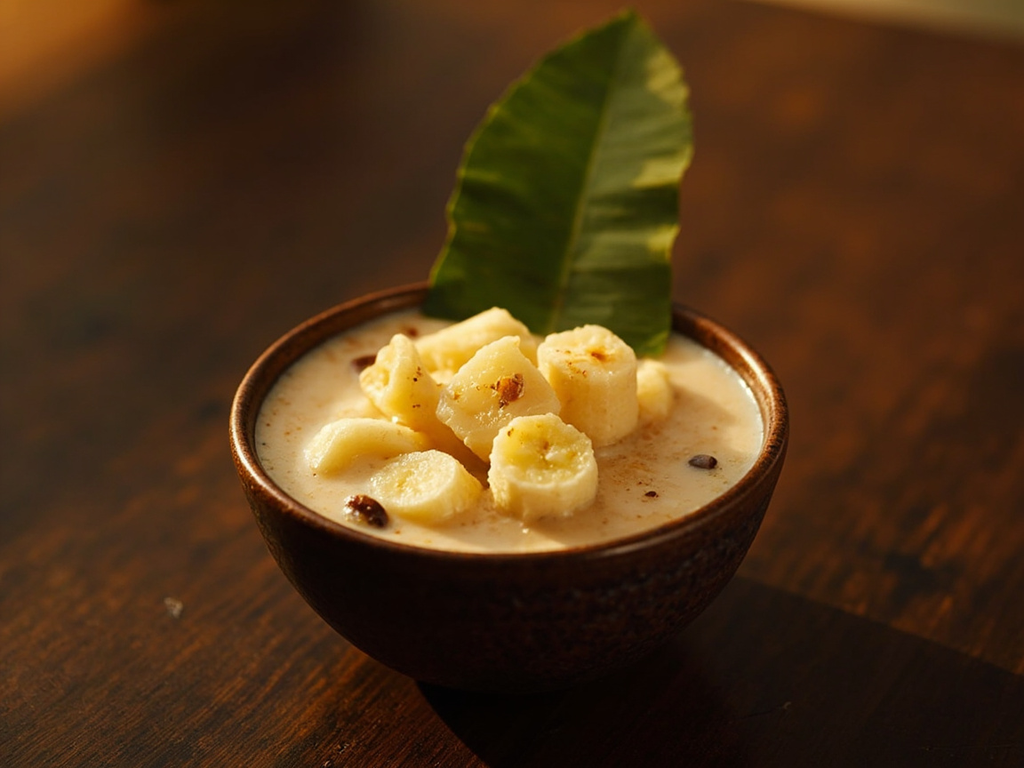
Melting bananas simmered in coconut milk sweetened with palm sugar and scented with pandan. Half dessert, half thick drink, served warm in a bowl.
Kolak is the sweetness of late afternoon, when the heat subsides in Jakarta. During Ramadan, it's what we wait for to break the fast: the bananas melted in coconut milk, the palm sugar that smells almost like caramel, and the pandan leaf that perfumes everything. We eat it warm, with a spoon, in a small bowl — it's soft, it's round, it comforts. Even in Paris, I make it to rediscover that sweet hug of my childhood.
- •Very ripe bananas (pisang) — several, cut into chunks (main fruit)
- •Fresh coconut milk — abundant (creamy liquid)
- •Palm sugar (gula jawa) — to taste (caramelized sweetness)
- •Pandan leaf — 1 or 2, tied (fragrance)
- •Sweet potato or yam — diced (optional) (melting addition)
- •Salt — a pinch (balance)
Kolak pisang
Melting bananas simmered in coconut milk sweetened with palm sugar and scented with pandan. Half dessert, half thick drink, served warm in a bowl.
Why this dish? Kolak, a warm banana compote in coconut milk and palm sugar, is the sweet comfort of Indonesian afternoons, and especially the dish for breaking the fast during Ramadan. For Anggun, raised between cultures, it is the family sweetness that spans Jakarta's festivities.
Kolak is the sweetness of late afternoon, when the heat subsides in Jakarta. During Ramadan, it's what we wait for to break the fast: the bananas melted in coconut milk, the palm sugar that smells almost like caramel, and the pandan leaf that perfumes everything. We eat it warm, with a spoon, in a small bowl — it's soft, it's round, it comforts. Even in Paris, I make it to rediscover that sweet hug of my childhood.
Ingredients (period version)
- Very ripe bananas (pisang) — several, cut into chunks (main fruit)
- Fresh coconut milk — abundant (creamy liquid)
- Palm sugar (gula jawa) — to taste (caramelized sweetness)
- Pandan leaf — 1 or 2, tied (fragrance)
- Sweet potato or yam — diced (optional) (melting addition)
- Salt — a pinch (balance)
Ingredients
- Plantains or firm ripe bananas — 4 (main fruit)
- Coconut milk — 500 ml (creamy liquid)
- Palm sugar or brown sugar — 80 g (caramelized sweetness)
- Pandan leaves (or extract) — 2 (or a few drops) (fragrance)
- Sweet potato — 1 small, diced (optional) (melting addition)
- Salt — 1 pinch (balance)
Method
- If using, first cook the sweet potato cubes in a little water until tender.
- In a saucepan, melt the palm sugar in coconut milk with the tied pandan and pinch of salt, over low heat without boiling hard.
- Add the banana chunks (and sweet potato).
- Simmer for 10 to 15 minutes until bananas are melting and sauce slightly thickened.
- Remove pandan and serve warm in bowls.
How it was made : Kolak gets its sweetness from gula jawa, palm sugar boiled and molded into cakes, and from coconut milk squeezed by hand from grated pulp. Associated with Ramadan, it was prepared in large quantities in the afternoon for the collective breaking of the fast (inspired by this tradition, without reproducing its religious framework).
The contemporary twist : Served warm in a thick glass with a scoop of coconut ice cream melting slowly on top — the hot-cold contrast in a modernized 'es kolak' version.
Anggun · Charactorium