 flip
flipWhole steamed fish (清蒸魚)
Whole steamed fish (清蒸魚)
Why this dish? For Lunar New Year in Chinatown, the Wong family would present a whole fish: in Cantonese, the word for fish (魚 yú) sounds like 'abundance.' Served with head and tail intact, it promised that the year would begin and end in prosperity — a ritual that young Anna experienced every winter of her childhood.
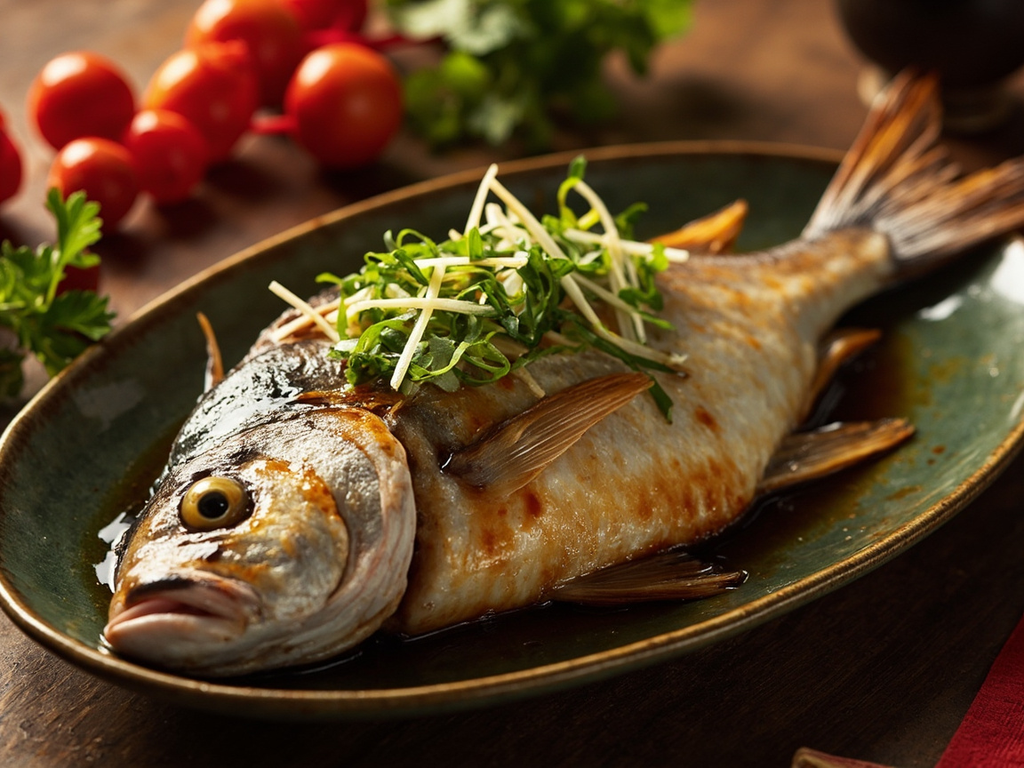
A very fresh whole fish, steamed for just a few minutes, drizzled with light soy sauce, crowned with ginger and scallion, then doused with hot oil that makes everything sizzle. The pinnacle of Cantonese delicacy: letting freshness speak.
At New Year, my father wanted the whole fish, head and tail, never cut short — because a whole beginning and end, you see, call for a whole year. My mother would choose it alive at the market, cook it just enough, until the flesh turned pearly. The secret is the oil: you heat it until it smokes, you pour it over the ginger and scallion, and everything sings on the plate. On Hollywood sets they often gave me tragic roles; at that table, at least, everything ended well.
- •Very fresh whole white fish — 1, gutted and scaled (star of the dish)
- •Ginger — one piece, cut into fine slivers (fragrance and freshness)
- •Scallion — a few stalks (aromatic and garnish)
- •Light soy sauce — to drizzle (umami seasoning)
- •Rice wine — a splash (reduces fishy odor, adds fragrance)
- •Peanut oil — one ladleful (poured boiling to release aromatics)
Whole steamed fish (清蒸魚)
A very fresh whole fish, steamed for just a few minutes, drizzled with light soy sauce, crowned with ginger and scallion, then doused with hot oil that makes everything sizzle. The pinnacle of Cantonese delicacy: letting freshness speak.
Why this dish? For Lunar New Year in Chinatown, the Wong family would present a whole fish: in Cantonese, the word for fish (魚 yú) sounds like 'abundance.' Served with head and tail intact, it promised that the year would begin and end in prosperity — a ritual that young Anna experienced every winter of her childhood.
At New Year, my father wanted the whole fish, head and tail, never cut short — because a whole beginning and end, you see, call for a whole year. My mother would choose it alive at the market, cook it just enough, until the flesh turned pearly. The secret is the oil: you heat it until it smokes, you pour it over the ginger and scallion, and everything sings on the plate. On Hollywood sets they often gave me tragic roles; at that table, at least, everything ended well.
Ingredients (period version)
- Very fresh whole white fish — 1, gutted and scaled (star of the dish)
- Ginger — one piece, cut into fine slivers (fragrance and freshness)
- Scallion — a few stalks (aromatic and garnish)
- Light soy sauce — to drizzle (umami seasoning)
- Rice wine — a splash (reduces fishy odor, adds fragrance)
- Peanut oil — one ladleful (poured boiling to release aromatics)
Ingredients
- Whole sea bass, bream, or cod — 600 to 800 g, gutted (star)
- Ginger — 30 g, julienned (fragrance)
- Scallion — 4 stalks (aromatic)
- Light soy sauce (preferably for steamed fish) — 3 tbsp + 1 tbsp water + pinch of sugar (final sauce)
- Shaoxing rice wine — 1 tbsp (fragrance)
- Neutral oil — 3 tbsp (hot oil to pour)
- Fresh cilantro — a few sprigs (finish)
Method
- Score the fish with 2-3 slits on each side, place it on a few scallion stalks and ginger slices in a shallow dish, and drizzle with rice wine.
- Steam over high heat for 8 to 12 minutes depending on size (the flesh should flake from the bone).
- Discard the cooking liquid and aromatics; place fresh julienned ginger and scallion on the fish.
- Pour the soy sauce mixed with water and a pinch of sugar around the fish.
- Heat the oil until shimmering and pour it over the aromatics: it should sizzle. Sprinkle with cilantro and serve immediately.
How it was made : Steaming was the queen of Cantonese cooking methods, fuel-efficient and respectful of freshness — essential when cooking a fish chosen alive that very morning. The gesture of pouring hot oil (淋油) served both to perfume and to 'awaken' the raw ginger without frying it.
The contemporary twist : Present the fish on a long black slate, with ginger julienne arranged like a fountain and a drizzle of scallion oil — a nod to the glamour of Anna's black-and-white film stills.
Sources : Eileen Yin-Fei Lo, The Chinese Kitchen, William Morrow, 1999 · Grace Young, The Wisdom of the Chinese Kitchen, Simon & Schuster, 1999
Anna May Wong · Charactorium