
Anne Ponsarde is a female figure of the early modern period, associated with the world of natural sciences and practical knowledge in France. Her story reflects the role of women in the transmission of knowledge during the early modern era.
Anne Ponsarde
Anne Ponsarde
8 min read
Frequently asked questions
Key Facts
- A female figure associated with natural knowledge in early modern France
- An era marked by the coexistence of empirical knowledge and emerging natural philosophy
- A context in which learned women were largely excluded from official institutions
Works & Achievements
A personal collection of medicinal recipes and botanical observations, representative of the practical knowledge corpora assembled by learned women of the early modern period outside official academic channels.
The cultivation and transmission of a medicinal garden was itself an act of living knowledge, perpetuating empirical botanical learning across several generations of women.
As a representative figure of learned women in the early modern period, Anne Ponsarde embodies the transmission of knowledge about plants, remedies, and preservation techniques outside official institutions.
Anecdotes
In early modern France, women with a curiosity for the natural sciences often worked from home, tending a physic garden and recording their observations in handwritten notebooks. Anne Ponsarde is said to have kept a small stock of medicinal plants, from which she prepared remedies and ointments for those around her, perpetuating an empirical knowledge passed down from mother to daughter for generations.
At a time when universities barred women from entry, women's knowledge circulated through other channels: recipes copied by hand, advice exchanged between neighbors, notes scrawled in the margins of illustrated herbals. These practices, invisible in official archives, nonetheless formed a dense network for transmitting botanical and medical knowledge.
The Wars of Religion that ravaged France from 1562 to 1598 created an urgent need for medical care, often in the absence of surgeons. Women who had mastered the secrets of medicinal plants played an essential role in tending the wounded and the sick, drawing on illustrated herbals distributed by printers in Lyon and Paris since the 1530s.
The publication of the Hortus sanitatis and the great illustrated herbals of the sixteenth century allowed learned women to compare their practical knowledge with scholarly learning. Some annotated these works in their own hand, supplementing the printed plates with their own field observations on the plants of Provence and Languedoc.
Primary Sources
No one may practice the healing art without having obtained a license from the sworn masters of the Faculty, under penalty of fine and imprisonment — a provision that in practice excluded women who practiced the healing arts without an academic title.
The medicinal plants of our regions, carefully observed and described, form the foundation of all healing art practiced with care and discernment by whoever knows their virtues.
The good housewife must know the virtues of the herbs in her garden, so as to provide for the health needs of her family and servants throughout the seasons.
For quartan fever, take dried gentian root, grind it in a mortar with honey and give it to the patient in the morning on an empty stomach; for inflamed wounds, apply a poultice of fresh plantain leaves.
Direct observation of nature and the experience of simples, practiced with method and consistency, is often worth more than reading the Ancients alone for those who know how to look carefully.
Key Places
A lively Provençal town and crossroads of medical, astrological, and commercial knowledge in the 16th century. The town drew together craftsmen, apothecaries, and scholars whose exchanges fed the curiosity of the region's learned women.
The medical capital of the kingdom of France, home to the oldest faculty of medicine in Europe. Women had no official access to it, yet the knowledge it produced circulated as far as the literate households of the entire Mediterranean world.
A major printing hub of the 16th century, where numerous works on botany, medicine, and natural philosophy were published. The books that came out of its presses stocked the libraries of learned women throughout the provinces.
The kingdom's academic and publishing center, home to its faculties of medicine and specialist booksellers. The knowledge radiating from it indirectly shaped medical practice across the whole of France.
A papal city and commercial crossroads of Provence where merchants, physicians, and scholars from Italy and Spain mingled, blending botanical and medical knowledge from across the western Mediterranean.
Typical Objects

An indispensable tool for grinding medicinal plants, minerals, and preparing powders and ointments. Anne spent long hours reducing the herbal remedies from her garden to powder, following precise dosages inherited from the herbals of her time.

A distillation apparatus used to extract essential oils, floral waters, and alcoholic tinctures. Her mastery of it demonstrated an advanced knowledge of the practical chemical techniques of the early modern period.

A collection of dried plants pressed and annotated by hand, accompanied by their medicinal properties and uses. These notebooks served both as daily working tools and as a personal record of botanical knowledge.

Essential for measuring the ingredients of medicinal preparations with exactness, since an incorrect dose could turn a remedy into a poison. Rigor in weighing was a cardinal virtue of the apothecary's art.

Containers used to store medicinal preparations, tinctures, ointments, and syrups. Their orderly arrangement on shelves reflected the rigorous organization of practical knowledge that defined a skilled mistress of the household.

The primary source of light for working in the evening, reading learned herbals, or writing up personal observations. The flickering flame required keeping close to texts and delicate materials.

A personal manuscript blending prayers, household remedies, and naturalistic observations. For learned women of the sixteenth century, these books represented a space of intellectual freedom outside the official academic world.
School Curriculum
Vocabulary & Tags
Key Vocabulary
Daily Life
Morning
The day begins before dawn with morning prayer and rekindling the fire. At sunrise, Anne inspects her herb garden and gathers plants at their best hour, following the precepts of the herbals. She prepares tisanes and the day's first remedies before tending to the household.
Afternoon
The afternoon is devoted to preparing and preserving remedies: grinding with mortar and pestle, distillation in the alembic, potting ointments and syrups. She sometimes receives neighbors or patients who come seeking advice for their ailments, perpetuating her role as a local healer.
Evening
In the evening, by candlelight, Anne reads or copies recipes into her notebooks, annotating her herbals with her own observations. The family gathers around a simple meal before evening prayers and bedtime, following the rhythm of the canonical hours that mark the time of the whole town.
Food
The diet is dominated by dark bread, legumes, garden vegetables, and seasonal fruits. Meat is reserved for feast days or for the sick who need it. Aromatic herbs — rosemary, thyme, sage, fennel — flavor both the dishes and the remedies prepared at the same table.
Clothing
Anne wears a dark wool dress with long sleeves, cinched at the waist with a leather belt, covered by a rough linen apron when she works. On her head, a white linen coif keeps her hair in place according to custom. In winter, a thick wool shawl completes the modest attire of an honest woman of good standing.
Housing
She lives in a two-story stone house typical of sixteenth-century Provence: a common room on the ground floor with a central hearth serving both for heating and cooking, and a bedroom upstairs. A small room is dedicated to medicinal preparations, with its shelves of stoneware pots, its herb-drying rack, and a narrow window opening onto the garden.
Historical Timeline
Period Vocabulary
Visual Style
Portrait Renaissance français aux tons chauds et terreux, femme en costume bourgeois du XVIe siècle entourée d'herbes séchées, de manuscrits botaniques et de fioles, dans un clair-obscur doux à la bougie.
Sound Ambience
L'atmosphère sonore d'une maison provençale du XVIe siècle : broyage d'herbes au mortier, feu de bois crépitant, alambic en cuivre qui gargouille, cloches de l'église et jardin de simples animé par les oiseaux.
Liens externes & ressources
Références
Œuvres
Pharmacopée domestique manuscrite
XVIe siècle
Jardin de simples entretenu et transmis
XVIe siècle
Transmission orale et manuscrite des savoirs féminins
XVIe-XVIIe siècle
See also
Related Characters
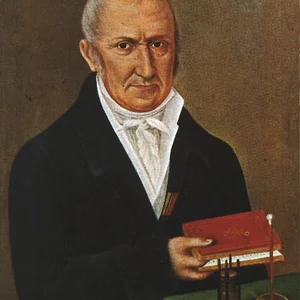
Alessandro Volta
1745 — 1827
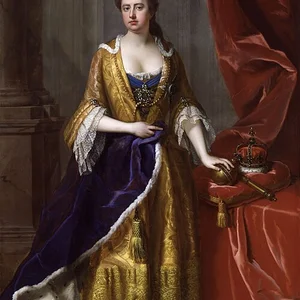
Anne of Great Britain
1665 — 1714
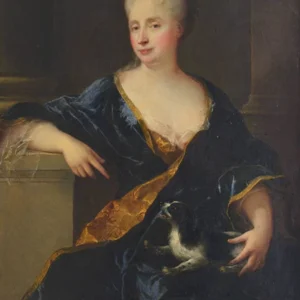
Anne Thérèse de Marguenat de Courcelles, marquise de Lambert
Antoine de Lavoisier
1743 — 1794
Antoine François de Fourcroy
1755 — 1809
Antoine Parmentier
1737 — 1813