 flip
flipJohnny Cake — Traveler's Corn Griddle Cake
Johnny Cake — Traveler's Corn Griddle Cake
Why this dish? Anne Royall traveled the United States by stagecoach to write her travel narratives, often short on money. The johnny cake — a cornmeal griddle cake cooked on a board or in a pan — was THE bread of the American traveler: cheap, quick, and portable in a trunk. Its name is said to come from 'journey cake'.
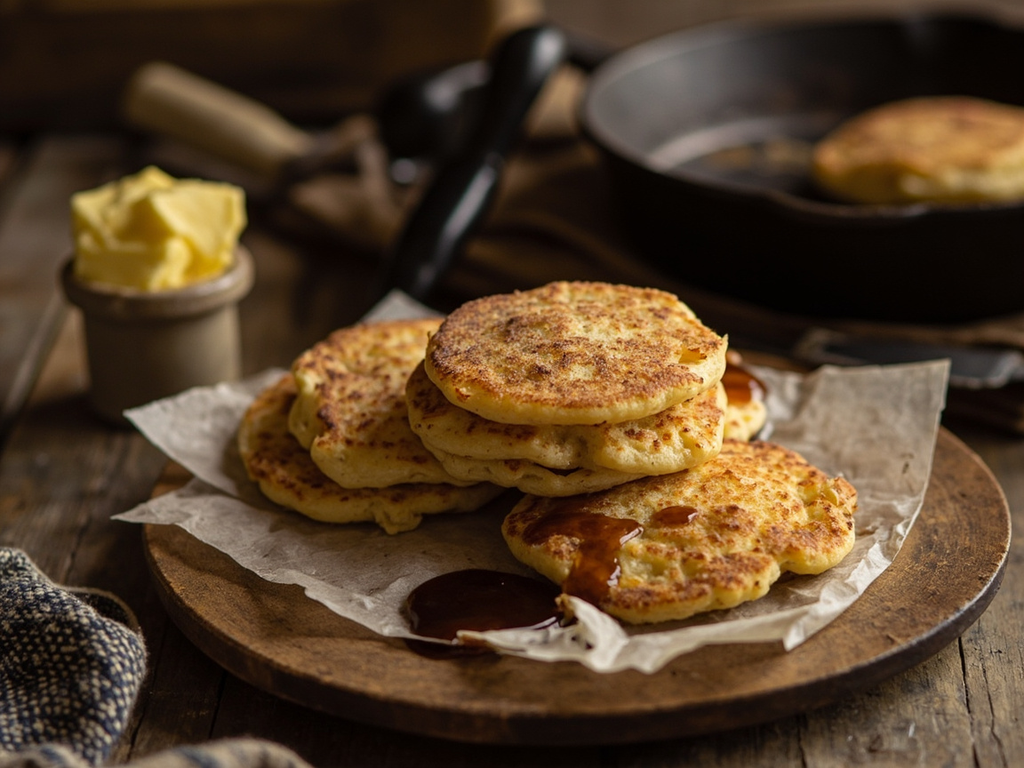
A golden griddle cake of cornmeal, crispy outside and soft inside, eaten warm with a little butter or cold on the road. The bread of all those who have neither oven nor time.
I have eaten more johnny cakes on the roads of this Republic than I have written pages, and God knows how many I have blackened! When the stagecoach stopped at the relay, a goodwife would flip the cake on her board before the hearth, and for a few pennies you had your lunch. Beware of corn too old, it smells musty; take it freshly ground, salt it well, and you will have enough to sustain a tired body until the next county.
- •Freshly ground cornmeal — two good handfuls (base)
- •Boiling water — as needed (binder)
- •Salt — a pinch (seasoning)
- •Fat (lard or butter) — a little (cooking)
Johnny Cake — Traveler's Corn Griddle Cake
A golden griddle cake of cornmeal, crispy outside and soft inside, eaten warm with a little butter or cold on the road. The bread of all those who have neither oven nor time.
Why this dish? Anne Royall traveled the United States by stagecoach to write her travel narratives, often short on money. The johnny cake — a cornmeal griddle cake cooked on a board or in a pan — was THE bread of the American traveler: cheap, quick, and portable in a trunk. Its name is said to come from 'journey cake'.
I have eaten more johnny cakes on the roads of this Republic than I have written pages, and God knows how many I have blackened! When the stagecoach stopped at the relay, a goodwife would flip the cake on her board before the hearth, and for a few pennies you had your lunch. Beware of corn too old, it smells musty; take it freshly ground, salt it well, and you will have enough to sustain a tired body until the next county.
Ingredients (period version)
- Freshly ground cornmeal — two good handfuls (base)
- Boiling water — as needed (binder)
- Salt — a pinch (seasoning)
- Fat (lard or butter) — a little (cooking)
Ingredients
- Fine cornmeal — 200 g (base)
- Boiling water — about 300 ml (binder)
- Salt — 1 tsp (seasoning)
- Butter or lard — 30 g + a little for the pan (cooking and softness)
- Sugar or molasses (optional) — 1 tsp (light sweetness)
Method
- Mix the cornmeal and salt in a bowl.
- Pour in the boiling water while stirring until you get a thick but spreadable dough; let rest for 10 minutes, the corn will swell.
- Stir in the melted butter (and molasses if you want a sweet note).
- Heat a cast-iron pan with a little fat over medium heat.
- Shape patties about 1 cm thick and cook for 5-6 minutes per side, until a nice golden crust forms.
- Serve hot with butter, or let cool to take along.
How it was made : Back then, yeast and ovens were often lacking. The salted cornmeal and water dough was cooked on a wooden board tilted before the fire (hence 'journey cake' / 'johnny cake'), or on a hot stone, or in a long-handled pan placed on the embers. It was the daily bread of farms and relay stations.
The contemporary twist : Serve it street-food style with a drizzle of molasses and a pinch of fleur de sel — a rustic pancake that tells two centuries of American history.
Sources : Amelia Simmons, American Cookery (1796) · Mary Randolph, The Virginia Housewife (1824)
Anne Royall · Charactorium