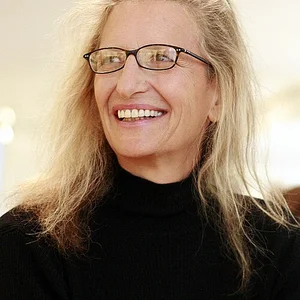

Annie Leibovitz is an American photographer born in 1949, famous for her celebrity portraits. Initially a photographer for Rolling Stone magazine, she became one of the most renowned portrait photographers in the world, notably through her work for Vanity Fair and Vogue.
Annie Leibovitz(1949 — ?)
Annie Leibovitz
États-Unis
5 min read
Frequently asked questions
Key Facts
- Born on October 2, 1949, in Waterbury, Connecticut, United States.
- Becomes chief photographer for Rolling Stone magazine in 1973.
- In 1980, takes the famous portrait of John Lennon and Yoko Ono, just hours before Lennon's assassination.
- Joins Vanity Fair in 1983 and creates numerous iconic covers.
- First woman to exhibit her photographs at the National Portrait Gallery in Washington in 1991.
Works & Achievements
An iconic image taken on the day of Lennon's death, which became one of the most famous photographs of the 20th century.
A portrait of a pregnant Demi Moore that transformed the way pregnancy was represented in the media.
A series and book created with Susan Sontag, featuring portraits of women from all walks of life, from everyday people to celebrities.
A retrospective blending commissioned photographs with intimate images, exhibited internationally.
She was the first American photographer to take an official portrait of the British monarch.
A series casting celebrities in the roles of Disney characters, blending advertising with the art of portraiture.
An edition praised for choosing women for their accomplishments rather than their nudity, breaking with tradition.
Anecdotes
In 1980, just hours before his murder, John Lennon posed naked in a fetal position, curled up against a clothed Yoko Ono, for Rolling Stone magazine. This photo taken by Annie Leibovitz became one of the most famous images of the 20th century and was voted the best magazine cover of the past 40 years.
Hired by Rolling Stone at just 23, Annie Leibovitz became its chief photographer in 1973. In 1975, she followed the Rolling Stones' tour for months as their official photographer, an exhausting experience that left a deep mark on her.
In 1991, her photograph of actress Demi Moore pregnant and naked on the cover of Vanity Fair caused an outright scandal in the United States: some newsstands hid the magazine under a wrapper. The image lastingly changed the way pregnancy and women's bodies were viewed.
Annie Leibovitz took several official portraits of Queen Elizabeth II of England starting in 2007, becoming the first American photographer to be granted this privilege. A media rumor falsely claimed at the time that the queen had stormed out of the session in anger.
Around 2009, buried in debt (estimated at more than 20 million dollars), she nearly lost the rights to all of her work, which had been put up as collateral for a loan. She ultimately reached an agreement and kept her photographic legacy.
Primary Sources
I don't have two lives. This is one life, and the personal pictures and the assignment work are all part of it.
The camera makes you forget you're there. It's not like you are hiding but you forget, you are just looking so much.
Photograph taken on December 8, 1980, the day of John Lennon's assassination, published on the cover of the tribute issue.
Portrait of the actress Demi Moore seven months pregnant, posing nude in profile, which sparked a nationwide controversy.
Key Places
Annie Leibovitz's birthplace, where she was born in 1949 into an American Jewish family.
Art school where she studied painting and then photography in the late 1960s, the starting point of her career.
Birthplace of Rolling Stone magazine, where she began her professional career in 1970.
City where she settled and worked for Vanity Fair and Vogue, the heart of American publishing and fashion.
Where she took the official portrait of Queen Elizabeth II in 2007.
Besieged city she visited in the early 1990s with Susan Sontag to photograph the Balkan war.