
Anticleia is a figure from Greek mythology, daughter of the cunning Autolycus and mother of Odysseus (Ulysses). Wife of Laertes, king of Ithaca, she dies of grief during the long absence of her son, who has gone off to the Trojan War.
Anticleia
Anticleia
6 min read
Frequently asked questions
Key Facts
- Daughter of Autolycus, son of Hermes, renowned for his cunning and his thieving
- Wife of Laertes, king of Ithaca, and mother of Odysseus, hero of the Odyssey
- According to Homer, she dies of grief during the absence of Odysseus, who has gone off to the Trojan War
- Odysseus meets her shade in the Underworld during the Nekyia (Book XI of the Odyssey)
- Some later traditions make her the mother of Odysseus by Sisyphus rather than by Laertes
Works & Achievements
Heir to the cunning of her father Autolycus, Anticlea passes on to Odysseus the crafty intelligence that will make him the most resourceful of the Greek heroes.
According to the swineherd Eumaeus, Anticlea raised her son Odysseus and her daughter Ctimene together, treating the children of the palace with almost equal care.
In the epic, Anticlea embodies the motif of the mother who died of sorrow, and her encounter in the Underworld is one of the most moving scenes in Greek poetry.
Through her descent from Autolycus, son of Hermes, Anticlea connects the lineage of Odysseus to the god of cunning and travelers.
The scene of Anticlea and Odysseus meeting in the Underworld has inspired painters, sculptors, and writers, from Greek ceramics to modern reinterpretations of the Odyssey.
Anecdotes
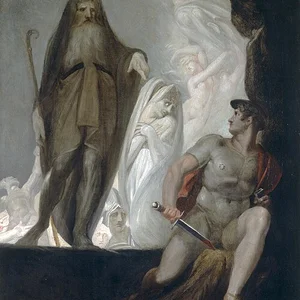
In Homer's *Odyssey*, Odysseus encounters the shade of his mother Anticlea during his descent into the Underworld (the Nekuia). When he tries to embrace her, his arms pass three times through the void: the dead no longer have bodies, only an elusive shade.
Anticlea reveals to her son that she did not die of illness nor struck down by an arrow of Artemis, but that she faded away from grief and longing, consumed by the absence of Odysseus, gone for so many years to the Trojan War.
Anticlea is the daughter of **Autolycus**, a thief so cunning that he could make invisible the beasts he stole. Odysseus inherits this family cunning (the famous Greek *mētis*), which makes him the hero of a thousand tricks, inventor of the Trojan Horse.
Some late traditions, reported by authors such as Hyginus, claim that before her marriage to **Laertes**, Anticlea had been seduced by **Sisyphus**, secretly making him the true father of Odysseus — a rumor that would explain the hero's legendary cunning.
During their meeting in the Underworld, Anticlea brings Odysseus news of Ithaca: his father **Laertes** lives withdrawn in the countryside in sorrow, his wife **Penelope** remains faithful, and his son **Telemachus** is growing up. These words strengthen Odysseus's determination to return home.
Primary Sources
Then came the soul of my dead mother, Anticlea, daughter of great-hearted Autolycus, whom I had left alive when I set out for sacred Ilion. At the sight of her I wept, and pity filled my heart.
It was not Artemis of the sure arrows who struck me down with her gentle shafts in my home, nor any sickness: it was longing for you, the memory of your tenderness, illustrious Odysseus, that robbed me of my life.
The swineherd Eumaeus recalls Anticlea, who raised Odysseus almost as the equal of her own daughter Ctimene, and who died of grief while awaiting her son.
Hyginus reports the tradition according to which Anticlea, daughter of Autolycus, was united with Sisyphus before marrying Laertes, and mentions her death from sorrow in the absence of Odysseus.
Key Places
Ionian island, kingdom of Laertes and Anticlea. It is there that she reigns, raises Odysseus, and finally dies of grief while awaiting his return.
Sacred mountain where Autolycus, the father of Anticlea, lived. The young Odysseus was wounded there by a boar during a hunt while staying with his grandfather.
Subterranean kingdom of the dead where the shade of Anticlea dwells. Odysseus meets her there during the Nekuia, the summoning of souls at the edge of the infernal river.
City of Asia Minor besieged by the Greeks. Odysseus's departure for this distant war is the indirect cause of Anticlea's death.
Rural estate on Ithaca where the old king Laertes withdraws in mourning after Anticlea's death, tilling the soil far from the court.
Typical Objects

Tools for spinning wool, a daily occupation of noblewomen in the Homeric world. Anticleia, like Penelope, would have spent her days spinning within the women's quarters.

A large wooden frame on which the women of the palace wove cloth and tapestries. Weaving is the emblematic female activity of the Homeric aristocracy.

A staff of command symbolizing royal authority over Ithaca, which Anticleia shares as queen. The scepter marks the legitimacy of power passed down through the lineage.

A vessel used for offerings of wine poured out to the gods and the dead. In the Underworld, it is by drinking the blood of the libations that the shade of Anticleia is able to speak to Odysseus.

A cloth covering the head and face worn by noblewomen in public, a sign of modesty and of the status of a lawful wife.

The elusive form that the soul becomes after death in Greek belief. Odysseus tries three times to embrace the shade of Anticleia, but his arms grasp only emptiness.
School Curriculum
Vocabulary & Tags
Key Vocabulary
Daily Life
Morning
Queen of a small island kingdom, Anticlea begins her day in the gynaeceum, the women's quarters. She organizes the work of the servants, oversees the palace stores, and watches over the education of the household's children.
Afternoon
The afternoon is spent at the loom and the distaff: spinning wool and weaving cloth are the noblest of activities for Homeric women. She also directs the preparation of meals and the welcoming of guests.
Evening
In the evening, the household gathers in the great hall (megaron) around the hearth. They share the meal and perhaps listen to a bard (*aoidos*) sing of the heroes' exploits, before the women withdraw to their quarters.
Food
The Homeric aristocratic diet rests on barley and wheat bread, wine mixed with water, olive oil, cheese, and roasted meats (pork, mutton, goat) during sacrifices and feasts. Fish, plentiful around Ithaca, rounds out the everyday fare.
Clothing
Anticlea wears the long woolen *peplos*, pinned at the shoulders with fibulae and belted at the waist, and covers herself with a veil in public. Gold jewelry, a diadem, and fine ornaments mark her royal rank.
Housing
She lives in the palace (megaron) of Laertes on Ithaca, a vast dwelling arranged around a great hall with a central hearth, surrounded by the women's quarters, the storerooms, and the courtyards where the livestock are kept.
Historical Timeline
Period Vocabulary
Liens externes & ressources
Références
Œuvres
Transmission de la mètis (ruse) à Ulysse
Temps légendaires
Éducation de Ctiméné et d'Ulysse
Temps légendaires
Figure de la mère endeuillée dans l'Odyssée
VIIIe siècle av. J.-C.
Lien généalogique entre Hermès et Ulysse
Temps légendaires
Postérité littéraire et artistique
De l'Antiquité à nos jours