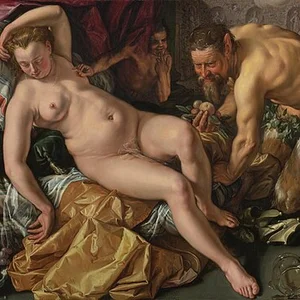

Antiope is a figure from Greek mythology, daughter of Nycteus, king of Thebes (or of the river-god Asopus, depending on the version). Seduced by Zeus disguised as a satyr, she gave birth to the twins Amphion and Zethus, future builders of the walls of Thebes.
Antiope
Antiope
6 min read
Frequently asked questions
Key Facts
- Daughter of Nycteus, king of Thebes, or of the river-god Asopus depending on the tradition
- Seduced by Zeus disguised as a satyr, she conceives the twins Amphion and Zethus
- Persecuted and imprisoned by her uncle Lycus and his wife Dirce
- Freed by her sons Amphion and Zethus, who avenge her captivity by putting Dirce to death
- Her sons Amphion and Zethus build the walls of Thebes (Amphion charming the stones with his lyre)
Works & Achievements
By giving birth to the twins fathered by Zeus, Antiope gives Thebes its future founders and musicians. Her role in the myth is essentially genealogical.
The major achievement of her descendants: the ramparts with their “seven gates” built by Amphion and Zethus, symbols of Theban grandeur.
A tragedy now surviving only in fragments, which made Antiope a heroine of the Athenian stage and set the active life against the contemplative life.
A monumental sculptural group depicting the revenge of Antiope's sons; one of the most famous ancient works rediscovered during the Renaissance.
Her earliest known literary appearance, among the illustrious heroines of Book XI, which secures her place in Greek memory.
A synthetic account that passed on to later ages the coherent whole of the legend of Antiope.
Anecdotes
According to the most widespread version, Zeus joined with Antiope after taking the form of a satyr. From this union were born the twins Amphion and Zethus, who would later be nicknamed the “Theban Dioscuri” by certain ancient authors.
Fearing the wrath of her father Nycteus (or the shame of her pregnancy), Antiope fled all the way to Sicyon, where King Epopeus married her. This departure triggered a war between Thebes and Sicyon, a frequent motif in mythological tales where an abducted woman sparks a conflict between cities.
Once grown, her sons Amphion and Zethus built the walls of Thebes: Zethus carried the stones by sheer strength, while Amphion, a musician, made the blocks assemble themselves to the sound of his lyre. This legend explains why Thebes was said to be “seven-gated.”
Antiope was long mistreated by her aunt Dirce, the jealous wife of King Lycus. Freed by her sons, she saw them punish Dirce by tying her to a wild bull — a famous scene depicted in the sculptural group of the “Farnese Bull,” discovered in Rome in the 16th century.
The playwright Euripides devoted a now-lost tragedy to this heroine, the *Antiope*, of which only fragments survive. These textual remnants show that her story set two ways of life against each other: the active life (Zethus) and the contemplative life devoted to the arts (Amphion).
Primary Sources
I also saw Antiope, daughter of Asopus, who boasted of having slept in the arms of Zeus, and who bore two sons, Amphion and Zethus, the first founders of seven-gated Thebes.
Antiope, daughter of Nycteus, was seduced by Zeus. When her father threatened her, she fled to Epopeus at Sicyon; later she gave birth to Amphion and Zethus on Mount Cithaeron.
The Thebans still point out the tomb of Amphion and Zethus; they tell how Dirce was punished for the harm she had done to Antiope.
Happy is the one who, schooled in knowledge, seeks neither the ruin of his fellow citizens nor unjust deeds, but contemplates the immortal order of nature.
Key Places
City of which Antiope is the princess and which her sons endowed with legendary walls. Center of the Theban cycle of Greek mythology.
Wild mountain between Boeotia and Attica where Antiope gave birth and where her twins were taken in and raised by a shepherd.
City of the Peloponnese where Antiope took refuge with King Epopeus, triggering a war with Thebes.
A fountain of Thebes born, according to legend, from the body of Dirce, transformed into a spring after her torment. A place of remembrance for the myth.
Abode of Zeus, the god who united with Antiope. The mythical dwelling of the Greek deities.
Typical Objects

A stringed instrument given by **Hermes**, whose music made the stones of the walls of **Thebes** move and assemble themselves. A symbol of the civilizing power of art.

The animal, hairy form taken by **Zeus** to approach **Antiope**. It embodies divine metamorphosis, a recurring motif in the love affairs of **Zeus**.

The ropes with which **Amphion** and **Zethus** tied **Dirce** to a bull to avenge their mother. The central object of the scene of the *Farnese Bull*.

The legendary ramparts built by the twins of **Antiope**, one carrying the stones, the other charming them with his music. An emblem of the founding of the city.

The shackles that held **Antiope** prisoner of **Lycus** and **Dirce** before her deliverance. They broke miraculously during her escape, according to **Euripides**.

The attributes of the warrior and herdsman twin, in contrast to the lyre of **Amphion**. They embody the active life and physical strength.
School Curriculum
Vocabulary & Tags
Key Vocabulary
Daily Life
Morning
As the mythical princess of Thebes, Antiope would have begun her day in the gynaeceum, the space reserved for women. The stories show her busy with domestic chores and weaving, under the watch of her royal family.
Afternoon
The versions of the myth emphasize her beauty, which attracted Zeus, and then her long ordeals: flight across the Greek countryside, followed by captivity under Lycus and Dirce. Her daily life then plunges into servitude and wandering.
Evening
The legend evokes her prayers and the lamentations of a prisoner, until her rescue by her sons. In Euripides' tragedy, the evening is the time of the moving reunion between the mother and her children.
Food
Like the figures of legendary Greek aristocracy, she would have shared a diet of barley bread, olives, cheese, figs, and water-diluted wine. During her captivity, the myth suggests deprivation.
Clothing
One imagines her dressed in the long woolen peplos, draped and fastened at the shoulder with fibulae, belted at the waist — the typical garment of high-ranking Greek women in the ancient imagination.
Housing
As a princess, she first resides in the royal palace of Thebes. The myth then has her live in contrasting places: the house of the king of Sicyon, then a prison cell, and finally the wild nature of Mount Cithaeron.
Historical Timeline
Period Vocabulary
Liens externes & ressources
Références
Œuvres
Naissance d'Amphion et Zéthos
Antiquité légendaire
Fondation des murailles de Thèbes (par ses fils)
Antiquité légendaire
Antiope d'Euripide
vers 410 av. J.-C.
Le Supplice de Dircé / Taureau Farnèse
IIᵉ-IIIᵉ s. apr. J.-C. (copie romaine)
Mention dans l'Odyssée d'Homère
VIIIᵉ s. av. J.-C.
Notice de la Bibliothèque d'Apollodore
Ier-IIᵉ s. apr. J.-C.