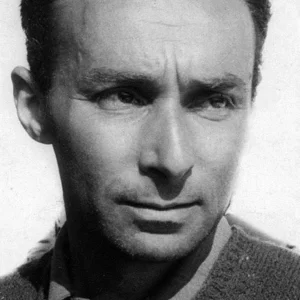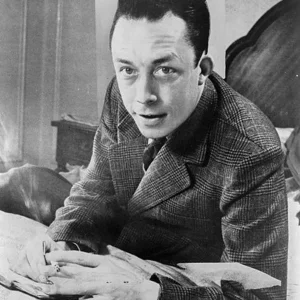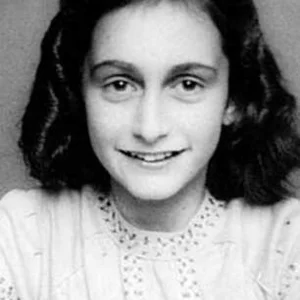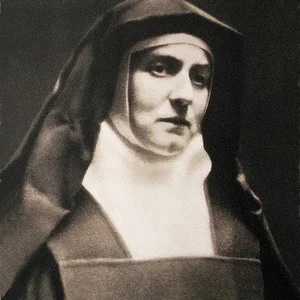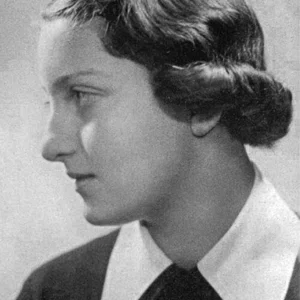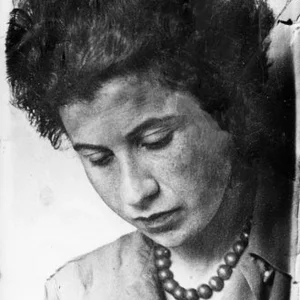

Etty Hillesum was a young Dutch Jewish woman whose diary, written between 1941 and 1943, bears witness to a profound inner life in the face of Nazi persecution. Working as a social worker at the Westerbork transit camp, she refused to flee and chose to share the fate of her people. She was deported to Auschwitz, where she died in November 1943 at the age of 29.
Etty Hillesum(1914 — 1943)
Etty Hillesum
Royaume des Pays-Bas
7 min read
Frequently asked questions
Famous Quotes
« There is a really deep well inside me. And in it dwells God.»
« Life is beautiful and meaningful after all.»
Key Facts
- Born in Middelburg (Netherlands) in 1914 into a cultivated Jewish family
- Kept her diary from March 1941 to October 1942; it was published posthumously in 1981
- Voluntarily worked as a social worker at the Westerbork transit camp (1942–1943)
- Deported to Auschwitz on 7 September 1943; died on 30 November 1943
- Her diary and letters have been translated into more than twenty languages and stand as a major spiritual testimony of the twentieth century
Works & Achievements
Diary written between March 1941 and September 1943, covering her inner life, her relationship with God, love, and the rise of persecution. It is one of the major spiritual and literary testimonies of the Holocaust.
Correspondence sent from the Westerbork transit camp to her friends in Amsterdam, describing the daily life of detainees with striking lucidity and humanity.
Complete edition gathering the eight notebooks of the diary and the full correspondence, allowing an exhaustive reading of Etty Hillesum's work.
Anecdotes
Etty Hillesum began keeping her diary in March 1941, at the suggestion of her therapist Julius Spier, a chirologist and disciple of Carl Jung. This act, intended to help her better know herself, became one of the most profound testimonies of a young woman's inner life under the Nazi Occupation. She had no idea then that these pages would endure across the decades.
Although she had several opportunities to flee the Netherlands and go into hiding, Etty Hillesum refused to leave. She deliberately chose to join her fellow Jews at the Westerbork transit camp in July 1942, initially as an assistant to the Jewish Council, in order to bear witness and help those who were suffering. This radical ethical choice sets her apart among the figures of the Shoah.
From the Westerbork camp, Etty Hillesum regularly sent letters to her friends in Amsterdam, describing with shattering clarity the daily life of the deportees, the Tuesday trains departing eastward, and her own spiritual transformation. These letters circulated clandestinely and were read in secret by resistance circles.
On September 7, 1943, Etty Hillesum was deported to Auschwitz along with her family in a freight convoy. According to the testimony of a survivor, she threw a postcard out of the wagon window, which was picked up by a farmer who mailed it. It read: 'We left the camp singing.' She died on November 30, 1943.
Primary Sources
"One must accept death in order to be able to live fully. And if one accepts death, then life becomes more precious, not less precious."
"I do not feel like a prisoner... I live freely on the inside, even if I am surrounded by barbed wire."
"Despite everything, I find life beautiful and I find meaning in this life. Yes, even here, now, at this very moment."
"I do not want to slip away. I cannot. If I were to hide, I would lose my reason for being. I must stay where I am and share the fate of those who share the same destiny as me."
Key Places
Etty lived in a large shared house in Amsterdam where she gave lessons and wrote her diary. It was there that she met Julius Spier and began her inner transformation.
The main Dutch transit camp, from which convoys departed every Tuesday bound for Auschwitz and Sobibor. Etty lived and worked there from July 1942 to September 1943, bearing witness to the living conditions through her letters.
The Nazi extermination camp to which Etty Hillesum was deported on 7 September 1943 along with her family. She died there on 30 November 1943 at the age of 29.
Etty studied law there, then Slavic studies from 1932 onwards. It was in this intellectual environment that she developed her literary and philosophical sensibility.
Etty Hillesum's birthplace, where she was born on 15 January 1914 into an intellectual Jewish family. Her father was the headmaster of a secondary school there.
Typical Objects

Etty filled school exercise books with her intimate, philosophical, and spiritual reflections. These eight handwritten notebooks, saved by her friend Maria Tuinzing, make up the core of her work.

An indispensable tool of her existence, the fountain pen accompanied Etty everywhere, even to Westerbork, where she continued to write despite the precarious conditions.

Etty read the Bible assiduously (particularly the Psalms) and Letters to a Young Poet by Rainer Maria Rilke, which deeply nourished her spiritual life and her writing.

The distinctive badge imposed on Jews by the Nazi occupiers from April 1942 onwards. Etty wore this star sewn onto her clothing, a symbol of the persecution she was subjected to.

Etty's last sign of life was a postcard thrown from the deportation wagon on 7 September 1943, picked up by a farmer and posted — a final testament to her inner freedom.

At Westerbork, detainees slept in overcrowded barracks under extreme cold; blankets were precious possessions that inmates took with them on their deportations.
School Curriculum
Vocabulary & Tags
Key Vocabulary
Daily Life
Morning
Etty rose early in the shared house on Gabriël Metsustraat in Amsterdam. She often began her day with a writing session in her diary, seeking to clarify her thoughts before the day began. She had a simple breakfast — bread, tea — in the communal kitchen.
Afternoon
In the afternoon, Etty gave private lessons in Russian and other languages to support herself. She also received patients of Julius Spier or took part in chirology sessions with him. She read intensely — the Bible, Rilke, Dostoevsky, the philosophers — in her room or in libraries still accessible to Jews.
Evening
In the evenings, Etty wrote at length in her diary, recording her reflections on love, God, and the human condition. She met with friends for intellectual or philosophical discussions, sometimes over a frugal meal. The threat of raids hung over every evening, imposing a silent vigilance.
Food
Under the Occupation, food was rationed and Jews subject to additional restrictions. Etty lived simply — bread, vegetables, staples — often sharing meals with the housemates in the large shared house. At Westerbork, rations were even more reduced, distributed collectively in the barracks.
Clothing
Etty wore the modest, functional clothing of Dutch female students in the 1940s: straight dresses or skirts, sweaters, a dark coat. From April 1942 onwards, she was required to sew the yellow star onto her clothes, a visible and humiliating marker imposed by the Nazis on all Jews in the occupied Netherlands.
Housing
Etty lived in a large shared bourgeois house at 27 Gabriël Metsustraat in Amsterdam, where Julius Spier also held his consultations. Several people cohabited there in an intellectual and sometimes bohemian atmosphere. At Westerbork, she slept in overcrowded communal barracks, on bunk beds, in rudimentary conditions.
Historical Timeline
Period Vocabulary
Visual Style
Style visuel intimiste inspiré des intérieurs hollandais et de la photographie documentaire des années 1940 : tons atténués, lumière douce, contraste entre chaleur domestique et austérité des camps.
Sound Ambience
Ambiance sonore d'Amsterdam occupée et du camp de Westerbork : une tension entre la vie quotidienne ordinaire et la menace sourde de la persécution nazie, ponctuée du silence de l'écriture intérieure.
Liens externes & ressources
Références
Œuvres
Journal intime (Het verstoorde leven / Une vie bouleversée)
1941-1943 (publié en 1981)
Lettres de Westerbork (Het denkende hart van de barak)
1942-1943 (publiées en 1982)
Lettres et journaux (édition complète)
1986