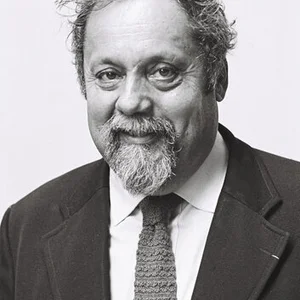

Antony Hewish (1924-2021) was a British radio astronomer. He led the work that resulted in the discovery of pulsars in 1967 and received the Nobel Prize in Physics for it in 1974, shared with Martin Ryle.
Antony Hewish(1924 — 2021)
Antony Hewish
Royaume-Uni
6 min read
Frequently asked questions
Key Facts
- Born on 11 May 1924 in Fowey (Cornwall), died on 13 September 2021
- Designs the radio telescope that made it possible to detect the first pulsars in 1967
- The discovery of the first pulsar is made by his doctoral student Jocelyn Bell in 1967
- Receives the Nobel Prize in Physics in 1974 with Martin Ryle, the first Nobel awarded for work in astronomy
- Professor of radio astronomy at the University of Cambridge
Works & Achievements
Design of a vast array of antennas to study quasars through scintillation. This instrument made the discovery of pulsars possible.
Identification of the first pulsar, a rotating neutron star emitting regular radio pulses. A revolution for astrophysics.
Landmark paper, co-authored with Jocelyn Bell and others, announcing the discovery to the scientific world.
Study of how the solar wind makes radio waves from distant sources scintillate. A new method for probing the interplanetary medium.
Talk given upon receiving the Nobel Prize, retracing the discovery and its implications for high-density physics.
Participation in the development of airborne radar jamming systems. This experience steered him toward radio astronomy.
Anecdotes
In 1967, it was Antony Hewish's doctoral student, Jocelyn Bell, who spotted on the radio telescope's long paper strips a strange signal repeating every 1.3 seconds. Half-jokingly, the team at first nicknamed it “LGM-1”, for “Little Green Men”, so artificial did the regularity of the signal seem.
The radio telescope that made the discovery of pulsars possible had not been designed for that purpose at all: Hewish wanted to study the scintillation of quasars. The instrument was a vast field of more than a thousand wooden posts linked by wires, covering the equivalent of 57 tennis courts, which students had helped to plant by hand.
The 1974 Nobel Prize in Physics sparked controversy: it rewarded Hewish and Martin Ryle, but not Jocelyn Bell, even though she had been the first to notice the signal. The astronomer Fred Hoyle protested publicly, and this “Nobel scandal” has remained a textbook case in debates about the place of doctoral students in major discoveries.
During the Second World War, the young Hewish worked on airborne radar countermeasure and jamming devices, alongside Martin Ryle. It was this wartime experience with radio waves that later led him toward the emerging field of radio astronomy at Cambridge.
A pulsar is in fact a rotating neutron star, so dense that a teaspoon of its matter would weigh hundreds of millions of tonnes. Hewish received the Nobel for having been able to prove that this signal truly came from a compact celestial object, and not from an instrument fault or a distant civilization.
Primary Sources
Unusual signals from pulsating radio sources have been recorded at the Mullard Radio Astronomy Observatory. The radiation seems to come from local objects within the galaxy, and may be associated with oscillations of white dwarf or neutron stars.
The discovery of pulsars was an unexpected result of a search for the scintillation of compact radio sources. The first indication that something unusual was happening came in August 1967.
Antony Hewish received the Nobel Prize in Physics for his decisive role in the discovery of pulsars, shared with Martin Ryle for their pioneering research in radio astrophysics.
Key Places
Small port town in southwest England where Antony Hewish was born in 1924. His seaside childhood left a lasting mark on his love of science.
University where Hewish studied and then spent his entire career. He became professor of radio astronomy there in 1977.
Cambridge's radio astronomy observatory, located at Lord's Bridge. This is where the radio telescope that detected the first pulsar was housed.
Famous physics laboratory at the University of Cambridge where Hewish joined Martin Ryle's team. A landmark of 20th-century British physics.
Village near Cambridge where Antony Hewish lived and died in 2021 at the age of 97.
Typical Objects

Vast array of dipole antennas covering several hectares at Cambridge, designed to pick up the radio waves of quasars. It was this instrument that detected the first pulsar in 1967.

Device that continuously traced the intensity of the radio signals received onto long strips of paper. It was while reviewing tens of metres of these traces that the pulsed signal was noticed.

Basic element of the array, made of wires strung between wooden posts. Thousands of these antennas together formed the receiving surface of the telescope.

Electronic device that amplified the very faint radio signals captured by the antennas. Its sensitivity was crucial for distinguishing a genuine cosmic signal from background noise.

Laboratory screen used to visualise the shape and regularity of electrical pulses. It served to confirm the extraordinary periodicity of the pulsar signal.

Manual calculating instrument used by physicists before computers became widespread. Hewish used it for his calculations of propagation and distances.
School Curriculum
Vocabulary & Tags
Key Vocabulary
Tags
Daily Life
Morning
Hewish would arrive early at the Cavendish Laboratory or the Lord's Bridge observatory, cycling or driving from his home in Cambridgeshire. Mornings were devoted to analysing data and meeting with his students.
Afternoon
In the afternoon, he supervised the experiments on the radio telescope, adjusted the instruments and discussed the results with his team. He also taught physics to the students at Cambridge.
Evening
In the evening, some observations required staying late to go back over the recording charts. Otherwise, he would head home to be with his family and prepare his lectures and publications.
Food
Like many British academics of his time, he often took his meals in the common halls of the Cambridge colleges. Classic English fare: tea, roasts, vegetables and puddings.
Clothing
As a man of his era and academic milieu, he wore a suit, shirt and tie, often a tweed jacket. A plain, understated style, typical of the Cambridge professor.
Housing
He lived in a house in Cambridgeshire, close to the university and the observatory. A peaceful English countryside setting, far from the bustle of the big cities.
Historical Timeline
Period Vocabulary
Liens externes & ressources
Références
Œuvres
Construction du radiotélescope de scintillation interplanétaire
1965-1967
Découverte des pulsars
1967
Observation of a Rapidly Pulsating Radio Source (Nature)
1968
Travaux sur la scintillation interplanétaire
années 1960
Conférence Nobel « Pulsars and High Density Physics »
1974
Recherches en contre-mesures radar (Seconde Guerre mondiale)
1943-1945