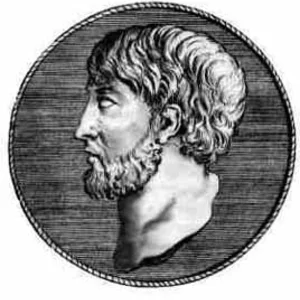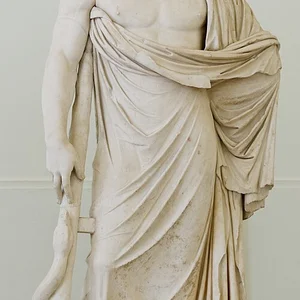

Greek philosopher of the 5th century BCE, daughter of Aristippus of Cyrene, founder of the Cyrenaic school. She is said to have taught philosophy and led the school after her father, personally educating her own son Aristippus the Younger.
Arete of Cyrene
Arete of Cyrene
6 min read
Frequently asked questions
Key Facts
- Daughter of Aristippus of Cyrene, founder of the Cyrenaic school (5th century BCE)
- Said to have led the school of Cyrene after her father's death
- Mother of Aristippus the Younger, known as 'Metrodidactus' (taught by his mother)
- One of the few women of Antiquity recognized as a philosopher in her own right
- Diogenes Laërtius credits her with 40 students taught and 35 philosophical works
Works & Achievements
Diogenes Laërtius mentions that Arete wrote philosophical works. None have survived, but their existence attests to a remarkable written intellectual activity for a woman of Antiquity.
Arete orally transmitted the principles of Cyrenaicism — the pursuit of present pleasure and mastery of the passions — to more than a hundred disciples, according to ancient sources.
Her most enduring contribution was the philosophical education of her son Aristippus the Younger, who carried on the Cyrenaic school. His epithet 'taught by his mother' stands as a unique testimony in the history of ancient philosophy.
Anecdotes
According to Diogenes Laërtius, Arete of Cyrene taught philosophy to more than one hundred and ten students over the course of her life. This figure, though difficult to verify, speaks to the intellectual reputation she had built for herself in the ancient Greek world — at a time when philosophical teaching was almost exclusively reserved for men.
Her son, Aristippus the Younger, received such a thorough philosophical education from his mother that he was nicknamed 'Metrodidactos', meaning 'taught by his mother'. This epithet, passed down from antiquity, is a rare acknowledgment of a woman's role as a philosophical educator.
Arete is recorded as having written philosophical works, placing her among the very few women of ancient Greece remembered for intellectual writing. Diogenes Laërtius includes her name among philosophers who left written texts, even though none of her writings have survived to the present day.
She is said to have taken over the leadership of the Cyrenaic school after the death of her father Aristippus, thereby ensuring the continuation of a philosophical tradition centered on present pleasure and self-mastery. This succession was exceptional: in ancient Greece, leadership of a philosophical school rarely passed to a woman.
Primary Sources
Aristippus had a daughter named Arete, who was herself the mother of Aristippus the Younger, surnamed Metrodidactus because he had been taught by his mother.
Arete of Cyrene, daughter of Aristippus, was a philosopher who taught the doctrines of her father to many disciples.
Among the correspondents of Aristippus mentioned in this corpus, Arete appears as a philosophical interlocutor, reflecting her position within the Cyrenaic school.
Key Places
Greek city founded on the North African coast (present-day Libya), birthplace of Arete and cradle of the Cyrenaic school. It was here that she taught philosophy and led the school founded by her father.
The public square of Cyrene where philosophers and citizens gathered to debate. Aristippus was accustomed to teaching there, and Arete is said to have carried on this tradition.
The intellectual center of the Greek world where Aristippus of Cyrene studied under Socrates. Arete maintained indirect ties to this philosophical hub through the Socratic legacy passed down by her father.
The city's principal sanctuary, dedicated to Cyrene's patron god. The religious and intellectual life of the city revolved around this site, which a philosopher of Arete's standing would certainly have frequented.
Typical Objects

The primary writing and reading medium in ancient Greece. Arete is said to have written philosophical works on these scrolls, passing down Cyrenaic doctrine in written form.

An instrument used to write on wax-coated tablets. It was used daily in Greek intellectual circles for taking philosophical notes and carrying on correspondence.

A two-handled cup used at banquets and philosophical gatherings (symposia). The symposion was an essential setting for philosophical discussion in ancient Greece.

A low backless seat used by teachers in Greek philosophical schools. Arete is said to have taught from this type of seat during her lessons with her many students.

The oil lamp made it possible to study and write after dark. In philosophical circles, working by lamplight was seen as a mark of intellectual devotion.

The coins of the city of Cyrene often depicted the silphium plant, a symbol of the city's prosperity. They reflect the rich commercial and cultural context in which Arete lived.
School Curriculum
Vocabulary & Tags
Key Vocabulary
Daily Life
Morning
Arétê rises at dawn in her home in Cyrene. She dedicates the first hours of the day to reviewing her philosophical notes and preparing her lessons. The cool mornings are well-suited to concentration before the heat of the day sets in.
Afternoon
She gathers her disciples under a shaded portico to teach Cyrenaic doctrine. Sessions blend oral exposition, Socratic dialogue, and discussion around happiness, pleasure, and self-mastery. She also oversees the progress of her son Aristippus in his studies.
Evening
In the evening, Arétê sometimes takes part in philosophical symposia where educated men and women exchange views on the great questions of happiness and the good life. By the light of an oil lamp, she dictates or writes down the ideas developed throughout the day.
Food
In keeping with Cyrenaic doctrine, she follows a moderate and refined diet, free from excess. Her meals include barley bread, olives, goat cheese, Mediterranean fish, fresh vegetables, and fruit, accompanied by wine mixed with water at philosophical gatherings.
Clothing
Arétê wears the Greek chiton, draped in linen or light wool, often in white or saffron hues characteristic of educated women in ancient Greece. A himation (cloak) covers her shoulders when going out. Her leather sandals are simple but well-kept.
Housing
She lives in a white limestone house typical of Cyrene, organized around a central patio with a fountain. A private library housing her papyrus scrolls sits at the heart of her home. The house likely adjoins the space where she gives her lessons.
Historical Timeline
Period Vocabulary
Visual Style
Style céramique grec à figures rouges et fresque méditerranéenne, lumière chaude et dorée de Cyrénaïque, architectures de marbre blanc et ocre, drapés élégants.
Sound Ambience
L'ambiance sonore de Cyrène antique : brise marine, discussions philosophiques sous un portique, bruits de la vie quotidienne d'une cité grecque prospère en Afrique du Nord.
Liens externes & ressources
Références
Œuvres
Traités philosophiques (perdus)
IVe siècle av. J.-C.
Enseignement oral de la doctrine cyrénaïque
IVe siècle av. J.-C.
Formation d'Aristippe le Jeune (Mètrodidaktos)
IVe siècle av. J.-C.