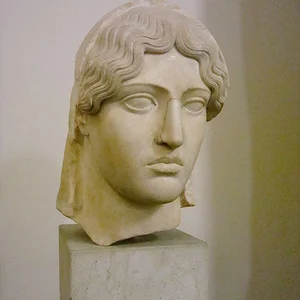

Born in Miletus around 470 BC, Aspasia was the companion of Pericles and a major intellectual figure in Athens. Renowned for her eloquence and mastery of rhetoric, she hosted a philosophical salon attended by Socrates, Plato, and the greatest minds of her era.
Frequently asked questions
Key Facts
- Born around 470 BC in Miletus, a Greek city in Ionia
- Companion of Pericles, Athenian statesman, from the 450s BC onward
- Hosted an intellectual salon frequented by Socrates, Anaxagoras, and other philosophers
- Cited by Plato in the Menexenus as Socrates' teacher of rhetoric
- Status as a foreigner (metic) in Athens, which denied her the civic rights reserved for citizens
Works & Achievements
In the 'Menexenus', Plato has Socrates claim that Aspasia composed the funeral oration delivered by Pericles at the start of the Peloponnesian War. This speech, a masterpiece of ancient rhetoric, celebrated the virtues of Athenian democracy.
For two decades, Aspasia hosted a unique intellectual gathering that brought together Socrates, Anaxagoras, Phidias, and the Sophists. This salon was a founding site of Western philosophical and rhetorical thought.
Several ancient authors mention writings by Aspasia on rhetoric and the art of persuasion. These works are lost, but their influence can be glimpsed in Plato's dialogues and the accounts of Xenophon.
Xenophon reports that Socrates himself recommended Aspasia as an advisor on political and oratorical matters. This intellectual transmission from a woman to a man was an exceptional occurrence in ancient Greece.
Anecdotes
Aspasia was the only woman in Athens cited by Socrates as one of his teachers in rhetoric. In Plato's dialogue 'Menexenus', Socrates attributes to Aspasia the composition of the funeral oration that Pericles delivered for soldiers who died in war — a text considered one of the greatest speeches of Antiquity.
In 432 BC, Aspasia was brought before the Athenian courts, charged with impiety (asebeia) by the political enemies of Pericles. According to Plutarch, Pericles pleaded her case himself with such rare emotion that he shed tears before the judges — an unusual display for a statesman of his standing. She was ultimately acquitted.
Although a foreigner (a metic from Miletus), Aspasia hosted an intellectual salon in Athens where Socrates, Phidias, and the greatest minds of the era would gather. This social anomaly — a woman leading philosophical discussions with the most powerful men in the city — caused scandal and inspired several satirical comedies, notably by Aristophanes.
Aspasia and Pericles could not legally marry: a law from 451 BC, which Pericles himself had championed, reserved Athenian citizenship for children born of two citizen parents. Their son, Pericles the Younger, was declared illegitimate until a special exception was granted by the Assembly after the deaths of Pericles's legitimate sons during the plague epidemic.
Primary Sources
It was Aspasia of Miletus who taught me. She has composed many speeches of this kind for me, including the one she prepared for Pericles, when she thought he would have to deliver one.
Aspasia was, it is said, highly regarded by Pericles for her wisdom and political acumen. Socrates would sometimes visit her with his disciples, and his close friends would bring their wives to hear her speak, even though she practiced a profession that was neither respectable nor decent.
Socrates said: 'I know a woman, Aspasia, who will give you better advice than I can on this subject.' [...] She understood political affairs better than many men.
Some drunken young men go to Megara and abduct the courtesan Simaetha. The Megarians, stung by the insult, retaliate by abducting two of Aspasia's girls. From this sprang the war — all for three harlots.
Key Places
Aspasia's birthplace, Miletus was a Greek city in Asia Minor renowned for its culture and intellectual openness. It was here that Aspasia received an exceptional education for a woman of her time.
The political and commercial heart of Athens, the Agora was the space where public debates took place. Socrates taught there, and the ideas discussed in Aspasia's salon found direct resonance within it.
The residence of Pericles and Aspasia in Athens, home to her celebrated philosophical salon where Socrates, Phidias, Anaxagoras, and the great minds of the Athenian Golden Age would gather.
Symbol of Athenian power under Pericles, the Acropolis was redeveloped with the Parthenon during Aspasia's lifetime. Phidias, the architect of the Parthenon, was a close member of her intellectual circle.
It was before this court that Aspasia was tried in 432 BC, charged with impiety. Her trial illustrates the tensions between intellectual freedom and political conservatism in Athenian democracy.
Typical Objects

Aspasia, renowned for her learning and eloquence, used papyrus scrolls to read and teach rhetoric. These scrolls contained the texts of poets and philosophers she would discuss and comment on in her intellectual salon.

Common writing tools in the 5th century BC, used to jot down arguments, prepare speeches, or send messages. Aspasia, a master of rhetoric, would have used them to compose and refine her addresses.

A central instrument in Greek education, the lyre accompanied poetry and philosophical banquets. In the intellectual circles Aspasia moved in, music was inseparable from philosophical inquiry.
📷 CC BY-SA 4.0 · Wikimedia Commons ↗
A draped garment worn by high-status women in ancient Greece. Although a foreigner, Aspasia most likely adopted the dress codes of educated Athenian women to assert her respectability.

Symposia — philosophical banquets held among men — revolved around wine. Aspasia was exceptionally permitted to attend, breaking a strong social norm; the kylix symbolizes these intellectual exchanges in which she distinguished herself.

A typical feminine object of the era, the bronze mirror also represents the ability to see oneself clearly — a philosophical metaphor dear to the Socratic circles Aspasia frequented.
School Curriculum
Vocabulary & Tags
Key Vocabulary
Tags
Daily Life
Morning
Aspasia began her day early, overseeing the household and domestic slaves. As a foreign woman free from the constraints imposed on Athenian citizen women, she could receive male visitors from the morning onward for philosophical or political discussions.
Afternoon
The afternoon was devoted to the intellectual gatherings of her salon: sophists, philosophers, and politicians came to debate rhetoric, ethics, and public affairs. She participated actively in these exchanges — a remarkable thing for a woman of her time.
Evening
Evenings often unfolded at symposia held at Pericles' home or at the houses of friends. Unlike citizen women, Aspasia was admitted to these philosophical banquets, where guests debated over wine, music, and poetry.
Food
The Athenian diet was built around the Mediterranean triad: barley or wheat bread, olives and olive oil, and wine diluted with water. Meals also included vegetables, goat's cheese, fish from the Aegean Sea, figs, and honey; meat was reserved for feast days.
Clothing
Aspasia wore the chiton, a tunic of linen or fine wool fastened with fibulae, draped over with a himation. As a woman of great learning and companion to Athens' foremost strategos, her garments were of fine quality — dyed in saffron or white — and accessorized with understated gold jewelry.
Housing
Aspasia lived in Pericles' residence, the home of a prominent Athenian citizen organized around an open-air central peristyle. The rooms were decorated with wall paintings and simply furnished; a library of papyrus scrolls formed the intellectual heart of the house.
Historical Timeline
Period Vocabulary
Visual Style
Une direction artistique ancrée dans l'âge d'or athénien : marbres blancs baignés de lumière méditerranéenne, céramique à figures rouges, drapés élégants et atmosphère de raffinement intellectuel.
Sound Ambience
L'ambiance sonore d'Athènes au Ve siècle av. J.-C. : le murmure des débats philosophiques dans les demeures cultivées, mêlé au brouhaha de l'Agora et à la musique des symposiums.
Liens externes & ressources
Références
Œuvres
Oraison funèbre (attribuée par Platon)
431 av. J.-C.
Salon philosophique d'Aspasie
vers 445-429 av. J.-C.
Traité de rhétorique (perdu)
Ve siècle av. J.-C.
Enseignement de la dialectique à Socrate
vers 440-429 av. J.-C.
See also
Related Characters
Alexander II of Macedon
Anaxagoras of Clazomenae
499 av. J.-C. — 427 av. J.-C.
Anaximander
609 av. J.-C. — 545 av. J.-C.
Catiline
107 av. J.-C. — 61 av. J.-C.
Confucius
550 av. J.-C. — 478 av. J.-C.
Crassus
114 av. J.-C. — 52 av. J.-C.