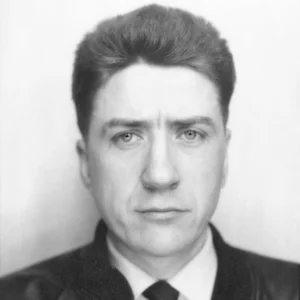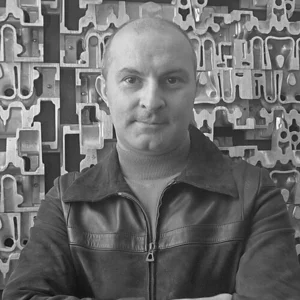

Arman (1928-2005) was a Franco-American artist and co-founder of Nouveau Réalisme alongside Yves Klein and Pierre Restany. He is celebrated for his "accumulations" of manufactured objects and his "destructions-reconstructions," which question consumer society.
Arman(1928 — 2005)
Arman
États-Unis, France
8 min read
Frequently asked questions
Key Facts
- 1928: born in Nice as Armand Pierre Fernandez
- 1960: co-founded Nouveau Réalisme with Yves Klein and Pierre Restany
- 1960: exhibition "Le Plein" at the Iris Clert gallery, filling the space with rubbish in response to Klein's "Le Vide"
- 1973: settled permanently in New York
- 2005: died in New York
Works & Achievements
Performance and installation: Arman filled the Galerie Iris Clert in Paris from floor to ceiling with garbage and everyday waste. A founding work of Nouveau Réalisme, it embodies a radical critique of consumer society.
The first major official accumulation: identical objects (cans, utensils) enclosed in a transparent box. This founding series laid the groundwork for Arman's serial and quantitative approach.
Arman smashed a violin and fixed its shattered fragments onto a board. An iconic work from the "Colères" series, it explores violence as a creative process and the paradox of destruction revealing an object's hidden structure.
Arman sliced objects (musical instruments, furniture) into regular cross-sections and arranged them in sequence. Hovering between sculpture and dissection, these works reveal the anatomy of things and question the integrity of everyday objects.
A monumental sculpture nineteen meters tall at Jouy-en-Josas: sixty automobiles cast in concrete, commissioned by the Fondation Cartier. The work is today one of the best-known monuments of public art in France.
A monumental installation in Beirut composed of an accumulation of military tanks from various armies. Erected at the end of the Lebanese Civil War, the work carries a message of collective memory and international reconciliation.
Anecdotes
Arman was born Armand Pierre Fernandez in Nice in 1928. Around 1957–1958, during the printing of an exhibition catalogue, a typographical error caused the final “d” of his first name to disappear. Rather than correcting it, the artist decided to keep this shortened signature. From then on, he signed all his works simply “Arman” — a name that became as famous as it was mysterious.
In 1960, Arman created one of the most spectacular performances in contemporary art: “Le Plein” (“The Full”). After his friend Yves Klein had exhibited an entirely empty gallery in 1958 (“Le Vide” — “The Void”), Arman did the opposite: he filled the Galerie Iris Clert in Paris from floor to ceiling with rubbish and debris. Visitors could only observe the scene from the street through the shop window, prompting reflection on consumer society and its waste.
Arman shared a deep friendship with Yves Klein dating back to their youth in Nice, where they bonded largely through judo — Arman even earned a black belt. This shared passion for martial arts and artistic creation was an essential driving force behind the founding of Nouveau Réalisme in October 1960, a movement that would go on to transform the history of contemporary art.
In 1982, Arman erected a monumental sculpture in Jouy-en-Josas (Essonne) entitled “Long Term Parking”: sixty automobiles submerged in a block of concrete nineteen metres tall. Commissioned by the Fondation Cartier, the work became one of the most striking symbols of his denunciation of industrial overproduction and planned obsolescence.
Towards the end of his life, Arman left behind a colossal personal collection of objects of every kind — musical instruments, clocks, gas masks, paint tubes. This compulsive taste for accumulation, which he transformed into works of art, was inseparable from his own existence: collecting was for him not only an artistic practice, but a way of being in the world.
Primary Sources
New Realism registers, with all the necessary expressive variety, the thrilling character of concrete life. These new perceptual approaches to reality are in themselves sufficient to define a sociology of feeling, even an original poetics.
What interests me in accumulation is precisely quantity. One spoon is just a spoon. A thousand spoons piled together is something else — a new presence, almost organic.
Arman invites the public to witness the invasion of the exhibition space by the accumulation of everyday discards, thereby questioning the relationship between art, object, and waste.
I do not choose objects for their beauty or ugliness, but for their identity, their repetition, their serial nature. It is quantity that creates meaning.
Key Places
Arman's birthplace, where he grew up and studied at the École Nationale d'Art Décoratif. It was here that he met Yves Klein, with whom he forged the friendships and ideas that would give birth to Nouveau Réalisme.
An iconic venue of the Parisian avant-garde in the 1960s, this gallery on the Rue des Beaux-Arts hosted "Le Plein" in 1960, Arman's landmark work created as a direct response to Klein's "Le Vide".
Arman moved to New York in 1961 and lived there until his death in 2005. The city allowed him to establish himself on the international art market and engage in direct dialogue with the American Pop Art movement.
A commune in Île-de-France where the monumental sculpture "Long Term Parking" (1982) stands: sixty automobiles cast into a nineteen-meter concrete pillar, an essential work of contemporary public art.
In 1995, Arman installed "Hope for Peace" here, an accumulation of military tanks from various armies around the world, a symbol of reconciliation erected at the end of the Lebanese Civil War.
Typical Objects

Arman used violins as his preferred material in his "Colères" (Anger) series: he smashed them, then fixed the shattered fragments onto a backing. These works question destruction as a creative act and the paradox of beauty revealed through fracture.

The transparent container is the iconic vessel of Arman's accumulations: the plexiglass box allows viewers to see and count the objects trapped inside while keeping them preserved. It transforms the mundane into a collective ready-made in which quantity becomes meaning.

Arman accumulated hundreds of twisted, emptied color tubes as a tribute to painting itself. This series illustrates his ambivalent relationship with pictorial tradition: he consumes it in order to interrogate it more deeply.

A symbol of war and industrial threat, the gas mask appears in several of Arman's accumulations. Lined up in series inside their transparent boxes, these objects evoke both collective protection and the horror of modern warfare.

The alarm clocks and watches accumulated by Arman symbolize the measurement of industrial time, the repetition of days, and the standardization of modern life. Their exposed mechanisms evoke the machine encroaching on everyday existence.

The car is the defining object of the consumer society of the postwar economic boom. Arman stacked sixty of them into a concrete block for *Long Term Parking*, a monument to planned obsolescence and industrial overproduction.
School Curriculum
Vocabulary & Tags
Key Vocabulary
Tags
Daily Life
Morning
Arman began his working days early in his vast studio, surrounded by his personal collections of all kinds of objects. He would scour flea markets, antique fairs, and industrial warehouses in search of materials for his future accumulations.
Afternoon
Afternoons were devoted to creation itself: selecting, arranging, gluing, or smashing objects in his New York or Nice studio. He also received gallery owners and collectors, always attentive to the international reach of his work.
Evening
In the evenings, Arman moved through Parisian and later New York artistic circles, cultivating a network of friendships with major figures of the avant-garde. His passion for judo, music, and collecting African art also filled his leisure hours.
Food
Arman had a fondness for the Mediterranean cuisine of his Nice childhood, even from New York where he spent most of the year. He enjoyed hosting friends and fellow artists around large tables, in a spirit of conviviality that reflected his taste for abundance and sharing.
Clothing
Arman favored a relaxed yet elegant style, halfway between French chic and New York nonchalance. He often wore dark jackets and turtleneck sweaters, a look characteristic of the artists and intellectuals of his generation.
Housing
He divided his life between a studio apartment in New York and a residence on the French Riviera. His interiors were overrun by his personal collections — musical instruments, African objects, antiques — a genuine private museum in perpetual expansion.
Historical Timeline
Period Vocabulary
Liens externes & ressources
Références
Œuvres
Le Plein
1960
Accumulation n° 1
1962
Colère de violon
1963
Hope for Peace
1995