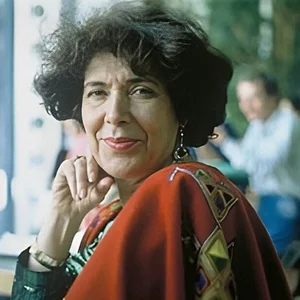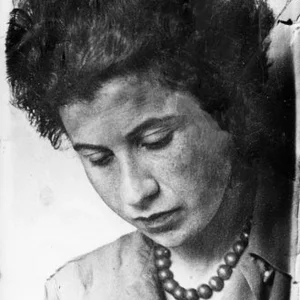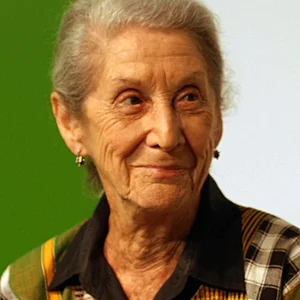

Nadine Gordimer (1923–2014) was a South African novelist whose work powerfully denounced the apartheid regime. Winner of the Nobel Prize in Literature in 1991, she devoted her entire life to defending human rights and freedom of expression in South Africa.
Nadine Gordimer(1923 — 2014)
Nadine Gordimer
Afrique du Sud
7 min read
Frequently asked questions
Famous Quotes
« Power is something of which no one can ever entirely rid themselves.»
« Writing is a way of being in opposition to the forces that oppress.»
Key Facts
- Born in 1923 in Springs, South Africa, into a family of European immigrants
- Published her first novel 'The Lying Days' in 1953, marking her literary debut
- Several of her works were banned by the apartheid regime during the 1960s and 1970s
- Awarded the Nobel Prize in Literature in 1991, in recognition of her commitment and her talent
- Active member of the African National Congress (ANC) and lifelong anti-apartheid activist throughout her career
Works & Achievements
Gordimer's first novel, autobiographical in nature, following the political awakening of a young white woman confronted with the absurdities of segregated South African society.
A novel banned in South Africa for 12 years due to its portrayal of friendly relations between white and black people, a taboo under apartheid.
Co-winner of the Booker Prize, this novel explores the psychology of a white landowner who refuses to acknowledge the inevitable collapse of white power in South Africa.
A masterpiece censored upon publication, it tells the story of the daughter of an imprisoned white communist activist, torn between her own life and her father's political legacy.
A dystopian novel imagining the collapse of the white regime, in which a bourgeois white family finds itself dependent on their former black servant for survival.
Published in the year of the first free elections, this novel examines new identities and the rebuilding of a post-apartheid society, between hope and disillusionment.
Set in democratic South Africa, this novel explores everyday violence and rising crime as the psychological aftermath of decades of apartheid.
Anecdotes
At the age of 9, Nadine Gordimer was taken out of school by her mother under the pretense of a heart condition, most likely fabricated. Isolated at home for years, she found refuge in reading and writing, publishing her first short story at just 15 in a South African children's magazine.
Several of her novels were banned in South Africa by the apartheid regime, including 'A World of Strangers' (1958) and 'Burger's Daughter' (1979). The latter was censored just a few months after its publication, sparking an international scandal that paradoxically ensured its worldwide distribution.
In 1991, upon learning she had been awarded the Nobel Prize in Literature, Nadine Gordimer announced it first to her housekeeper. She stated that this Black woman, who had shared her daily life for decades, deserved to be the first to know — a powerful symbolic gesture in a country still emerging from apartheid.
Nadine Gordimer was a close friend of Nelson Mandela and helped him draft his famous defence speech at the Rivonia Trial in 1964, which concluded with the words 'It is an ideal for which I am prepared to die.' She campaigned throughout her life within the ANC, at the risk of her own freedom.
After the abolition of apartheid in 1994, Gordimer continued to write with commitment about the new inequalities of post-apartheid South Africa, corruption, and the HIV/AIDS epidemic. She refused to fall silent once democracy had been achieved, believing that the struggle for social justice was never-ending.
Primary Sources
"The writer is always seeking what humanity is in its complexity, beyond what society permits to be expressed."
"I am the daughter of Burger. There can be no other definition of myself than that, at this moment of my life."
"Apartheid deformed all of us, White and Black. It created human beings who should never have existed in that form."
"What did she know of him? After fifteen years, he remained at a certain distance — the distance that everything kept between them."
"A writer censored in his own country is not only wounded in his freedom of expression; it is the very reality of his people that is denied."
Key Places
Mining town where Nadine Gordimer was born in 1923. This community of white settlers living above the gold mines forms the backdrop for her earliest observations on racial segregation.
City where Gordimer spent most of her adult life. The cosmopolitan and segregated metropolis of Johannesburg is the beating heart of most of her novels.
Township where millions of Black South Africans lived under apartheid. Gordimer visited friends and activists there, feeding her literary testimony with the reality of segregation.
City where Gordimer received the Nobel Prize in Literature in December 1991, before an international audience. Her speech emphasised the moral role of the writer in the face of injustice.
Prison island where Nelson Mandela was imprisoned for 18 years. Gordimer, who was close to Mandela, evoked this place in her work as a symbol of resistance to oppression.
Typical Objects

Gordimer wrote daily on a typewriter and later on a computer. Writing was for her a daily discipline and an act of political resistance.

Several of her own novels appeared on lists of works censored by the apartheid regime, symbols of the power of literature in the face of oppression.

Gordimer was active within the African National Congress (ANC), Mandela's anti-apartheid movement, at a time when such membership was illegal and dangerous for a white person.

She collected newspaper clippings and police reports on human rights violations, the documentary raw material for her politically engaged novels.

Gordimer kept notebooks of observations on daily life in Johannesburg, recording the social and racial contradictions that fuelled her realist writing.

Received in 1991, this prize recognized a body of work inseparable from the struggle against apartheid, making Gordimer a global voice for human rights.
School Curriculum
Vocabulary & Tags
Key Vocabulary
Tags
Daily Life
Morning
Nadine Gordimer rose early in her Johannesburg home and dedicated the first hours of the morning to writing, considering this time to be the most intellectually fertile. She worked with discipline, often for several hours at a stretch, before social and political obligations began.
Afternoon
The afternoon was often devoted to meetings with ANC activists, intellectuals, and journalists, sometimes clandestinely at a time when such gatherings were illegal. She read extensively — world literature, philosophy, political reports — to fuel her writing.
Evening
Gordimer's evenings frequently unfolded at dinners with artist friends, writers, and academics of all races in her Johannesburg living room — a transgressive act in itself in apartheid South Africa, where social mixing across racial lines was illegal.
Food
Gordimer led a typically bourgeois life common among wealthy white South Africans, with a varied home-cooked diet that included Ashkenazi Jewish influences inherited from her parents. She regularly hosted dinner parties, the table serving as a space for intellectual and political sociability.
Clothing
Gordimer dressed with simple, unpretentious elegance, reflecting her identity as an intellectually engaged woman rather than a socialite. Her understated, neat attire matched the image of a serious writer, far removed from the conventions of white South African high society.
Housing
She lived for decades in a comfortable house in the affluent Parktown neighbourhood of Johannesburg, surrounded by books and African artworks. This home, with its garden, was both her writing retreat and a space of resistance where she organised illegal mixed-race gatherings.
Historical Timeline
Period Vocabulary
Visual Style
Esthétique documentaire en noir et blanc inspirée de la photographie sud-africaine des années 1950-1990, avec la lumière dorée du Highveld, l'architecture des townships et la tension visuelle entre opulence blanche et pauvreté noire.
Sound Ambience
Ambiance sonore de Johannesburg sous l'apartheid : bruit des mines d'or, musique des townships, cliquetis d'une machine à écrire et tension sourde de la vie sous ségrégation.
Liens externes & ressources
Références
Œuvres
The Lying Days
1953
Un monde d'étrangers (A World of Strangers)
1958
The Conservationist
1974
Fille de Burger (Burger's Daughter)
1979
July's People
1981
None to Accompany Me
1994
The House Gun
1998