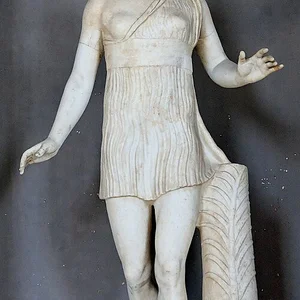

Heroine of Greek mythology, Atalanta is a huntress of unmatched agility and speed. An Argonaut and participant in the Calydonian Boar Hunt, she is famous for her challenge: any suitor had to outrun her on pain of death.
Atalanta
Atalanta
10 min read
Frequently asked questions
Key Facts
- Abandoned at birth by her father who wanted a son, she is raised by a bear
- Takes part in the Calydonian Boar Hunt alongside heroes such as Meleager
- Joins the Argonauts in the quest for the Golden Fleece
- Challenges her suitors to a footrace and kills those who lose
- Is defeated by Hippomenes thanks to the golden apples of Aphrodite, and ends up transformed into a lioness
Works & Achievements
Atalanta was the only woman admitted to this great hunt gathering the Greek heroes. She was the first to wound the boar, a feat that earned her the admiration of Meleager and the hide of the beast as a trophy of victory.
According to several ancient sources, Atalanta was among the Argonauts who accompanied Jason to Colchis, establishing herself as one of the rare women admitted to this expedition of heroes and exceptional men.
Atalanta imposed her legendary challenge on all her suitors: outrun her or die. She defeated and killed many of them, asserting a radical autonomy against the matrimonial codes of traditional Greek society.
Atalanta killed two centaurs with her arrows when they attempted to assault her during a hunting expedition. This feat confirmed not only her mastery of the bow but also her courage in the face of monstrous and superhuman adversaries.
The figure of Atalanta, an unbeatable runner and exceptional huntress, served as a symbolic model for the Heraea, the female athletic competitions organized at Olympia in honor of Hera — the only Greek games reserved for women.
Anecdotes
Abandoned at birth on Mount Parthenion in Arcadia because her father wanted a son, Atalanta was taken in and nursed by a she-bear sent by the goddess Artemis. Raised in the forest far from all civilization, she became an exceptional huntress, devoted to chastity, capable of rivaling the greatest Greek heroes.
During the famous Calydonian Boar Hunt, Atalanta was the only woman admitted among the heroes — a rare feat in Greek Antiquity. It was she who first wounded the fearsome boar with an arrow, before Meleager finished it off. To honor her, Meleager offered her the beast's hide, which triggered a deadly quarrel within his own family.
Atalanta challenged every suitor to a footrace: if the man outran her, he would win her hand; if he lost, he was put to death. She had already defeated and killed many suitors when Hippomenes obtained three golden apples from Aphrodite. During the race, he threw them one by one to distract the huntress, and thus won through a stratagem worthy of the gods.
After their marriage, Hippomenes and Atalanta lay together in a sacred sanctuary of Cybele, thereby profaning the holy place. As punishment, the two spouses were transformed into lions condemned to pull the goddess's chariot for eternity — a fate at once glorious and penitent, a symbol of divine wrath in the face of mortal hubris.
Some versions of the myth make Atalanta an Argonaut, a member of the crew of the ship Argo that set out to conquer the Golden Fleece under the command of Jason. Her inclusion in this expedition, usually reserved for men, illustrates her exceptional status in Greek mythology — the only woman capable of holding her own among the greatest heroes of her time.
Primary Sources
Ovid describes the Calydonian Boar Hunt: "Among all the hunters there was also an Arcadian girl, Atalanta... The first shaft to wound the boar was the maiden's: the arrow whistled and lodged in the beast's back. Meleager saw it and, with a single blow, brought down the monster, then presented Atalanta with the hide that was rightfully hers."
Ovid tells the story of the race with the golden apples: "Hippomenes threw the first gleaming golden apple, and Atalanta, drawn by its brilliance, swerved from her course to pick it up. He passed the girl, the spectators cheered. She made up lost ground... a second apple stopped her again. The third won him the victory and the huntress's hand."
Apollodorus recounts the origins of Atalanta: "Iasus had a daughter, Atalanta, whom he exposed at birth because he wanted sons. A bear suckled her until hunters found and raised her. As an adult, she kept her virginity and lived by the hunt; when two centaurs, Rhoecus and Hylaeus, attempted to violate her, she killed them with her arrows."
The fragments attributed to Hesiod mention Atalanta among the great Greek heroines, evoking her Arcadian birth and her participation in the great hunts of the heroic age, placing her among the most illustrious female figures, comparable to the sons of the gods themselves.
Diodorus recounts Atalanta's role in the Calydonian Boar Hunt: "This woman surpassed all the men of her time in speed and skill. She alone, among all the hunters assembled, inflicted the first wound on the fearsome boar, and the glory of that feat was acknowledged by Meleager himself."
Key Places
It was on this wooded peak in Arcadia that Atalanta was abandoned at birth by her father. She was taken in by a she-bear sent by Artemis and grew up in the forest, teaching herself the arts of hunting and survival.
The mythical city of Aetolia where the great Calydonian Boar Hunt took place — the fearsome beast having been sent by Artemis to ravage the land. It was here that Atalanta achieved her most celebrated feat, drawing first blood against the formidable animal before all the assembled Greek heroes.
Arcadia, a rugged and wild mountainous region of the Peloponnese, is Atalanta's mythical homeland. These forests were her hunting ground, the setting of her upbringing among bears, and the space of her free life beyond the walls of any city.
The destination of the Argonauts' expedition on the shores of the Black Sea, where the Golden Fleece was kept. According to some versions of the myth, Atalanta sailed aboard the Argo and took part in this legendary voyage to the very edge of the known Greek world.
It was inside a sacred sanctuary dedicated to Cybele, the great mother goddess, that Atalanta and Hippomenes came together, desecrating the holy site. The gods punished them by transforming them into lions condemned to pull the goddess's chariot for eternity.
Typical Objects
Atalante's emblematic weapon, dedicated to Artemis, goddess of the hunt. It was with her bow that she was the first to wound the Calydonian boar, distinguishing herself among all the heroes present.

The three golden apples given by Aphrodite to Hippomenes were the only means ever found to defeat Atalante in a foot race. They symbolize the power of desire and cunning, capable of diverting even the most determined of heroines.

Atalante wielded the javelin with formidable precision during collective hunting expeditions. This precision weapon reflects her training from childhood in the wild forests of Arcadia.
Raised in the forest, Atalante covered herself with wild animal hides, a symbol of her belonging to the natural world and her life outside the conventions of Greek society.
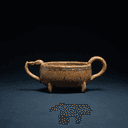
Meleager gave Atalante the hide and tusks of the Calydonian boar in recognition of her feat. This hunting trophy became the symbol of her exceptional valor and sparked the deadly quarrel that followed.
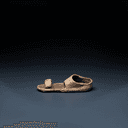
Legendarily swift, Atalante was nicknamed “swift-footed.” Her sturdy sandals symbolize the prodigious speed that allowed her to defeat every suitor who dared challenge her to a deadly foot race.
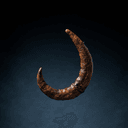
Used during great collective hunts such as the Calydonian hunt, the net was deployed to drive and trap game. Atalante took part in these maneuvers alongside the most renowned heroes of Greece.
School Curriculum
Vocabulary & Tags
Key Vocabulary
Daily Life
Morning
Atalanta rose at dawn in the Arcadian forest, sharpening her arrows and preparing her weapons before the sun had climbed high. She set out immediately on a hunting expedition, tracking game — deer, boars, bears — guided by tracks and the sounds of nature, alone or with a small group of hunters.
Afternoon
In the afternoon, after a successful hunt, Atalanta trained by running over the rugged mountain terrain, building the speed and endurance that made her legendary. She also honed her technique with the javelin and the bow — disciplines she had practiced since childhood with formidable precision.
Evening
As evening fell, Atalanta returned to her forest refuge, prepared and ate the day's catch, and kept watch under the stars. Dedicated to Artemis, she observed simple rites in honor of the goddess: offering the first kill, silent prayers, and meditation in the stillness of the wild that was her true home.
Food
Atalanta lived off what the hunt provided: deer, boar, and hare roasted over embers, accompanied by berries, wild fruits, and herbs gathered in the forest. Far from the banquets of Greek cities, her diet was frugal, natural, and perfectly suited to her life as an athlete and huntress of the woods.
Clothing
Atalanta wore a chitoniskos, a short tunic hitched up to the knee for freedom of movement, typical of Greek hunters and devotees of Artemis. She wrapped herself in an animal hide to face the cold of mountain nights, and wore sturdy sandals laced high on the ankle for her runs through the undergrowth.
Housing
Atalanta lived apart from cities, in caves or makeshift shelters deep in the forests of Arcadia. Her home was the wilderness itself: rocks and trees for shelter, springs to quench her thirst, clearings for training — a life radically different from that of ordinary Greek women, secluded in the family gyneceum.
Historical Timeline
Period Vocabulary
Liens externes & ressources
Références
Œuvres
Participation à la chasse au sanglier de Calydon
Âge héroïque (temps mythique)
Voyage des Argonautes avec Jason
Âge héroïque (temps mythique)
Les courses-défis et leurs victoires
Âge héroïque (temps mythique)
Combat contre les Centaures Rhoïkos et Hylaïos
Âge héroïque (temps mythique)
Modèle des Héréia d'Olympie
VIIIe-Ve siècle av. J.-C.