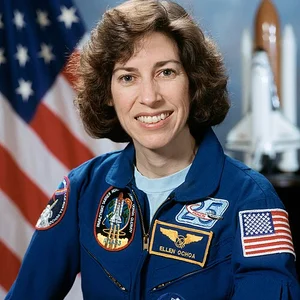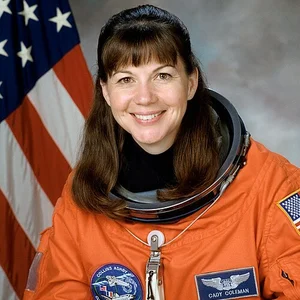

An American astronaut and chemist, Catherine Coleman completed three spaceflights, including a 159-day stay aboard the International Space Station in 2010–2011. A US Air Force officer, she contributed to scientific experiments in microgravity.
Catherine Coleman(1960 — ?)
Catherine Coleman
États-Unis
9 min read
Frequently asked questions
Key Facts
- Selected by NASA in 1992 as part of astronaut Group 14
- First spaceflight aboard the Space Shuttle Columbia in 1995 (STS-73)
- Second mission aboard Discovery in 1999 (STS-93)
- Long-duration stay of 159 days aboard the ISS in 2010–2011 (Expedition 26/27)
- Played the transverse flute aboard the ISS, collaborating musically with Earth
Works & Achievements
Coleman's first spaceflight, aboard the shuttle Columbia, dedicated to materials science in weightlessness. This 16-day mission allowed scientists to study crystal growth, fluid dynamics, and combustion properties under conditions impossible to replicate on Earth.
Coleman took part in deploying the Chandra telescope, one of NASA's four Great Observatories, dedicated to cosmic X-ray astronomy. Still in operation, Chandra has enabled scientists to map black holes, study supernovae, and analyze dark matter, revolutionizing astrophysics.
A 159-day stay on the ISS — her most significant mission — during which she conducted more than 80 scientific experiments and took command of Expedition 27. The mission gave her invaluable expertise on the physiological effects of long-duration spaceflight, essential groundwork for future crewed missions to Mars.
On January 25, 2011, Coleman played the flute live from orbit in a duet with musician Ronnie Browne on Earth, during the traditional Scottish celebration. This unprecedented cultural gesture showed how space exploration can be a bridge between people and art, transcending national borders.
Graduate research completed at the University of Massachusetts Amherst that formed the scientific foundation of her astronaut career. Her work on polymer materials under specialized conditions directly prepared her for the microgravity experiments she would conduct during her missions.
Anecdotes
As passionate about music as she was about science, Catherine Coleman brought a transverse flute aboard the International Space Station during her 159-day mission in 2010–2011. On January 25, 2011, for Burns Night (the traditional Scottish celebration), she performed live from orbit in a duet with musician Ronnie Browne on Earth, creating one of the first space concerts in musical history.
During the STS-93 mission in July 1999, Coleman and her crew deployed the Chandra X-ray Observatory. Still orbiting Earth at a record altitude of 139,000 km, Chandra has since enabled major discoveries about black holes, supernova remnants, and dark matter, transforming our understanding of the universe.
A chemist by training with a doctorate in polymer science, Coleman was selected by NASA in 1992 thanks to her dual expertise in science and the military. She represents a generation of astronauts for whom laboratory rigor and military discipline were complementary, indispensable assets for long-duration missions.
During her 159 days aboard the ISS (December 2010 – May 2011), Coleman conducted more than 80 scientific experiments in microgravity covering combustion, fluid physics, and human cell biology. Her results directly contributed to medical advances on Earth, particularly in understanding bone loss and muscle atrophy.
An officer in the US Air Force before joining NASA, Coleman logged thousands of flight hours in military aircraft before ever launching into space. This unusual trajectory, combining fundamental sciences with a military career, earned her selection from among thousands of candidates to join NASA's astronaut corps.
Primary Sources
Dr. Coleman has logged over 4,330 hours in space. She was a mission specialist on STS-73 in 1995 and STS-93 in 1999, and served as Flight Engineer for Expedition 26 and commander of Expedition 27 aboard the International Space Station.
Coleman discusses her astronaut career and the importance of scientific research in orbit: experiments conducted in microgravity make it possible to observe phenomena that cannot be reproduced on Earth, opening unprecedented new perspectives for physics, chemistry, and medicine.
The STS-93 crew successfully deployed the Chandra X-ray Observatory on July 23, 1999. The deployment sequence was executed nominally, placing the observatory on its highly elliptical transfer orbit for subsequent orbital maneuvers to its final operating altitude.
During the 159-day mission, Flight Engineer and then Commander Coleman conducted more than 80 scientific experiments spanning combustion science, fluid physics, and human physiology research. Data collected will support future long-duration exploration missions beyond low Earth orbit.
Key Places
Coleman's hometown, a coastal city in Virginia that is also home to NASA's Langley Research Center. Growing up surrounded by the aerospace industry helped shape her scientific and spacefaring ambitions.
The nerve center of NASA's astronaut program, where Coleman trained from 1992 onward and prepared for her three spaceflights. All communications with the ISS are routed through this mission control hub.
The primary launch site for American crewed missions, from which Coleman lifted off aboard the Space Shuttle Columbia for STS-73 (1995) and STS-93 (1999). Launch Complex 39A, used for both missions, is an iconic symbol of American space exploration.
The world's oldest and largest space launch facility, from which Coleman launched aboard a Soyuz in December 2010 to reach the ISS. Managed by Russia, this site became essential for missions to the station after 2011.
The orbital laboratory where Coleman spent 159 days during Expeditions 26 and 27, at approximately 400 km altitude. The ISS, the product of cooperation among 15 nations, stands as a symbol of science and diplomacy beyond earthly borders.
The university where Coleman earned her doctorate in polymer science in 1991, a qualification that proved decisive in her selection as a mission specialist astronaut. Her academic research on materials found direct application in her experiments aboard the space station.
Typical Objects

A self-contained pressurized suit weighing over 120 kg on Earth, essential for any spacewalk. Coleman trained hundreds of hours wearing it in the neutral buoyancy pool at Johnson Space Center to simulate weightlessness.

A musical instrument Coleman personally brought aboard the ISS during her 2010–2011 mission. She played from orbit during concerts broadcast live on Earth, making the flute an unexpected symbol of cultural cooperation in space.

The Russian space capsule Coleman used to reach the ISS in December 2010 and return to Earth in May 2011. After the retirement of the American Space Shuttle, the Soyuz became for a decade the only means of human access to the station.

A 17.6-meter manipulator arm permanently installed on the ISS, used for maintenance operations, assembly, and capturing resupply vehicles. Mastering it is a key skill for any astronaut on a long-duration mission.

A set of sealed containers, miniaturized reactors, and sensors for conducting chemistry, physics, and biology experiments in weightlessness. This equipment is specially designed to operate without gravity and transmit data to the ground.

A camera adapted for the space environment to document missions, photograph Earth from orbit, and contribute to atmospheric and geographical studies. Photographs taken by astronauts form a valuable scientific and artistic archive.
School Curriculum
Vocabulary & Tags
Key Vocabulary
Tags
Daily Life
Morning
Aboard the ISS, Coleman wakes up without a natural sunrise — the station experiences sixteen per day — at an audible signal synchronized to GMT. She begins with a meticulous wash using wet wipes and water in sealed pouches, before having a freeze-dried or thermostabilized meal rehydrated with hot water. The morning then opens with a video conference with Mission Control in Houston to plan scientific activities and check the station's systems.
Afternoon
Afternoons are devoted to scientific experiments in the ISS's pressurized laboratory modules. Coleman moves from one compartment to another by floating, collecting samples, performing microscopic observations, and taking measurements for the dozens of experiments in her mission. She must regularly perform maintenance checks on the station's vital systems and relay her results to ground science teams via radio and video link.
Evening
Evenings include a mandatory two hours of intense physical exercise on a harness treadmill or ergometer bike, to counter the muscle atrophy and bone loss caused by prolonged weightlessness. Coleman then devoted time to personal hobbies: playing the flute, photographing the Earth and stars through the cupola's windows, or keeping her mission journal. She slept in an individual sleep pod fixed to the wall of a habitat module, in a sleeping bag tethered to prevent drifting during sleep.
Food
Space food is based primarily on freeze-dried or thermostabilized items: rice, chicken, vegetables, dried fruit, energy bars, and even small cakes. Beverages are consumed from flexible pouches with valve straws to prevent droplets from floating away and damaging electronic equipment. Resupply vehicles occasionally bring fresh foods such as fruit or bread, greatly appreciated after weeks of standardized menus.
Clothing
For everyday life aboard the station, Coleman wears light, comfortable clothing: short- or long-sleeved t-shirts, pants with multiple pockets for storing tools and floating pens, and special anti-static socks. For spacewalks, she dons the white EMU suit — a true autonomous spacecraft weighing 127 kg that provides pressure, temperature regulation, communications, and protection against radiation and micrometeoroids.
Housing
Coleman lived in one of the ISS's habitat modules — a station the size of an American football field whose habitable space is equivalent to a six-room house. Her personal cabin, barely larger than a phone booth, was equipped with a sleeping bag, a laptop for private communications with her family, and a small porthole offering a stunning view of Earth 400 km below.
Historical Timeline
Period Vocabulary
Liens externes & ressources
Références
Œuvres
Mission STS-73 — Laboratoire de microgravité américain (USML-2)
1995
Mission STS-93 — Déploiement du télescope spatial Chandra
1999
Expédition 26/27 — Mission de longue durée à bord de l'ISS
2010-2011
Concert spatial depuis l'ISS — Nuit de Burns
2011
Thèse de doctorat en sciences des polymères
1991