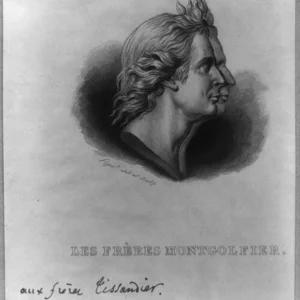

French inventor brothers who achieved the first manned hot-air balloon flight in 1783. Their invention revolutionized the concept of aerial travel and paved the way for aeronautics.
Montgolfier (brothers)
Joseph-Michel Montgolfier and Jacques-Étienne Montgolfier
8 min read
Frequently asked questions
Key Facts
- 1783: First flight of an unmanned hot-air balloon at Annonay (June 1783)
- 1783: First manned hot-air balloon flight with Pilâtre de Rozier and the Marquis d'Arlandes (November 21, 1783)
- 1783: Demonstration before Louis XVI at Versailles with animals on board (sheep, rooster, duck)
- The invention grew out of observations on smoke and hot gases at their family paper mill
- Étienne Montgolfier was elected to the Academy of Sciences in 1783
Works & Achievements
The first public demonstration of a hot-air balloon, before the elected members of the États du Vivarais. The 800-cubic-metre balloon rose to nearly 1,000 metres and travelled two kilometres, marking the official birth of aeronautics.
The first test flight carrying live passengers, performed before the royal court. This milestone confirmed that living creatures could survive travelling at altitude, and convinced Louis XVI to authorize trials with human passengers.
Aboard a 2,000-cubic-metre balloon, Pilâtre de Rozier and the Marquis d'Arlandes made the first human aerial journey, flying over Paris for twenty-five minutes and covering roughly nine kilometres.
Joseph-Michel, an inventor to the last, designed a machine that improved the continuous manufacture of paper. This invention illustrates the breadth of his inventive genius, reaching far beyond aeronautics alone.
Joseph-Michel developed the hydraulic ram, a pump that uses the energy of a flowing stream to raise a portion of that water to a greater height. Still in use today in some parts of the world, this device stands as a testament to the brothers' mechanical creativity.
Anecdotes
On September 19, 1783, the Montgolfier brothers launched their balloon before King Louis XVI and the court of Versailles with three unusual passengers: a sheep named Montauciel (“climb-to-the-sky”), a duck, and a rooster. The flight lasted about eight minutes and covered three kilometers. All the animals landed safely, and the experiment proved that living creatures could survive at altitude.
Joseph-Michel is said to have conceived the idea for the balloon while watching shirts billow above a fire in a fireplace. In November 1782, he fashioned a small silk bag and held it over a flame: the bag rose toward the ceiling. This seemingly unremarkable observation was the starting point of a revolution in human history.
During the first human flight on November 21, 1783, the physicist Pilâtre de Rozier and the Marquis d'Arlandes flew over Paris for twenty-five minutes aboard the hot air balloon. From the ground, Benjamin Franklin, then the United States Ambassador to Paris, watched the scene. A bystander asked him what use it could possibly be: he is said to have replied, “What good is a newborn baby?”
The Montgolfier brothers came from a prosperous family of paper makers from Annonay, in the Ardèche. It was precisely their mastery of paper that allowed them to craft the first balloon envelopes, made of canvas coated with paper. Their father ran a major royal paper mill, which gave them access to the materials and resources needed for their experiments.
During the first public demonstration in Annonay on June 4, 1783, the balloon rose to about 1,000 meters in altitude and traveled nearly two kilometers before landing. The spectators, initially incredulous, watched open-mouthed at what they would never have believed possible. The Royal Academy of Sciences was immediately informed, and Paris became captivated by this extraordinary invention.
Primary Sources
On 4 June 1783, the Montgolfier brothers conducted, before a large gathering and in the open air, an experiment with an aerostatic machine. This machine, spheroid in shape, measured 35 feet in diameter; it is estimated to have risen to a height of 1,000 toises.
The machine rose majestically, and after floating for a few moments in the air, it disappeared behind the neighbouring rooftops. The spectators, seized with astonishment and admiration, could scarcely believe their eyes.
The Montgolfier brothers have discovered the art of filling globes of canvas or paper with smoke, and of causing them to rise into the atmosphere. This invention opens a new era in the history of the physical sciences.
M. de Rozier and the Marquis d'Arlandes crossed Paris from the Château de la Muette to the Butte-aux-Cailles, in an aerial journey of twenty-five minutes, without the slightest mishap. The machine reached a height of approximately 900 metres.
Key Places
Birthplace of both brothers and cradle of the hot-air balloon's invention. It was here that the first public demonstration took place on **4 June 1783**, before the members of the États particuliers of Vivarais.
Site of the royal demonstration on **19 September 1783**, where the balloon rose before **Louis XVI**, **Marie Antoinette**, and a crowd of courtiers, carrying aboard the sheep Montauciel, a duck, and a rooster.
Departure point of the first human flight in history, on **21 November 1783**. The hot-air balloon lifted off from this royal park and crossed Paris over twenty-five minutes, landing near the Butte-aux-Cailles.
The Montgolfier family's paper manufactory, one of the most important in France during the 18th century. It was in this workshop that the brothers gained access to the materials and infrastructure that made the design of the first balloons possible.
Typical Objects

Made of linen canvas lined with paper, sewn in sections and held together by a rope net, it was the centerpiece of the Montgolfière. The Montgolfiers drew on their family paper-manufacturing business to design an envelope that was both lightweight and heat-resistant.

A woven wicker basket suspended beneath the balloon's opening, where passengers sat. Light and flexible, it absorbed the shock of landing and was the only inhabited space during the first human flights.

A metal basket placed beneath the balloon's opening and fed with damp straw and wool, whose combustion produced the hot air needed for ascent. The Montgolfiers initially believed it was the smoke, not the heat, that lifted the envelope.

Indispensable tools of Enlightenment scholars, the brothers meticulously recorded their calculations, observations, and prototype modifications. Joseph-Michel in particular filled pages with technical notes and sketches of his machines.

Used to calculate aerostatic lift and the weight of the envelope, these instruments allowed the brothers to refine their mathematical models before each flight. Experimental rigor was a hallmark of the Enlightenment scientific spirit.

At the demonstration at Versailles before Louis XVI, the brothers wore velvet coats, embroidered waistcoats, and powdered wigs — the obligatory dress for appearing before the king. This contrast between the elegance of the costume and the revolutionary novelty of the invention illustrates the ambivalence of the Ancien Régime toward the sciences.
School Curriculum
Vocabulary & Tags
Key Vocabulary
Daily Life
Morning
The brothers rose early, as was customary in bourgeois manufacturing families. After a quick wash and a light breakfast (bread, butter, coffee or hot chocolate), they would head to the workshops of the family paper mill to oversee the workers and machinery. The morning was devoted to the day-to-day running of the manufactory.
Afternoon
The afternoon allowed more freedom for experiments and scientific correspondence. Joseph-Michel, the more inventive of the two, spent these hours on calculations, designing new machines, and reading treatises on physics and chemistry. Jacques-Étienne, the more business-minded brother, handled relations with clients, suppliers, and royal institutions.
Evening
In the evening, the family gathered for the main meal, served in keeping with bourgeois customs: soup, meat, vegetables, and Rhône wine. Conversation often turned to science, current events, and business matters. As in many prosperous 18th-century households, they would sometimes read aloud from gazettes or the works of Enlightenment philosophers.
Food
True to their Ardèche roots, the Montgolfiers ate simple, hearty food: chestnuts, seasonal vegetables, poultry, and freshwater fish. At the table, local red wine accompanied every meal. In Paris, during their stays to present their inventions, they discovered more refined cuisine at the homes of the academicians who received them.
Clothing
As prosperous provincial bourgeois, the brothers wore fine woolen coats, breeches, and silk stockings for important occasions, and more practical clothing in the workshop. For official demonstrations — notably at Versailles — they donned the obligatory court dress: velvet, lace, and powdered wig, all symbols of social standing under the *Ancien Régime*.
Housing
The family lived in a large bourgeois residence adjoining the Vidalon paper mill, complete with a garden and outbuildings. This spacious home reflected the success of the Montgolfier paper business, one of the most important in the kingdom. During their stays in Paris, the brothers lodged with acquaintances or at inns near the academies district.
Historical Timeline
Period Vocabulary
Liens externes & ressources
Références
Œuvres
Premier vol public non habité à Annonay
4 juin 1783
Vol avec des animaux à Versailles
19 septembre 1783
Premier vol humain de l'histoire
21 novembre 1783
Réformette — machine à papier continue
vers 1800
Bélier hydraulique (co-invention)
1796