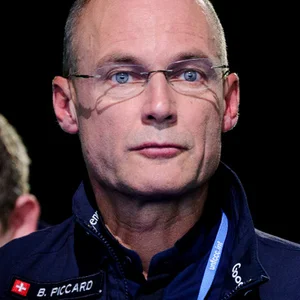

Swiss psychiatrist and aeronaut born in 1958, Bertrand Piccard completed the first non-stop round-the-world balloon flight in 1999. He then became the driving force behind Solar Impulse, the solar-powered aircraft that completed the first fuel-free circumnavigation of the globe in 2015–2016.
Bertrand Piccard(1958 — ?)
Bertrand Piccard
Belgique, Suisse
8 min read
Frequently asked questions
Famous Quotes
« Exploration is not only geographical — it is also inner.»
« Change your altitude to change your attitude.»
Key Facts
- 1999: first non-stop round-the-world balloon flight with Brian Jones aboard the Breitling Orbiter 3
- 2003: launch of the Solar Impulse project, an aircraft powered solely by solar energy
- 2015–2016: fuel-free circumnavigation by Solar Impulse 2 with André Borschberg
- 2017: launch of the Solar Impulse Foundation initiative for clean solutions
- From a family of explorers: grandson of Auguste Piccard, son of Jacques Piccard
Works & Achievements
First non-stop circumnavigation of the globe by balloon, completed with Brian Jones in 19 days and 21 hours. This achievement earned Piccard the Gold Medal of the Fédération Aéronautique Internationale and a place in the history of exploration.
The first solar-powered aircraft to cross the Alps, the Mediterranean Sea, and the United States, demonstrating the technical feasibility of long-distance flight powered solely by solar energy.
Together with André Borschberg, Piccard completed the first round-the-world flight in a solar aircraft across 17 legs, covering more than 40,000 km without emitting a single gram of CO₂ — proving that clean technologies are ready for large-scale use.
A book blending adventure narratives with philosophical and psychiatric reflections, in which Piccard develops his vision of exploration as a metaphor for personal and social transformation.
A compendium of more than 1,400 clean and economically viable technologies, assessed by independent experts, designed to give governments concrete arguments for accelerating the global energy transition.
A book in which Piccard argues for a pragmatic optimism in the face of environmental challenges, showing that protecting the planet is compatible with economic growth and technological innovation.
Anecdotes
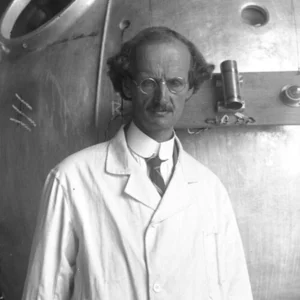
Bertrand Piccard belongs to an extraordinary family of explorers: his grandfather Auguste Piccard reached the stratosphere by balloon in 1931, his father Jacques Piccard dived to the bottom of the Pacific Ocean in the bathyscaphe *Trieste* in 1960, and he himself circumnavigated the globe by balloon in 1999. This lineage of 'firsts' spanning three generations is unique in the history of human exploration.
During the Breitling Orbiter 3 round-the-world balloon flight in 1999, Bertrand Piccard and Brian Jones came close to abandoning their mission several times due to extreme weather conditions. After 19 days, 21 hours and 55 minutes of flight, they landed in the Egyptian desert on **21 March 1999**, exhausted but triumphant, becoming the first in history to circumnavigate the globe by balloon non-stop.
A trained psychiatrist, Bertrand Piccard uses meditation and self-hypnosis techniques to manage the extreme stress of long solo crossings. He believes that inner exploration is just as important as geographical exploration, and that overcoming one's own fears is the first step of any adventure.
The Solar Impulse 2 aircraft has the wingspan of a Boeing 747 (72 metres) but weighs only 2,300 kg — roughly the equivalent of a large car. Its 17,248 photovoltaic cells allow it to fly day and night without fuel. During the round-the-world journey completed with André Borschberg in 2015–2016, the aircraft covered more than 40,000 km over 505 hours of actual flight time.
After the Solar Impulse 2 round-the-world trip concluded on **26 July 2016** in Abu Dhabi, Bertrand Piccard launched the “1,000 solutions” challenge: his foundation identified more than 1,400 clean and profitable technologies capable of cutting global CO₂ emissions in half. This catalogue was presented to the European Parliament and the United Nations to accelerate the energy transition.
Primary Sources
Life is a succession of moments where we must choose between the security of the known and the adventure of the unknown. Every time I chose the unknown, I grew.
If we want to protect the environment, we must not sacrifice our quality of life, but modernize it. Clean technologies today are more efficient and less expensive than polluting ones.
Solar Impulse is not an aeronautical project, it is a message: if an airplane can fly day and night without fuel, imagine what we could do on Earth with the same technologies.
We took off from Château-d'Œx with the hope and certainty that nothing is impossible. Nineteen days later, flying over Africa, we knew we had changed the history of aviation.
In 17 legs and 505 hours of flight, Solar Impulse 2 demonstrated that it is possible to cross the planet without emitting a single molecule of CO₂, using only the energy of the sun.
Key Places
Bertrand Piccard's birthplace, where he grew up in the intellectual and scientific environment of his family of explorers. He also completed his studies in medicine and psychiatry there.
The Alpine village from which the Breitling Orbiter 3 balloon departed on March 1, 1999, for its historic round-the-world flight. The site is now a landmark destination for international hot-air ballooning.
Landing site of the Breitling Orbiter 3 on March 21, 1999, after 19 days of non-stop flight around the globe. This point in the Egyptian desert entered the history books of aeronautical exploration.
Starting and finishing point of the Solar Impulse 2 round-the-world flight (March 2015 – July 2016). Piccard deliberately chose an oil-producing country to launch a solar aviation project, intending it as a powerful political statement.
Headquarters of the Solar Impulse Foundation founded by Bertrand Piccard, from which he coordinates the promotion of clean technologies to governments and international institutions such as the United Nations.
Typical Objects

A 2.4-meter-long capsule suspended beneath the balloon envelope, equipped with navigation, life-support, and communication systems. Piccard lived in this cramped space for 19 days at extreme temperatures, sleeping in short rotating shifts.

A single-seat aircraft powered entirely by solar energy, fitted with 17,248 photovoltaic cells covering its wings and fuselage. Piccard and André Borschberg took turns at the controls to complete the first round-the-world flight without fuel between 2015 and 2016.

Essential instruments for navigating high-altitude air currents during balloon flights, allowing Piccard to catch favorable jet streams. These devices are the direct descendants of the tools used by his grandfather Auguste during his stratospheric ascents.

Protective gear worn by Piccard to withstand temperatures that can drop to -40°C at high altitude. It incorporates heating systems and an oxygen supply to sustain survival during extreme high-altitude climbs.

Key components of the Solar Impulse project, these ultra-thin cells (135 microns) capture solar energy to power four electric motors and recharge batteries for night flight. They embody the technological heart of Piccard's vision for a sustainable future.

A notebook in which Piccard records his scientific observations, personal thoughts, and philosophical reflections during his expeditions. He views this writing practice as a psychiatric tool for maintaining clarity of mind through long periods of isolation.
School Curriculum
Vocabulary & Tags
Key Vocabulary
Daily Life
Morning
During major expeditions (balloon or solar aircraft), the morning begins with a meticulous check of navigation instruments, weather systems, and propulsion systems. On board Solar Impulse 2, Piccard devotes his first hours to analyzing flight data and communicating with the control center in Monaco to optimize his flight path according to atmospheric currents.
Afternoon
The afternoon is devoted to active piloting, heading adjustments, and monitoring the solar energy supply. In ordinary life between expeditions, this time is taken up by meetings with the Solar Impulse Foundation team, outreach to political decision-makers, and lectures at universities and international forums such as Davos or the United Nations.
Evening
On board the aircraft, evening marks the transition to night flight powered by batteries charged during the day — a critical phase requiring heightened vigilance. Piccard regularly practices meditation and self-hypnosis in the evening to maintain his focus and manage the stress of prolonged isolation, techniques drawn from his psychiatric practice.
Food
On expedition, food is reduced to the constraints of weight and preservation: freeze-dried meals, energy bars, and water in strictly calculated quantities. In his daily life, Piccard follows a balanced Mediterranean diet, aware that his physical and intellectual performance depends directly on his nutrition.
Clothing
In high-altitude flight, Piccard wears a pressurized, heated suit with an integrated helmet to withstand the sub-zero temperatures of the stratosphere. On the ground, during public appearances, he favors understated formal attire (a dark suit) that contrasts with his image as an adventurer to underscore the seriousness of his message on the energy transition.
Housing
During the 19-day round-the-world balloon flight, Piccard lived in a gondola barely 2.4 meters across, sleeping seated in his chair in shifts of a few hours. For Solar Impulse 2, the 3.8 m³ cockpit was slightly more spacious, allowing for brief periods lying down. In his ordinary life, Piccard resides in French-speaking Switzerland, dividing his time between his family, his medical practice, and travel related to his activities as a speaker and ambassador for sustainable development.
Historical Timeline
Period Vocabulary
Liens externes & ressources
Références
Œuvres
Tour du monde en ballon sans escale — Breitling Orbiter 3
1999
Solar Impulse 1 — Programme de démonstration
2009–2013
Changer d'altitude — Quelques vérités que je me suis dites entre ciel et terre
2014
Catalogue des 1 000 solutions Solar Impulse Foundation
2019
Le monde est plus beau que tu ne le crois
2018