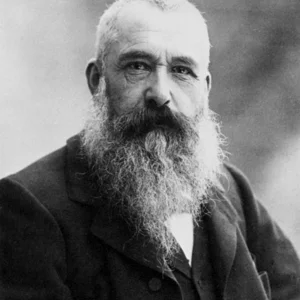

French painter (1840–1926), founder of the Impressionist movement. Monet revolutionized art by capturing the effects of light and atmosphere, most notably through his series of water lilies and his famous painting "Impression, Sunrise."
Frequently asked questions
Famous Quotes
« I discovered painting the day I understood that light was the true subject of the canvas»
Key Facts
- 1872: Paints "Impression, Sunrise" in Le Havre, giving rise to the term "Impressionism"
- 1883: Settles in Giverny, where he creates his garden and paints his famous water lilies
- 1890–1891: Creates his first complete pictorial series with the Haystacks
- 1892–1894: Paints Rouen Cathedral under different light conditions
- 1898–1926: Devotes his final years to the Water Lilies, exploring the effects of reflection and light
Works & Achievements
A view of the port of Le Havre in the morning mist, this painting inadvertently gave its name to the Impressionist movement at the 1874 exhibition.
An outdoor portrait of Camille Monet and their son Jean on a hillside, a masterpiece of spontaneity and luminosity that embodies the Impressionist aesthetic.
A series of twelve canvases depicting the Parisian train station, its trains and swirls of steam. Monet applies Impressionist principles to a resolutely modern and industrial subject.
A series of around thirty canvases depicting haystacks at different times of day and seasons. This series marks the beginning of Monet's systematic approach to changing light.
More than thirty variations of the cathedral facade painted at different times of day, demonstrating that the subject matters less than the light that transforms it.
A monumental ensemble of panels depicting the water lily pond at Giverny, installed in the Orangerie des Tuileries. These immersive works are considered precursors of abstract art.
One of the first depictions of the Japanese bridge over the Giverny pond, inaugurating a theme that Monet would explore for nearly thirty years.
Anecdotes
In 1872, Monet painted at the port of Le Havre a canvas he titled "Impression, Sunrise". At the 1874 exhibition, critic Louis Leroy used this title to mock the group of painters, calling them "Impressionists". This derisive nickname would become the official name of one of the most famous artistic movements in history.
Monet was so obsessed with light that he would rise before dawn and work on several canvases at the same time. He moved from one to another throughout the day to capture the variations of light on the same subject. For his Haystacks series, he sometimes brought a wheelbarrow loaded with canvases into the fields.
At Giverny, Monet had a pond dug and a branch of the Epte river diverted to create his famous water garden. He employed several full-time gardeners, and one of them had the sole task of cleaning the water lilies every morning so that Monet could paint them under perfect conditions.
Monet suffered from cataracts at the end of his life, which impaired his color perception. His last canvases took on unusual reddish and brownish hues. After an operation in 1923, he was astonished to rediscover colors and destroyed several paintings made during his illness, deeming them unworthy.
Primary Sources
I am in a state of perpetual anxiety and I would very much like to be in Paris to see what you are doing. Here I am working a great deal, I have about twenty canvases well under way.
Impression — I was certain of it. I was just telling myself that, since I was impressed, there must be some impression in it… and what freedom, what ease of workmanship! Wallpaper in its embryonic state is more finished than that seascape!
I am chasing nature without being able to grasp it. What I want to render is what lies between the motif and myself.
This is not a country for working — everything changes from one moment to the next. Today I could do nothing; the fog was too thick, then all of a sudden the light was so beautiful that I wanted to set to work, and everything had changed again.
Key Places
Monet lived in Giverny from 1883 until his death in 1926. There he created his famous water garden with the Japanese bridge and water lilies, an inexhaustible source of inspiration for his final great works.
Monet grew up in Le Havre, where he painted his first works en plein air. It was in the port of Le Havre that he painted Impression, Sunrise in 1872, the founding work of Impressionism.
Monet settled in Argenteuil from 1871 to 1878, a period of intense creative work along the Seine. There he painted scenes of boating, regattas, and modern suburban life on the outskirts of Paris.
Between 1892 and 1894, Monet painted more than thirty canvases of the façade of Rouen Cathedral from windows directly opposite, capturing the variations of light at different times of day and across the seasons.
This museum has housed since 1927 the eight monumental panels of the Water Lilies donated by Monet to the French state, installed in two oval rooms specially designed according to the artist's wishes.
Typical Objects

Monet painted en plein air and carried his folding easel to his motif, sometimes in difficult weather conditions, to capture natural light.

The invention of tin paint tubes allowed Monet to easily carry his colors outdoors. His palette favored light tones and banished pure black.

Inspired by Daubigny, Monet had a covered boat fitted out as a floating studio to paint reflections on the Seine as close to the water as possible.

Monet used a large parasol to shield his canvas from direct sun glare and to control the light on his palette during plein air sessions.

An indispensable accessory for the plein air painter, the hat protected Monet from the sun during his long hours of work outdoors.

For his series, Monet brought several canvases to his motif and moved from one to the next as the light evolved throughout the hours.
School Curriculum
Vocabulary & Tags
Key Vocabulary
Tags
Mouvement
Daily Life
Morning
Monet rose very early, often before five in the morning, to make the most of the first light. After a hearty breakfast, he would head to his garden or out to his motif with his canvases and easel. He worked intensely during the hours when the light matched the effect he was seeking.
Afternoon
In the afternoon, Monet continued painting if the light allowed, or returned to his canvases in the studio to rework them. He also devoted time to supervising the upkeep of his gardens, giving precise instructions to his gardeners. He sometimes received visitors — art dealers or painter friends.
Evening
In the evening, Monet dined with family in his yellow dining room at Giverny, often in the company of his children and stepchildren. He read the press and his correspondence, and wrote letters to his dealers and friends. He went to bed early to be in good shape at dawn.
Food
Monet was a true gourmet and took a keen interest in cooking. His table at Giverny was renowned: vegetables from the kitchen garden, fish from the Seine, farm poultry, and carefully crafted desserts. He kept a personal recipe book and particularly appreciated simple but flavourful Norman dishes.
Clothing
Monet dressed comfortably for painting: a work smock, loose trousers, and a wide-brimmed hat to shield himself from the sun. In society, he wore sober bourgeois suits. With age, he adopted his famous long white beard, and his clothing became more casual.
Housing
At Giverny, Monet lived in a large house with green shutters and a pink façade, surrounded by gardens he had entirely designed himself. The house included a vast studio, a yellow dining room, and a blue-tiled kitchen. The flowering Norman clos and the Japanese-inspired water garden formed a unique ensemble.
Historical Timeline
Period Vocabulary
Visual Style
Style impressionniste aux touches visibles et aux couleurs vibrantes, baigné d'une lumière douce et diffuse évoquant les jardins aquatiques et les reflets sur l'eau de Giverny.
Sound Ambience
Ambiance paisible du jardin de Giverny au petit matin : eau calme, chant des oiseaux, brise dans les saules et bruits discrets du peintre au travail en plein air.
Liens externes & ressources
Références
Œuvres
La Promenade (La Femme à l'ombrelle)
1875
La Gare Saint-Lazare (série)
1877
Les Meules (série)
1890-1891
La Cathédrale de Rouen (série)
1892-1894
Les Nymphéas (Grandes Décorations)
1914-1926
Le Bassin aux nymphéas, harmonie verte
1899