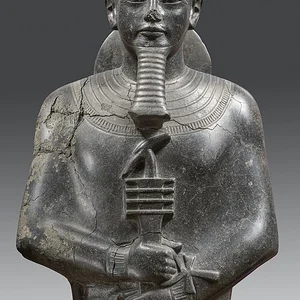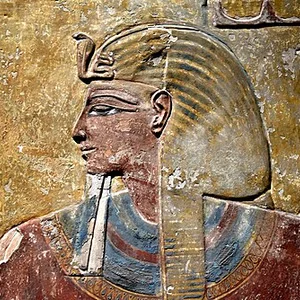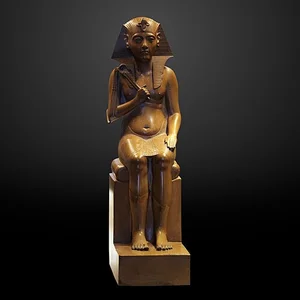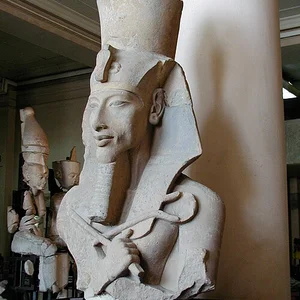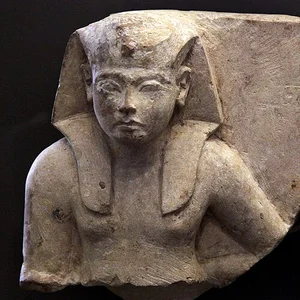

Ay was pharaoh of Egypt around 1323–1319 BCE, successor to Tutankhamun. A senior official and priest, he played a key role at the close of the Amarna period by restoring the traditional worship of the Egyptian gods.
Ay(1400 av. J.-C. — 1400 av. J.-C.)
Ay
Égypte antique
9 min read
Frequently asked questions
Key Facts
- Reigned around 1323–1319 BCE, following the death of Tutankhamun
- Likely guardian and advisor to Tutankhamun
- Took part in restoring the cult of Amun after the heretical period of Akhenaten
- His tomb (KV23) is located in the Valley of the Kings
- Succeeded by the general Horemheb, who erased his memory from history
Works & Achievements
Ay continued and consolidated the policy initiated by Tutankhamun by restoring the temples, priesthood, and worship of the traditional deities, definitively bringing the Amarna religious interlude to a close.
Ay had a columned hall erected in the great temple of Amun at Karnak, affirming in stone his commitment to the traditional clergy and inscribing his brief reign within the lineage of pharaonic builders.
The organization and celebration of Tutankhamun's funeral was the founding political act of Ay's reign. By officiating as sem-priest, he placed himself within the dynastic succession and publicly legitimized his claim to the throne.
His tomb in the Western Valley of the Kings, decorated with hunting scenes and the Amduat, represents the continuation of 18th Dynasty artistic traditions while marking the return to classical funerary conventions after the Amarna period.
The tomb Ay prepared at Amarna before his reign contains the longest and best-preserved version of the Great Hymn to the Aten, a major poetic text of ancient Egyptian literature that continues to be studied by scholars today.
Anecdotes
Ay was one of the rare individuals to perform the 'Opening of the Mouth' ritual for a deceased pharaoh: he presided over the funerary ceremony of Tutankhamun, as depicted in the paintings of tomb KV62. This ritual act, normally reserved for the king's son, allowed him to symbolically assert his legitimacy to ascend the throne.
To seize power, Ay married Ankhesenamun, the widow of Tutankhamun and daughter of the heretic pharaoh Akhenaten. This political union granted him dynastic legitimacy, despite his advanced age. Ankhesenamun subsequently disappears from historical sources, leaving her fate shrouded in mystery.
Ay had prepared a grand tomb for himself (WV23) in the Western Valley of the Kings, but it is believed he ultimately appropriated the tomb originally intended for Tutankhamun (KV62) for his young predecessor who died before his burial was complete, keeping WV23 for himself. This detail reveals the dynastic tensions of the era.
After his death, the pharaoh Horemheb ordered Ay's name erased from numerous monuments — a practice the Romans would later call 'damnatio memoriae.' This posthumous act of revenge aimed to wipe out all traces of the Amarna period. This is why sources concerning Ay are so scarce and fragmentary.
Before becoming pharaoh, Ay held the enigmatic title of 'God's Father' (it-netjer) at the court of Akhenaten. This title may indicate that he was the pharaoh's father-in-law, or even the father of the famous Queen Nefertiti — though this family connection remains hotly debated among Egyptologists.
Primary Sources
Ay, depicted as pharaoh dressed in the leopard skin of the sem-priest, performs the Opening of the Mouth ritual before the upright mummy of Tutankhamun. This scene is the only contemporary representation of Ay as his legitimate successor.
The tomb Ay had prepared at Amarna contains the most complete version of the Great Hymn to Aten: "How beautiful you are, living Aten, you who arose at the horizon of the sky!" This poetic text bears witness to Ay's closeness to the Amarna religious reform.
This decree, of which Ay was one of the chief political architects, ordered the reopening of the traditional gods' temples, the remaking of divine statues, and the reorganization of the priesthood, officially abandoning the exclusive worship of Aten.
The walls of WV23 reproduce the Book of Amduat and scenes from the Book of the Dead, illustrating the pharaoh's nightly journey through the twelve hours of the night. Several of Ay's cartouches were chiseled out and replaced with those of Horemheb.
The queen writes: "My husband has died and I have no son. Send me one of your sons and he shall become my husband." This letter reveals the dynastic pressure Ankhesenamun was under, most likely from Ay, who sought to install himself as successor.
Key Places
Capital founded by Akhenaten where Ay served as a high dignitary. His courtier's tomb (AT25) contains the most complete version of the Great Hymn to the Sun, a testament to his involvement in the Amarna revolution.
The religious and political capital where Ay reigned as pharaoh. The great temples of Karnak and Luxor were restored and expanded under his rule, marking the triumphant return to the cult of Amun.
Ay's burial site in the western branch of the Valley of the Kings. His tomb is decorated with marsh hunting scenes unique in royal funerary art; his cartouches were systematically chiseled out by Horemheb.
The tomb where Ay is depicted performing the Opening of the Mouth ritual, the founding act of his royal legitimacy. Some Egyptologists believe KV62 was originally intended for Ay himself.
Egypt's ancient administrative capital, which post-Amarna pharaohs — including Ay — worked to restore by supporting its religious institutions, priesthood, and royal craftsmanship.
Typical Objects

The quintessential emblem of pharaonic power, the heqa scepter symbolized the king's authority over his people. Ay is depicted holding it during official ceremonies, asserting his legitimacy despite his non-dynastic origins.

Ritual garment worn by the priest performing the Opening of the Mouth ceremony. Ay is depicted wearing this skin in Tutankhamun's tomb, illustrating his dual role as both priest and royal successor.

The royal headdress combining the white crown of Upper Egypt and the red crown of Lower Egypt. Ay wore it as a symbol of his reign over the Two Lands, legitimizing his rise to power.

The hieroglyphic oval enclosing the pharaoh's name, protecting it magically for eternity. Many of Ay's cartouches were chiseled out and replaced with those of Horemheb, erasing his trace from the official historical record.

Vessels used to preserve the organs of the mummified deceased. Canopic jars bearing Ay's name have been discovered, attesting to the elaborate funerary preparations he arranged for himself during his lifetime.

A ring bearing the paired cartouches of Ay and Ankhesenamun, discovered by archaeologists. It bears witness to their political union, which sealed Ay's dynastic legitimacy on the throne of Egypt.

A ritual musical instrument used during ceremonies in honor of Hathor and Amun. As a restorer of traditional cults, Ay oversaw the crafting of new instruments for temples reopened after the Amarna period.
School Curriculum
Vocabulary & Tags
Key Vocabulary
Tags
Daily Life
Morning
Ay rose at dawn to attend the temple opening rites, when the divine statue was awakened, washed, and dressed by the priests. As 'Divine Father' and later as pharaoh, he presided over these morning ceremonies that upheld the cosmic order (Ma'at). Offerings of bread, beer, and lotus blossoms were laid before the statues of the restored gods.
Afternoon
Afternoons were devoted to royal audiences, during which nobles, ambassadors, and senior officials came to report on the affairs of government. Ay also oversaw temple restoration sites, inspecting the work of sculptors and painters who were erasing traces of the Aten cult and reinstating the images of the ancient gods.
Evening
In the evenings, Ay participated in the temple closing ceremonies, during which the sanctuaries were sealed and the divine statues secured for the night. Refined banquets brought the court together in the royal apartments, with harp music, singing, and dancers in attendance. Scribes would then read aloud to him from sacred texts or administrative reports.
Food
The royal Egyptian table was lavish: several varieties of bread, fine beer, roasted meats (beef, duck, goose), fish from the Nile, vegetables (onions, lettuce, leeks), fruits (figs, dates, grapes), and honey. Ceremonial feasts featured exotic delicacies and wine imported from Canaan or Nubia.
Clothing
Ay wore full royal regalia for ceremonies: a pleated white linen kilt, pectorals of gold and lapis lazuli, broad usekh collars, bracelets, and cartouche rings. For funerary rituals, he donned the leopard skin of the sem priest. The double crown (pschent) or the blue war crown (khepresh) adorned his head depending on the official occasion.
Housing
The pharaoh resided in a royal palace at Thebes — a vast complex of hypostyle halls, open courtyards, and private apartments. The walls were painted with scenes from nature (birds, fish, lotus flowers) in vivid hues. Garden pools, fruit trees, and aviaries graced the inner courtyards, echoing the splendor of the Amarna period palaces he had known in his earlier years.
Historical Timeline
Period Vocabulary
Visual Style
Style artistique de la XVIIIe dynastie post-amarnienne : figures hiératiques aux traits légèrement assouplis par l'influence d'Amarna, dans une palette dorée et bleu lapis, avec retour progressif aux canons traditionnels de l'art pharaonique.
Sound Ambience
Ambiance sonore d'une cour royale thébaine sous la XVIIIe dynastie finissante : chants liturgiques au temple d'Amon, sistres sacrés et rumeur du Nil se mêlent aux bruits des chantiers de restauration des temples.
Liens externes & ressources
Références
Œuvres
Restauration des cultes traditionnels égyptiens
Vers 1323-1319 av. J.-C.
Salle hypostyle du temple d'Amon à Karnak
Vers 1323-1319 av. J.-C.
Organisation des funérailles royales de Toutânkhamon
Vers 1323 av. J.-C.
Tombe royale WV23 (Vallée des Rois Ouest)
Vers 1319 av. J.-C.
Tombe de cour à Amarna (AT25) avec le Grand Hymne au Soleil
Vers 1350-1336 av. J.-C.