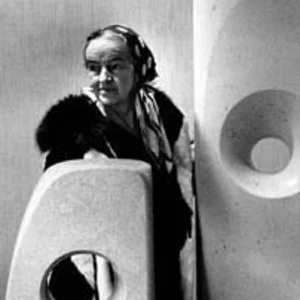

A major British sculptor of the 20th century (1903–1975), Barbara Hepworth is a central figure of modernist abstraction. Her sculptures in stone, marble, and wood explore organic forms, hollowed volumes, and the relationship between form and space.
Barbara Hepworth(1903 — 1975)
Jocelyn Barbara Hepworth
Royaume-Uni
8 min read
Frequently asked questions
Key Facts
- 1903: Born in Wakefield, Yorkshire, England
- 1920s: Trained at the Leeds School of Art, then at the Royal College of Art in London
- 1939: Settled in St Ives (Cornwall), which became a major artistic hub
- 1954: Represented Great Britain at the Venice Biennale and won the Grand Prize for sculpture
- 1975: Died in a fire in her St Ives studio, now the Barbara Hepworth Sculpture Garden
Works & Achievements
Sculpture in elm wood with taut strings, evoking the sea and the bay of St Ives. This iconic work illustrates Hepworth's exploration of interior void and the relationship between form, space, and line — what would become her defining stylistic signature.
A monumental bronze standing 6.4 metres tall, installed at the United Nations headquarters in New York as a memorial to Dag Hammarskjöld. It is one of the largest public sculptures of the twentieth century and the most celebrated commission of the artist's career.
A painted wood sculpture pierced with oval forms, exemplifying Hepworth's investigation into the dialogue between solid and void. It marks the culmination of her biomorphic abstraction during the wartime years.
A large aluminium sculpture mounted on the façade of the John Lewis department store on Oxford Street in London. Commissioned for a public setting, this monumental work reflects the recognition Hepworth had earned from major British institutions.
A group of blue slate forms commissioned for the Festival of Britain in 1951, now in Harlow, Essex. This sculpture illustrates Hepworth's rhythmic sensibility, drawing inspiration from music and the movement of bodies through space.
Two vertical bronze forms evoking both human presence and prehistoric megaliths. This work reflects Hepworth's interest in ancient cultures and the archetypal power of the upright form.
Anecdotes
Barbara Hepworth and Henry Moore met at Leeds College of Art in 1919, when both were barely seventeen years old. This youthful friendship between two future giants of British sculpture led them to inspire each other for decades, while each developed a very different artistic vision — Moore towards organic figuration, Hepworth towards an increasingly pure abstraction.
In 1939, at the outbreak of the Second World War, Hepworth fled London with her children — including triplets born in 1934 — to take refuge in St Ives, Cornwall. This small fishing village became her permanent home and a profound source of inspiration: the cliffs, the sea, and the distinctive light of the Cornish coast nourished her organic forms and polished surfaces evoking smooth pebbles.
When UN Secretary-General Dag Hammarskjöld died in a plane crash in 1961, his friends chose Barbara Hepworth to create a memorial in his honour. The sculpture 'Single Form' (1964), a monumental bronze standing over six metres tall, was installed outside the United Nations headquarters in New York — an exceptional international recognition for a British sculptor.
Hepworth died tragically in a fire that broke out in her St Ives studio on the night of 20 May 1975, when she was 72 years old. Her studio, the Trewyn Studio, was transformed into a museum and sculpture garden: the Tate now holds around twenty of her works displayed in the open air, within the lush setting she herself had shaped over the decades.
Primary Sources
"From childhood, Yorkshire taught me to read shapes in the landscape — hills, valleys, stones — and it is this reading of relief that lies at the heart of my work as a sculptor."
"What I seek in sculpture is the unity of form and space — that one cannot exist without the other, that the void is as present as the mass."
"Direct carving, the gesture of the chisel in stone or wood, is for me a physical dialogue with material: I cannot decide the final form in advance — it reveals itself in the very act of carving."
"I want my sculptures to be touched, to have hands run over their surfaces, to feel their weight and their tension. Sculpture is not made to be looked at from a distance, but to be inhabited by the whole body."
Key Places
Birthplace of Barbara Hepworth, born on 10 January 1903. The rolling landscape of Yorkshire, with its hills and dry-stone walls, left a deep imprint on her sensitivity to natural forms and to the relationship between mass and space.
Hepworth studied sculpture here from 1921 to 1924 on a national scholarship. The institution opened the doors of London's art world to her and allowed her to meet key figures in modern British art.
During a study trip from 1924 to 1926, Hepworth discovered Italian Renaissance sculpture and the techniques of direct carving in marble. This experience proved decisive in shaping the direction of her entire body of work.
A studio purchased in 1949 where Hepworth lived and worked until her death in 1975. The site is now the Barbara Hepworth Sculpture Garden, managed by Tate, with around twenty of her works displayed in the garden she had laid out.
It is in front of this building that *Single Form* (1964) stands — a monumental bronze, 6.4 metres tall, commissioned in memory of Dag Hammarskjöld. The work symbolises the international recognition Hepworth had achieved at the height of her career.
Typical Objects

Fundamental tools of direct carving, Hepworth used them daily to sculpt stone and marble. Unlike the academic tradition that relied on intermediaries, she worked the raw material herself.

Hepworth personally selected her stone blocks, often Italian marbles or local limestones. The nature of the material directly influenced the final form of the sculpture.

From the 1940s onward, Hepworth incorporated taut strings into her hollow sculptures (notably *Pelagos*, 1946), creating a visual tension between solid mass and interior void. This technique evoked vibration, music, and energy.

Wood was a favourite material during the 1940s–1950s: its natural grain and organic warmth contrasted with the coldness of metal or stone. Hepworth carved directly into massive trunks.

For her large public commissions, Hepworth first made plaster maquettes, sometimes painted white or in colour. These preparatory studies allowed her to test proportions before casting in bronze.

Hepworth drew regularly, including gouache studies of surgeons at work in the operating theatre, observed during the 1940s at the invitation of the British Arts Council. These drawings reveal her thinking about gesture, movement, and the human form.
School Curriculum
Vocabulary & Tags
Key Vocabulary
Tags
Lieu
Daily Life
Morning
Hepworth began her day very early in her studio at Trewyn Studio. After a morning cup of tea, she put on her work smock and went straight to the stone or wood, making the most of the natural morning light to work her surfaces. Direct carving was for her an intense physical effort that demanded complete presence of mind.
Afternoon
In the afternoon, she continued sculpting or overseeing the production of plaster maquettes for her large commissions. She also received visitors and corresponded with gallery owners and institutions. When the weather allowed, she walked along the Cornish cliffs to feed her inspiration through contact with the rocks and the sea.
Evening
Evenings in St Ives were often animated by the artists' colony that had grown up around her — painters, sculptors, poets. Hepworth entertained at home, cooked for her friends, and talked about art late into the night. She also read widely, particularly texts on the philosophy of art and music.
Food
Like many artists of her generation in England, Hepworth ate simply: bread, vegetables, fresh fish from the Cornish coast, and tea in abundance. During the rationing years of the Second World War, she adapted to food restrictions while making sure her children were properly fed.
Clothing
In her studio, Hepworth invariably wore a work smock or overalls stained with stone dust and wood shavings. For private views and official occasions, she dressed elegantly, favouring bright colours that contrasted with the neutral tones of her everyday working attire.
Housing
Hepworth lived at Trewyn Studio in St Ives, a complex of buildings she gradually transformed into workshops, storage spaces, and a landscaped garden for displaying her sculptures outdoors. This fusion of living space and creative space was essential to her — she did not separate art from everyday life.
Historical Timeline
Period Vocabulary
Liens externes & ressources
Références
Œuvres
Two Figures (Menhirs)
1964