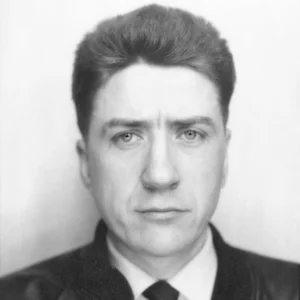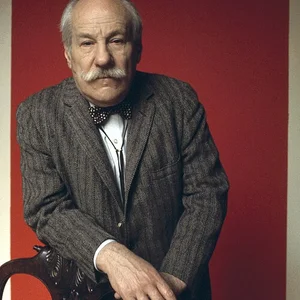

Barnett Newman (1905-1970) was an American painter, a major figure of Abstract Expressionism and Color Field painting. He is famous for his vast canvases of color crossed by vertical bands known as “zips.”
Barnett Newman(1905 — 1970)
Barnett Newman
États-Unis
6 min read
Frequently asked questions
Famous Quotes
« The impulse of modern art was this desire to destroy beauty.»
Key Facts
- Born in 1905 in New York to a family of Polish Jewish immigrants
- From 1948 onward, develops his signature motif, the “zip” (a vertical band), with the work *Onement I*
- A central figure of Abstract Expressionism and Color Field painting alongside Rothko and Pollock
- Creates the series *Stations of the Cross* between 1958 and 1966
- Dies in 1970 in New York; his influence on Minimalism and later abstract art is profound
Works & Achievements
Foundational canvas where the “zip” first appears: the moment Newman found his personal language.
Immense red field crossed by several zips, a manifesto of his painting of color and the sublime.
Vast deep-blue canvas evoking the infinity of the sky, among his most contemplative works.
Series of fourteen black-and-white canvases, a meditation on suffering and abandonment, exhibited at the Guggenheim.
Series of very large canvases confronting the pure primary colors; several were vandalized in museums.
Monumental steel sculpture, an inverted obelisk balanced on a pyramid, dedicated to the memory of Martin Luther King.
Extremely narrow, tall canvas reduced almost to a single zip: a zip that became a painting in its own right.
Anecdotes
In 1948, Barnett Newman painted *Onement I*: on a brown-red background, he stuck a strip of masking tape down the center, applied a color over it, then decided not to peel it off. This vertical band, which he would call a “zip,” became the signature of his entire body of work.
Newman signed few paintings for a long time and sold even fewer: for years he was known mainly as a thinker and an organizer of exhibitions rather than as a painter, and it was only late in his life that he gained real recognition.
In 1933, at the height of the Great Depression, **Newman** ran for mayor of New York on a platform that called notably for the construction of museums and playgrounds: a largely symbolic candidacy meant to defend the place of culture in the city.
Several of his immense blue and red canvases titled *Who's Afraid of Red, Yellow and Blue* were vandalized with a knife in European museums, proof that his radical art could provoke very violent reactions.
Newman gave some works titles in Hebrew, such as *Abraham* or the series *The Stations of the Cross*, showing that for him his abstract bands carried a spiritual, almost sacred charge.
Primary Sources
Instead of making cathedrals out of Christ, man, or “life,” we are making them out of ourselves, out of our own feelings.
The first man was an artist. Man's expression, his original cry, was a poetic song, not a demand for food.
Lema Sabachthani — “Why hast thou forsaken me?”: this is the question that has no answer, the cry that everyone utters.
Key Places
Newman's native city and the world capital of modern art after 1945. He lived, painted, and exhibited here all his life.
The gallery that hosted Newman's first solo exhibition in 1950. At first the public and critics remained baffled by it.
The museum where the “Stations of the Cross” were exhibited in 1966, finally securing his recognition.
The art school where Newman studied drawing and painting in his youth, while also pursuing philosophy studies at City College.
A place of meditation where his sculpture “Broken Obelisk” was installed in tribute to Martin Luther King. It links his work to spiritual and civic commitment.
Liens externes & ressources
Références
Œuvres
Onement I
1948
Cathedra
1951
The Stations of the Cross : Lema Sabachthani
1958-1966
Who's Afraid of Red, Yellow and Blue
1966-1970