
Nut is the Egyptian goddess of the sky in ancient Egyptian mythology. Her arched body, scattered with stars, forms the celestial vault that protects the earth. She swallows the sun each evening and gives birth to it again each morning.
Nut
Nut
8 min read
Frequently asked questions
Key Facts
- Nut is mentioned in the Pyramid Texts (c. 2400–2300 BCE), among the oldest known written religious texts
- According to Egyptian textual tradition, she is the daughter of Shu (god of air) and Tefnut (goddess of moisture), and wife of Geb (god of the earth)
- She is the mother of Osiris, Isis, Seth, and Nephthys — the major deities of the Heliopolitan Ennead
- Her arched body, depicted as a woman whose hands and feet touch the four corners of the earth, symbolizes the starry celestial vault
- She plays a central role in funerary beliefs: sarcophagus lids bear her image to protect the deceased and ensure their rebirth
Works & Achievements
The ceiling of Seti I's burial chamber features the most complete and masterly depiction of Nut arched over the world. This masterpiece of Egyptian funerary art is preserved in the Valley of the Kings.
This circular bas-relief depicts Nut surrounded by constellations, planets, and the zodiac. The original is housed in the Louvre Museum in Paris, while a copy still adorns the Temple of Dendera in Egypt.
This Coptic papyrus held in Copenhagen is the most comprehensive compilation of astronomical and cosmological traditions associated with Nut. It describes in detail the cycle of stars within the body of the goddess.
The first major textual attestation of the myth of Nut, carved on the walls of the burial chamber of Pharaoh Unas at Saqqara. These magical spells invoke Nut to ensure the king's resurrection.
This sarcophagus at the Egyptian Museum in Cairo illustrates the narrative sequences of the myth of Nut with rare precision, combining texts and images to guide the soul of the deceased toward resurrection.
Anecdotes
Nut is often depicted as a woman whose arched body stretches across the earth, her fingers and toes touching the four corners of the world. This striking image adorns the ceilings of many royal tombs, particularly in the Valley of the Kings, where she welcomes the deceased into her celestial embrace.
According to myth, Nut and Geb (the earth) were inseparable, locked in a perpetual embrace. Ra, the sun god, ordered Shu (the air) to separate them, creating the space between sky and earth. Geb and Nut were left forever longing for each other, never able to touch.
Each evening, Nut swallows the sun at the western horizon and carries it through her body during the night, giving birth to it again at dawn. This metaphor of the solar cycle explained the daily return of daylight to the Egyptians and nourished their hope of resurrection after death.
Thoth, god of wisdom, played dice with the Moon and won five extra days for Nut, defying Ra's prohibition. During these five epagomenal days, Nut was able to give birth to Osiris, Isis, Seth, Nephthys, and Horus the Elder — the great deities of the Egyptian pantheon.
In the Pyramid Texts, Nut is called 'the Great Sow who devours her piglets' — her star-children, whom she swallows at sunrise and releases again at nightfall. This image, surprising to modern readers, reflects the ancient Egyptians' cyclical, non-linear conception of time.
Primary Sources
O Nut, you have spread yourself over your father Geb, you have placed your splendor above him. You have covered him with your limbs in your form as Mystery of the Sky.
Nut the Great, mother of the gods, receive the deceased in her arms and guide him toward the Fields of Ialu.
I am Nut, I was born from nothingness. My body is the path of millions of stars. I am she who gives birth to the gods.
O Mother of the Sky, receive the king within you. He lives, he lives, he is renewed like the stars within you.
Nut completes her course in 365 days. She swallows the stars at dawn and gives birth to them at nightfall. Her body is the sky and her life is measured by the stars.
Key Places
A major theological center of ancient Egypt, Heliopolis was the birthplace of the Ennead, the group of nine deities of which Nut is a part. The priests of Heliopolis developed and transmitted the cosmogonic myths in which she plays a central role.
The pyramid of Unas at Saqqara contains the oldest known Pyramid Texts, in which Nut is invoked as celestial mother and protector of the deceased pharaoh. It is one of the earliest written attestations of the myth.
The royal tombs of the New Kingdom, particularly those of Seti I and Ramesses VI, feature the most stunning depictions of Nut arched across the ceiling, welcoming the pharaohs into her starry embrace.
The astronomical ceiling of the Temple of Dendera, dating from the Ptolemaic period, depicts Nut surrounded by constellations and planets, reflecting the blend of mythology and practical astronomy practiced by Egyptian priests.
The temple at Abydos, dedicated to the Osirian deities, portrays Nut in her role as mother of the gods — most notably Osiris and Isis, the central figures of Abydos's funerary cult.
Typical Objects

The inner lid of Egyptian sarcophagi frequently depicted Nut with arms outstretched, so that the goddess could protect the deceased during their journey through the afterlife.

The internal organs of the deceased were sometimes placed under the protection of Nut, whose image adorned certain canopic jar lids, ensuring the resurrection of the vital organs.

A symbol of the sun that Nut swallows and gives birth to each day, the winged solar disk adorns the lintels of many temples and evokes the cosmic cycle governed by the goddess.

Stars painted in yellow on a deep blue background represent the children of Nut scattered across her body. They decorate the ceilings of royal burial chambers as far back as the Old Kingdom.

Priests would place ritual offerings to Nut to ensure the regularity of the solar cycle and the protection of the dead, particularly during festivals tied to the epagomenal calendar.

The 365-day calendar — including the five epagomenal days associated with Nut — was written on papyrus and used by scribes to schedule religious festivals and agricultural work.
School Curriculum
Vocabulary & Tags
Key Vocabulary
Tags
Daily Life
Morning
At dawn, Nut gives birth to the sun from her womb: in the temples, priests perform the Opening of the Mouth ritual to awaken the divine statue. Hymns to the rising sun are sung in chorus in the temple courtyard, greeting the daily rebirth made possible by the goddess.
Afternoon
At midday, the sun crosses the sky in the barque of Ra, symbol of the daytime journey. Priests recite protective spells shielding Nut from Apophis, the serpent of chaos who threatens to swallow the sun. Offerings of bread, beer, lotus flowers, and incense are placed upon the altars.
Evening
At dusk, Nut swallows the sun at the western horizon in a fiery sunset. Priests symbolically extinguish the sanctuary lamps, then light star-lamps to honor the goddess's children appearing in the night sky. Funerary litanies are recited for the deceased entrusted to her protection.
Food
As a cosmic goddess, Nut is symbolically nourished by the stars and the sun — her divine children. In rites held in her honor, priests consumed star-shaped barley bread, honey representing the light of the celestial bodies, and sacred beer brewed during the great festivals of the epagomenal calendar.
Clothing
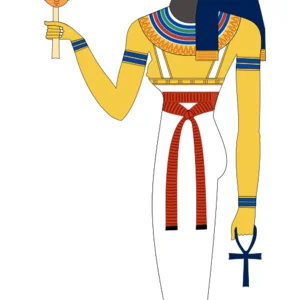
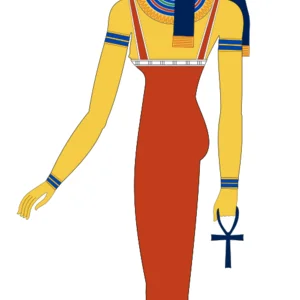
Nut is depicted wearing a form-fitting midnight-blue gown studded with five-pointed golden stars. She wears a black wig streaked with blue, crowned by a diadem in the shape of a hieroglyphic vessel meaning 'sky.' Her jewelry is made of gold and lapis lazuli, stones symbolizing the night sky and divine light.
Housing
Nut does not dwell in an earthly temple but in the sky itself: her body is her home and her sanctuary. On earth, her primary representations appear on the ceilings of royal funerary chambers, whose walls symbolically recreate the vault of heaven to welcome the dead into her sacred space.
Historical Timeline
Period Vocabulary
Visual Style
Art funéraire égyptien du Nouvel Empire : déesse à la peau bleu lapis, corps arqué couvert d'étoiles dorées, représentation plane et solennelle inspirée des plafonds des tombes royales de la Vallée des Rois.
Sound Ambience
Silence de la nuit désertique égyptienne sous un ciel étoilé immense, ponctué du murmure du Nil, de chants rituels de prêtres au loin et du frémissement de l'aube naissante.
Liens externes & ressources
Références
Œuvres
Plafond de la tombe de Séthi Ier (KV17)
vers 1279 avant J.-C.
Plafond astronomique du temple de Dendera
vers 50 avant J.-C.
Papyrus Carlsberg I — Le Livre de Nout
vers 150 après J.-C.
Textes des Pyramides de la pyramide d'Ounas
vers 2350 avant J.-C.
Sarcophage de Nespanetjerperi (Livre de Nout illustré)
vers 1000 avant J.-C.