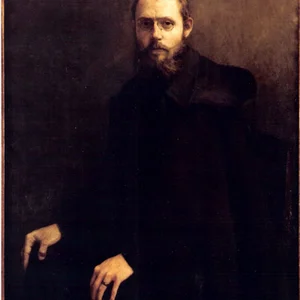

French writer, poet, and essayist (1873–1914), founder of the Cahiers de la Quinzaine. A committed Dreyfusard, he evolved from socialism toward a fervent mystical Catholicism. Mobilized in 1914, he was killed at the Battle of the Marne on September 5, becoming an emblematic figure of the intellectuals who died for France.
Charles Péguy(1873 — 1914)
Charles Péguy
France
9 min read
Frequently asked questions
Famous Quotes
« Everything begins in mysticism and ends in politics.»
« Blessed are those who died for the carnal earth, provided it was in a just war.»
« One must always say what one sees: above all one must always — and this is harder — see what one sees.»
Key Facts
- 1873: Born in Orléans into a working-class family; a scholarship student of the Republic
- 1898–1899: Active involvement in the Dreyfus Affair on the side of the Dreyfusards
- 1900: Founded the Cahiers de la Quinzaine, an independent literary and political review
- 1910: Public return to Catholicism; publication of Notre Jeunesse and Le Mystère de la charité de Jeanne d'Arc
- September 5, 1914: Killed at Villeroy during the Battle of the Marne, aged 41, on the eve of the French counter-offensive
Works & Achievements
A three-volume drama self-published by Péguy, this was the first incarnation of the Johannine myth he would return to throughout his life. Blending prose and free verse, the work already expresses his mystical socialism and his love of deep-rooted France.
A fortnightly review founded and run single-handedly by Péguy, in which he published Romain Rolland, Georges Sorel, and his own committed essays. A monument of French intellectual independence during the Belle Époque, the series constitutes an irreplaceable primary source on the life of ideas from 1900 to 1914.
A pivotal essay in which Péguy analyzes the Dreyfus Affair and forges his famous distinction between *mystique* (selfless devotion to a cause) and *politique* (the co-opting of that cause by political machinery). An essential text for understanding the author's intellectual and spiritual evolution.
A dramatic prose poem marking Péguy's public return to the Catholic faith. Meditating on Joan of Arc and the Passion of Christ, it inaugurates his cycle of *Mystères* — widely recognized masterpieces of twentieth-century French religious poetry.
A poetic hymn to hope — the smallest and most surprising of the three theological virtues, according to Péguy. Built from long, repetitive, hypnotic litanies, this text is considered one of the most original works in French spiritual literature.
A poem of 7,652 alexandrine quatrains, one of the longest in all of French literature. A vast meditation on the Fall, Redemption, and the fate of humanity, it is often cited as Péguy's mystical testament on the eve of his death in combat.
Anecdotes
The son of an Orléans chair-caner who died when he was barely a year old, Péguy was raised by his mother and grandmother, who caned chairs to survive. This working-class origin left a deep mark on him: throughout his life he refused to cut himself off from ordinary people and distrusted uprooted intellectuals, insisting that poverty is not a common misfortune but a desecration of human dignity.
A convinced Dreyfusard from 1898 onward, Péguy sold pro-Dreyfus pamphlets outside the Sorbonne and nearly fought a duel in defense of the cause. His positions cost him subscribers and cherished friendships, yet he never backed down, writing in *Notre Jeunesse* that the Dreyfus Affair had been a crisis of Christian mysticism as much as a political one.
In June 1912, learning that his son Pierre was gravely ill with typhoid fever, Péguy made a vow to walk as a pilgrim to Notre-Dame de Chartres if the child recovered. The child recovered: Péguy kept his word and walked more than 140 kilometers from the outskirts of Paris, inaugurating a pilgrimage that Catholic students have continued every year since.
The *Cahiers de la Quinzaine*, which Péguy edited from 1900 to 1914, were an extraordinary publishing venture: he printed Romain Rolland, Sorel, and his own texts there, without advertising or compromise. He ran the bookshop on the Boulevard Saint-Michel single-handedly, sometimes sleeping on the premises to get issues out, perpetually in debt but refusing any subsidy that might compromise his independence.
On 5 September 1914, during the Battle of the Marne, Lieutenant Péguy was leading his platoon in an assault across a beet field near Villeroy when a bullet struck him in the forehead. He died instantly at forty-one, standing at the head of his men — embodying to the last the ideal of sacrifice for one's country that he had celebrated in his verse.
Primary Sources
Everything begins in mysticism and ends in politics. [...] The Dreyfus cause was truly, in its essence, a mystical cause, and that is why mystical men devoted themselves to it.
Grace must come first. Grace must have begun. Otherwise nature would never have had the strength to begin.
The faith that I love best, says God, is hope. Faith does not surprise me. It is not surprising. [...] But hope, says God, that is what surprises me.
Star of the sea, behold the heavy expanse / And the deep swell and the ocean of wheat / And the shifting foam and our full granaries, / Behold your gaze upon this immense cope.
Key Places
Péguy's birthplace, where he was born on **7 September 1873** in the Faubourg Bourgogne district. The figure of Joan of Arc, liberator of Orléans, haunted his entire body of work as a symbol of the mystical and earthly homeland.
Péguy entered the ENS on the rue d'Ulm in **1894**, where he met Romain Rolland and the future intellectuals of his generation. It was there that he developed his mystical socialism and his commitment to the Dreyfus cause, before gradually breaking with official ideology.
From this small shop in the Latin Quarter, Péguy ran an independent and influential intellectual journal for fourteen years. He often worked there until dawn, living in constant financial hardship but refusing all editorial compromise.
The destination of Péguy's pilgrimage on foot in **1912**, undertaken in fulfillment of a vow for his son's recovery. His *Présentation de la Beauce à Notre-Dame de Chartres* (1913) is one of the finest Marian poems in French literature.
A village near Meaux where Péguy fell on **5 September 1914**, during the opening engagements of the Battle of the Marne. A memorial stele marks the spot where he was killed, standing at the head of his section under German fire.
Typical Objects

Péguy wrote with a quill in a tireless hand, producing thousands of manuscript pages for the Cahiers de la Quinzaine. His large, tightly-looped handwriting filled entire notebooks with rhythmic prose and verse built from long, repetitive litanies.

A review founded and run single-handedly by Péguy from 1900, published every two weeks from his bookshop on the boulevard Saint-Michel. These staple-bound notebooks with beige covers published the major engaged texts of the era, from Romain Rolland to Georges Sorel.

A symbol of Péguy's inner conversion to mystical Catholicism around 1907, the rosary accompanied his pilgrimages and meditations on the Virgin Mary. He never attended Mass publicly — his wife had not been baptized — yet his deep faith permeates all of his later work.

In August 1914, Péguy donned the horizon-blue uniform of a lieutenant to join the front at the Marne. It was at the head of his men, standing upright in that uniform, that he was killed at Villeroy on September 5, 1914, embodying his ideal of sacrifice for the homeland to the very end.

Péguy had a deep admiration for Victor Hugo, from whom he inherited an epic sweep, and for Henri Bergson, whose philosophy of duration and memory nourished his own reflections on time and mysticism. The Bergsonian influence is particularly evident in *Clio* and *Notre Jeunesse*.
School Curriculum
Vocabulary & Tags
Key Vocabulary
Daily Life
Morning
Péguy rose early and made his way to his bookshop on the Boulevard Saint-Michel on foot or by tram, opening the *Cahiers* at dawn. He answered subscriber correspondence, supervised the printing of issues, and prepared manuscripts received from his contributors — managing the entire publishing enterprise single-handedly.
Afternoon
Afternoons were devoted to writing his own texts, often standing at his desk in the bookshop, or to lively discussions with the journal's regulars — philosophers, students from the ENS, and socialist then Catholic activists. He also took part in public debates on political and intellectual current affairs.
Evening
In the evenings, Péguy returned to his apartment in the southern suburbs of Paris to be with Charlotte and their children. He read — Hugo, Bergson, the Church Fathers — meditated, and sometimes wrote on by candlelight. After his inner reconversion around 1907, he set aside time for silent prayer.
Food
Like many modest intellectuals of his era, Péguy ate simply: bread, soup, vegetables, and meat on weekdays, with no bourgeois refinement. His contemporaries recall that he had no time for society dinners and preferred a frugal meal eaten quickly so he could return to work.
Clothing
Péguy dressed with a deliberate working-class austerity — a soft hat, a dark cape, no tie or evening wear — which sometimes shocked Parisian literary circles. His unmistakable, unpolished appearance in the Latin Quarter was a statement of refusal: a rejection of dandyism and an affirmation of his identity as a son of the people.
Housing
Péguy lived for many years in modest apartments in the southern suburbs of Paris (Lozère, then Bourg-la-Reine), far from bourgeois and fashionable Paris. His home was simple, filled with books and manuscripts in disarray — a reflection of a life entirely given over to writing and reflection, lived in near-permanent financial hardship.
Historical Timeline
Period Vocabulary
Liens externes & ressources
Références
Œuvres
Jeanne d'Arc
1897
Cahiers de la Quinzaine (229 numéros)
1900-1914
Notre Jeunesse
1910
Le Mystère de la charité de Jeanne d'Arc
1910
Le Porche du mystère de la deuxième vertu
1911