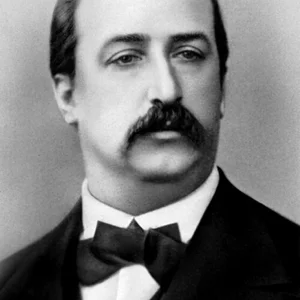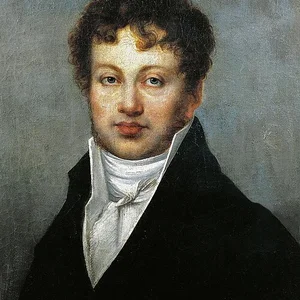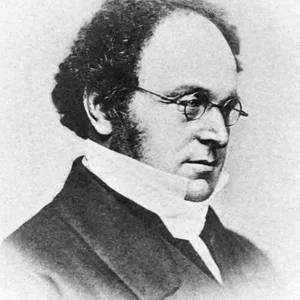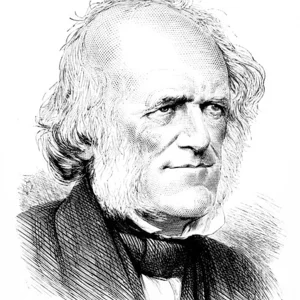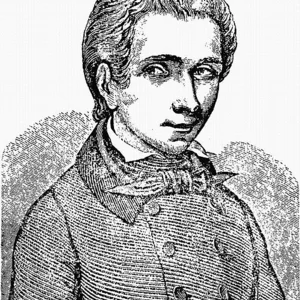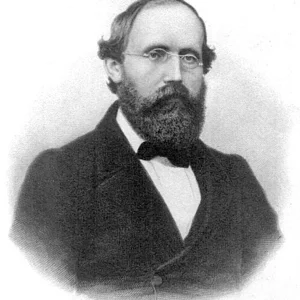

A 19th-century German mathematician, Riemann revolutionized geometry by developing Riemannian geometry, the mathematical foundation of Einstein's general relativity. His work on complex functions and the Riemann hypothesis remains among the most influential in modern mathematics.
Bernhard Riemann(1826 — 1866)
Bernhard Riemann
royaume de Hanovre
8 min read
Frequently asked questions
Key Facts
- 1826: born in Breselenz, Kingdom of Hanover
- 1851: doctoral thesis on functions of a complex variable, supervised by Gauss
- 1854: inaugural lecture founding Riemannian geometry (Über die Hypothesen, welche der Geometrie zu Grunde liegen)
- 1859: publication of the Riemann hypothesis on the distribution of prime numbers, still unsolved
- 1866: premature death at age 39 in Selasca, Italy
Works & Achievements
A foundational thesis that introduces Riemann surfaces and lays the groundwork for modern complex analysis. Gauss judged it to be of exceptional originality — a rare compliment coming from him.
A memoir that defines the Riemann integral, a central concept in mathematical analysis still taught today in every university curriculum around the world.
The founding text of Riemannian geometry, which generalizes Euclidean space to curved spaces of arbitrary dimension. Einstein would draw on it sixty years later to formalize the theory of general relativity.
A major memoir on Abelian functions and Riemann surfaces that unifies geometry and complex analysis, opening the way to modern topology.
A paper of just eight pages, yet one that introduces the Riemann zeta function and formulates the famous Riemann hypothesis — one of the most important unsolved problems in contemporary mathematics.
Publication by Dedekind and Weber of Riemann's complete works following his death. This edition revealed the full extent of his discoveries to the international mathematical community and secured his lasting legacy.
Anecdotes
In 1854, Gauss had to choose from three topics proposed by Riemann for his habilitation lecture. He deliberately chose the one on the foundations of geometry — the least prepared, according to Riemann himself — sensing that his student would produce something extraordinary. This lecture, in which Riemann laid the foundations of n-dimensional geometry, is today considered one of the most important in the entire history of mathematics.
Riemann suffered from debilitating shyness and fragile health from childhood. When he had to deliver his inaugural lecture before the faculty at Göttingen, he worked for several weeks in a row in a state of intense anxiety, barely sleeping. Gauss, usually sparing with compliments, left the room visibly moved and told his colleagues he had just heard ideas of breathtaking originality.
In 1859, Riemann published an eight-page paper on the distribution of prime numbers that contained, almost in passing, a conjecture about the zeros of a mathematical function. This 'Riemann hypothesis' is today one of the most famous unsolved problems in mathematics: despite more than 166 years of attempts and the promise of a one-million-dollar prize, no one has yet managed to prove it.
Gravely ill with tuberculosis, Riemann traveled to Italy several times in an attempt to recover in a milder climate. It was on the shore of Lake Maggiore, in the village of Selasca, that he died in July 1866, at only 39 years old, holding his wife's hand beneath a fig tree. There was still bread, wine, and meat on the table: he had slipped away peacefully in the middle of a meal.
The geometry invented by Riemann — in which space can be curved and take on shapes impossible to visualize in three dimensions — struck his contemporaries as a purely speculative abstraction with no practical application whatsoever. Sixty years later, Albert Einstein discovered that this geometry described exactly the structure of real spacetime: general relativity could not have existed without Riemann's work.
Primary Sources
Die Fragen über das Ausgedehnte sind von einem dreigeteilten Standpunkte zu erörtern. [...] Es wird daher entweder das wirkliche Ausgedehnte eine discrete Mannigfaltigkeit bilden, oder der Grund der Maassverhältnisse außerhalb, in darauf wirkenden bindenden Kräften, gesucht werden müssen.
Ich glaube, daß alle Wurzeln reell sind. Hierzu wäre allerdings ein strenger Beweis zu wünschen; ich habe indess die Aufsuchung desselben nach einigen flüchtigen vergeblichen Versuchen vorläufig bei Seite gelassen.
Eine veränderliche complexe Größe w heißt eine Function einer anderen veränderlichen complexen Größe z, wenn sie mit ihr so sich ändert, daß der Werth des Differentialquotienten dw/dz unabhängig von dem Werthe des Differentials dz ist.
Die vorliegende Abhandlung behandelt zunächst den Begriff des bestimmten Integrals und den Umfang seiner Gültigkeit, ehe sie zur eigentlichen Untersuchung über trigonometrische Reihen übergeht.
I am convinced that my work on geometry will find its use one day, even if that day has not yet come. I live only for mathematics and for your love, dear father.
Key Places
A small village in the Kingdom of Hanover where Riemann was born on September 17, 1826. His father served there as a Lutheran pastor, an upbringing that left a lasting mark on his sense of moral rigor and his relationship with truth.
The center of Riemann's scientific life: he studied there under Gauss, defended his doctoral thesis there, delivered his groundbreaking 1854 lecture there, and taught there until the end of his life. Göttingen was at the time the world's foremost center of mathematics.
Riemann studied there from 1847 to 1849, working alongside Dirichlet and Jacobi, two of the greatest mathematicians of the era. This Berlin period deepened his mastery of analysis and complex functions.
It was in this peaceful village on the shores of Lake Maggiore that Riemann died on July 20, 1866, carried off by tuberculosis at the age of 39. He had sought out the mild climate there for his health during his final months.
Riemann made several extended stays in Italy between 1862 and 1866 to seek treatment for his tuberculosis. There he met Italian mathematicians such as Betti and Casorati, helping to spread his ideas throughout the peninsula.
Typical Objects

The universal writing instrument of 19th-century scholars. Riemann composed his proofs and letters with a pen, filling notebooks with dense calculations that his contemporaries sometimes struggled to decipher.

The central tool of university teaching in Göttingen. Riemann used it to illustrate his lectures, drawing curves and surfaces to help his students visualize abstract geometric concepts.

A landmark reference work that Riemann reportedly studied in his teens — in just six days — demonstrating his precocious command of advanced mathematics. The book exemplifies the influence of mathematical physics on his education.

19th-century geometers used maps and globes to reason about the properties of curved surfaces. Riemann drew on these representations to develop his concept of a manifold with variable curvature.

Riemann was also deeply interested in theoretical physics and electromagnetism. He made use of the measurement instruments in the Göttingen laboratory to inform his thinking about the nature of physical space.

Letters were the primary channel of scientific communication in the 19th century. Riemann kept up a regular correspondence with his father (a pastor) and with mathematicians such as Dirichlet and Dedekind.
School Curriculum
Vocabulary & Tags
Key Vocabulary
Daily Life
Morning
Riemann rose early, as befitted the son of a Lutheran pastor accustomed to discipline. He began his day with some reading or a short walk around Göttingen, then settled at his desk to work on mathematics before his lectures, in the quiet that suited concentrated thought. His fragile health often forced him to pace himself from the very start of the morning.
Afternoon
The afternoon was devoted to university teaching: Riemann gave his lectures in the halls of the University of Göttingen, before audiences that were often small, since his courses had a reputation for difficulty. He would then spend time revising his notes or corresponding with fellow mathematicians in Berlin or Italy, filling pages with formulas and proofs.
Evening
In the evening, Riemann spent time with family or close friends such as Richard Dedekind. He read natural philosophy and works on physics, since his mathematical research was deeply informed by questions about the true nature of space and matter. He retired early, his state of health demanding regular rest.
Food
Like most German professors of modest means in the nineteenth century, Riemann ate simply: rye bread, potatoes, seasonal vegetables, cured meats, and occasionally boiled beef. During his stays in Italy, he came to appreciate the lighter Mediterranean cuisine, which seemed to suit him better given his pulmonary illness.
Clothing
Riemann wore the standard dress of middle-class German academics of the mid-nineteenth century: a dark buttoned frock coat, waistcoat, a cravat knotted beneath a stiff white collar, and a top hat for formal occasions. His appearance was sober and neat, reflecting his Protestant upbringing and his desire to carry himself with dignity despite long years of limited means.
Housing
In Göttingen, Riemann lived in modest university lodgings close to the campus. As a pastor's son, he had grown up in a plain parsonage and retained habits of austerity throughout his life. After his marriage in 1862, he shared an apartment with his wife Elise and their family. In Italy, he stayed in boarding houses or rented villas by the lakes, seeking the fresh air that benefited his health.
Historical Timeline
Period Vocabulary
Liens externes & ressources
Références
Œuvres
Grundlagen für eine allgemeine Theorie der Funktionen (Thèse de doctorat)
1851
Über die Darstellbarkeit einer Function durch eine trigonometrische Reihe
1854
Über die Hypothesen, welche der Geometrie zu Grunde liegen (Leçon d'habilitation)
1854
Theorie der Abel'schen Functionen
1857
Über die Anzahl der Primzahlen unter einer gegebenen Größe
1859
Gesammelte mathematische Werke (Œuvres complètes)
1867 (posthume)