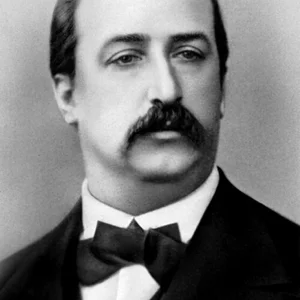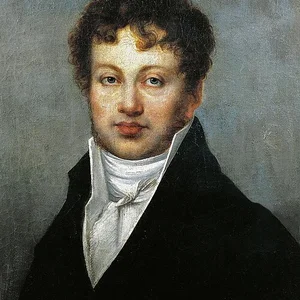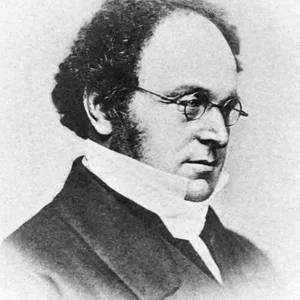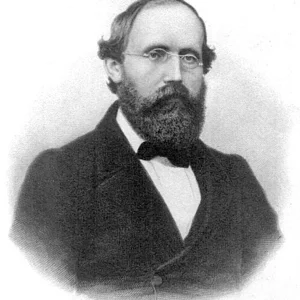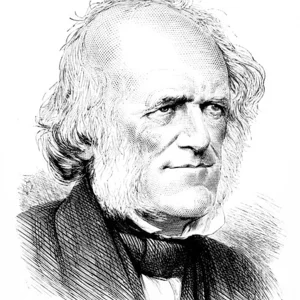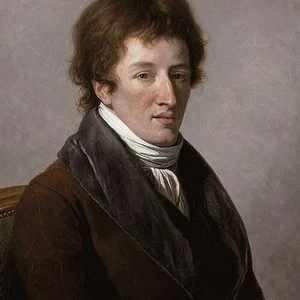

French naturalist and anatomist (1769–1832), Georges Cuvier is the founder of paleontology and comparative anatomy. He established the catastrophism theory to explain species extinctions and classified the animal kingdom into four phyla.
Georges Cuvier(1769 — 1832)
Georges Cuvier
France
9 min read
Frequently asked questions
Famous Quotes
« Geology is a science whose object is to discover the ancient state of the globe.»
« Genius is long patience.»
Key Facts
- 1769: Born in Montbéliard
- 1795: Appointed professor at the Muséum national d'Histoire naturelle in Paris
- 1796: Demonstrates the extinction of species by studying fossils of elephants and mammoths
- 1812: Publication of Researches on Fossil Bones, foundational work in paleontology
- 1817: Publication of The Animal Kingdom Arranged According to Its Organization, classifying animals into four phyla
Works & Achievements
Cuvier's first major work, it demonstrates that the mammoth is an extinct species distinct from the living elephant. This work scientifically establishes the concept of extinction and launches the paleontology of mammals.
A sweeping five-volume synthesis that lays the foundations of modern comparative anatomy. In it, Cuvier establishes his laws of the correlation of forms and the subordination of characters, making it possible to deduce the whole of an organism from a single fragment.
A landmark multi-volume work that reconstructs dozens of extinct species from bone fragments. In it, Cuvier develops his theory of the revolutions of the globe to explain the successive extinctions recorded in the fossil record.
A complete classification of the animal world into four branches (Vertebrates, Mollusks, Articulates, Radiates), which overhauled Linnaeus's linear classification and remains a cornerstone reference of modern zoology.
A work of popular science presenting the catastrophist theory: the Earth has undergone successive upheavals that wiped out entire faunas. Widely read across educated Europe, it had a lasting influence on geology and paleontology.
A course delivered at the Collège de France and published after his death, tracing the history of the life sciences from Antiquity. It bears witness to Cuvier's encyclopedic erudition and his awareness of placing his work within a long intellectual tradition.
Anecdotes
Cuvier possessed an extraordinary analytical ability he called the “correlation of parts”: he claimed he could reconstruct the complete anatomy of an unknown animal from a single bone. His students would sometimes put him to the test by presenting him with a mystery bone fragment — he was rarely wrong, and this astonishing aptitude forged his reputation throughout learned Europe.
In 1830, a great scientific quarrel publicly pitted Cuvier against his colleague Étienne Geoffroy Saint-Hilaire before the Académie des sciences in Paris: one defended the irreducible diversity of animal forms, the other the unity of the organizational blueprint. Goethe, then 80 years old, was so shaken by this controversy that he reportedly told his secretary: “Everything is ablaze!” — referring to the scientific debate rather than the July Revolution that had just broken out.
In 1796, the young Cuvier presented a landmark paper to the Institut national: through meticulous comparison of teeth and bones, he demonstrated that the woolly mammoth was not an elephant living in cold regions, but a species gone forever. This was one of the first rigorous scientific proofs that a species could go extinct — a profoundly revolutionary idea at the time.
Cuvier climbed the social ladder as swiftly as he did the scientific one: appointed Councillor of State by Napoleon, ennobled by Louis XVIII, then elevated to the peerage by Louis-Philippe, he was one of the rare scholars to pass unscathed through the Revolution, the Empire, and the Restoration. His Parisian salon at the Jardin des Plantes was frequented by the greatest minds of the age.
While studying the skull of the Mosasaurus of Maastricht — an immense fossil reptile whose remains had been seized by French armies during the occupation of the Netherlands — Cuvier identified an extinct giant marine lizard and thus helped found the paleontology of reptiles. The creature, nicknamed the “great animal of Maastricht,” had fascinated all of learned Europe since its discovery in 1770.
Primary Sources
It is therefore proven that the Siberian mammoth does not constitute the same species as the Indian elephant, and that it forms a lost species whose representatives we no longer find upon the face of the earth.
Every organized being forms a whole, a unique and closed system, whose parts all correspond to one another and concur toward the same final action through a reciprocal interaction. None of these parts can change without the others changing as well.
I endeavored, by a path hitherto little trodden, to work back from effect to cause, and to reconstruct these ancient monuments of nature with the help of a small number of remains.
We distinguish four principal forms, four general plans according to which all animals appear to have been modeled: the Vertebrates, the Mollusks, the Articulates, and the Radiates.
Life has therefore been often disturbed on this earth by terrible events. Countless living beings have been victims of these catastrophes; some, inhabitants of dry land, were swallowed up by floods.
Key Places
Cuvier's birthplace, a Protestant enclave under the rule of the Duchy of Württemberg. His rigorous Lutheran upbringing and access to the family library nurtured an early passion for the natural sciences.
Cuvier studied here from 1784 to 1788, receiving a broad education in science, languages, and administration. It was here that he discovered Linnaeus and laid the foundations of his lifelong passion for natural classification.
From 1788 to 1795, Cuvier worked as a tutor for a Norman noble family. Far from the upheaval of the Revolution in Paris, he conducted his first dissections and observations of local wildlife, all while actively corresponding with naturalists in the capital.
The center of Cuvier's scientific life from 1795 onward. He served there as professor of comparative anatomy and administrator, assembling the largest collection of zoological specimens in Europe — the foundation of all his research and teaching.
Cuvier held the chair of natural history of organized bodies here, delivering free public lectures that drew students, scholars, and curious minds from across Europe, cementing his international reputation.
It was in this amphitheater that the famous 1830 debate between Cuvier and Geoffroy Saint-Hilaire unfolded — one of the great public scientific controversies of the 19th century, followed with keen interest by intellectuals across Europe.
Typical Objects

Cuvier dissected hundreds of animals to compare their internal structures. His scalpels, forceps, and polished metal probes were his everyday tools for revealing the hidden organization of bodies and establishing his anatomical laws.

Cuvier collected fossil bone fragments sent from across Europe and had plaster casts made to preserve and share the most valuable specimens. These pieces formed the primary material of the nascent science of paleontology.

The Museum's collections housed thousands of animals preserved in alcohol jars. Cuvier drew on them constantly for his anatomical comparisons, building what was the largest zoological collection in Europe.

His major publications were accompanied by engraved plates depicting bones, skulls, and reconstructed skeletons with meticulous precision. These illustrations, produced by specialist artists, were essential for spreading his discoveries across Europe.

Cuvier meticulously recorded his observations in notebooks: measurements, sketches, and comparative notes. He also maintained a prodigious correspondence with naturalists in London, Vienna, and Saint Petersburg, who sent him specimens and information.

Cuvier worked primarily with a magnifying glass for macroscopic anatomy, but the compound microscope was beginning to establish itself in the naturalist laboratories of his era. These optical instruments allowed him to observe structural details invisible to the naked eye.
School Curriculum
Vocabulary & Tags
Key Vocabulary
Daily Life
Morning
Cuvier rose early and began his day by reading scientific correspondence from across Europe — he maintained a prodigious exchange of letters with naturalists in London, Vienna, and Saint Petersburg. He would then make his way to the Muséum national d'Histoire naturelle to oversee the collections and carry out his morning dissections, often surrounded by assistants and students.
Afternoon
Afternoons were devoted to writing memoirs, preparing his lectures at the Collège de France, and attending administrative meetings — for Cuvier was also a senior civil servant involved in the reorganization of public education under Napoleon and then the Restoration. He regularly took part in the weekly sessions of the Académie des sciences.
Evening
His evenings in his apartment at the Muséum were often occasions for learned socializing: he received philosophers, politicians, and scientists in a salon renowned for the quality of its intellectual exchange. His personal library, one of the finest in Paris, allowed him to work late into the night on his manuscripts.
Food
Like the prosperous bourgeoisie of the early nineteenth century, Cuvier ate heartily: roasted meats, broths, seasonal vegetables, and wines from Burgundy or Bordeaux. Meals were important social occasions, well suited to intellectual discussion with his many guests.
Clothing
Cuvier wore the austere yet distinguished dress of the enlightened bourgeoisie: a black coat with a high collar, waistcoat, carefully tied white cravat, and top hat for official outings and academic sessions. In his laboratory he put on a protective smock for dissections to keep his clothes clean.
Housing
Cuvier lived in a spacious apartment within the grounds of the Muséum national d'Histoire naturelle, in the Jardin des Plantes in Paris. This official residence, surrounded by zoological and botanical collections, was also his workplace: he had fitted it out with a study-library whose shelves were lined with scientific works from around the world.
Historical Timeline
Period Vocabulary
Liens externes & ressources
Références
Œuvres
Mémoire sur les espèces d'éléphants tant vivants que fossiles
1796
Leçons d'anatomie comparée
1800-1805
Recherches sur les ossements fossiles de quadrupèdes
1812
Le Règne Animal distribué d'après son organisation
1817
Discours sur les révolutions de la surface du globe
1825
Histoire des sciences naturelles depuis leur origine (cours posthume)
1841