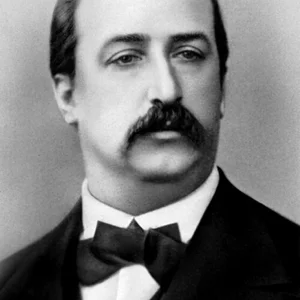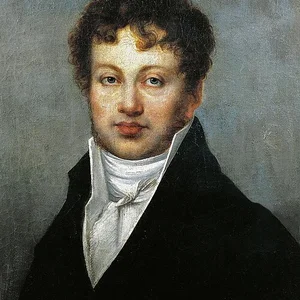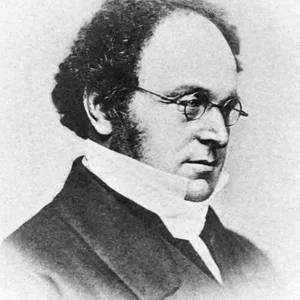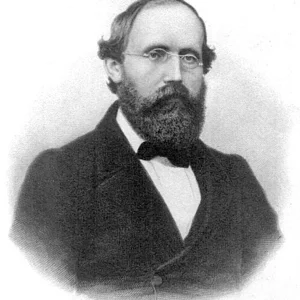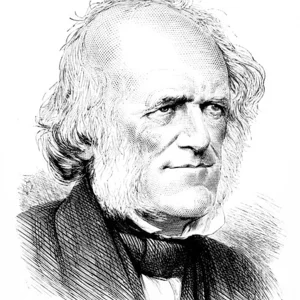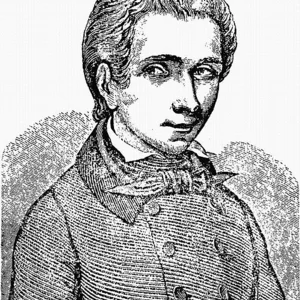

French mathematician (1811–1832), a precocious genius who died in a duel at the age of 20. He founded group theory and proved the impossibility of solving by radicals equations of degree higher than 4.
Évariste Galois(1811 — 1832)
Évariste Galois
France
9 min read
Frequently asked questions
Famous Quotes
« I have no time.»
« I have done several new things in analysis.»
Key Facts
- Born on October 25, 1811, in Bourg-la-Reine
- Rejected twice from the École polytechnique
- Wrote his foundational works the night before his duel (1832)
- Died on May 31, 1832, at age 20, from wounds sustained in a duel
- His work on groups, published posthumously, laid the foundations of modern algebra
Works & Achievements
The first article published by Galois in the Bulletin de Férussac. In it he introduces the concept of finite fields (now called Galois fields), a fundamental advance in modern algebra used in cryptography and coding theory.
An article published in the Bulletin de Férussac in which Galois sets out, for the first time in print, his theory of the conditions for the solvability of equations, laying the groundwork for what would become Galois theory.
Galois's masterpiece, in which he proves that a polynomial equation is solvable by radicals if and only if its symmetry group is solvable. This memoir simultaneously founded group theory and Galois theory.
Written the night before his fatal duel, this letter summarizes the entirety of Galois's discoveries and opens up mathematical avenues that nineteenth-century researchers took decades to fully explore and formalize.
Anecdotes
The night before his duel, on May 29, 1832, Galois spent hours writing a long letter to his friend Auguste Chevalier to summarize his mathematical discoveries, aware that he might die the next day. In the margins of his calculations, he noted several times: “I have not time.” This letter would become his scientific testament, one of the most important documents in the history of mathematics.
Galois dreamed of entering the École Polytechnique, the great scientific school of his era, but he failed the entrance exam twice, in 1828 and again in 1829. During the second attempt, exasperated by an examiner who could not follow his reasoning, he reportedly hurled a blackboard eraser at the man’s face. He refused to spell out steps that seemed obvious to him, and it cost him his admission.
Galois submitted his revolutionary work to the Paris Academy of Sciences on several occasions, without ever receiving recognition in his lifetime. Augustin-Louis Cauchy lost or ignored his first memoir in 1829. In 1831, Siméon Denis Poisson, after months of review, returned his manuscript as incomprehensible. It was not until 1846, fourteen years after his death, that the mathematician Joseph Liouville finally published his work and publicly acknowledged its genius.
A committed republican and member of the Society of the Friends of the People, Galois was arrested twice for his political activities. In May 1831, at a republican banquet, he raised a toast deemed threatening toward King Louis-Philippe, knife in hand. Imprisoned at Sainte-Pélagie prison, he nonetheless continued to work on his mathematics in his cell.
On the morning of May 30, 1832, Galois was shot during the duel and left alone, dying, on the field. A passerby found him and had him taken to the Cochin hospital, where his brother Alfred and his friend Chevalier joined him. He died the following day, May 31, 1832, at only 20 years old. According to his brother, his last words were: “Don’t cry, I need all my courage to die at twenty.”
Primary Sources
You will publicly ask Jacobi or Gauss to give their opinion, not on the truth, but on the importance of the theorems. After that, there will be, I hope, people who will find it to their advantage to decipher all this mess.
Every function of the roots of an equation has the property of remaining invariant under the substitutions of the group of the equation; this is the fundamental principle of the theory.
We propose here to determine in which cases a primitive equation is solvable by radicals, and to indicate the procedure to follow in all solvable cases.
We have made every effort to understand the proof by M. Galois. His reasoning is neither clear enough nor sufficiently developed for us to have been able to judge its correctness.
Key Places
Birthplace of Évariste Galois, on 25 October 1811. His father Nicolas-Gabriel Galois served as the town's mayor. A street and a secondary school in this commune of Val-de-Marne now bear the mathematician's name.
Galois entered as a boarding student in 1823 and spent six formative years there. It was here that he discovered his passion for mathematics, read Legendre and Lagrange, and began developing his revolutionary theories during supervised study sessions.
Galois was admitted in 1829 with the top entrance rank, but was expelled in January 1831 for publicly criticising the policies of director Guigniault during the events of the July Revolution.
Galois was imprisoned here twice for his republican activities in 1831–1832. He continued working on his mathematics from his cell in this penitentiary in the 5th arrondissement, since demolished.
It was here that Galois was brought, dying, after his duel on 30 May 1832. He died the following day, surrounded by his brother Alfred and his friend Auguste Chevalier, to whom he entrusted his final words.
The learned institution to which Galois repeatedly submitted his revolutionary memoirs, without success. Cauchy, and later Poisson, examined his work there without recognising its significance. His manuscripts were lost or rejected during his lifetime.
Typical Objects

Galois tirelessly wrote down his theories in notebooks and on loose sheets of paper. His farewell letter, written the night before his duel, reveals the urgency with which he sought to commit his discoveries to paper, filling the margins with the annotation "I don't have time."

The weapon used in the duel of May 30, 1832, which mortally wounded Galois in the abdomen. The pistol duel was still a widespread practice in the 19th century for settling matters of honor between men, despite being legally prohibited.

A symbol of republicans and revolutionaries, the tricolor cockade was worn by Galois at political demonstrations and gatherings. It signified allegiance to the ideals of the French Revolution and served as an open act of defiance toward the monarchy.

Galois read and drew inspiration from the republican press, such as *Le National* and *La Tribune*, which spread ideas opposing the July Monarchy. This reading fueled his political commitment within the Society of the Friends of the People.

It was by reading Adrien-Marie Legendre's *Éléments de géométrie* at the age of 15 that Galois revealed his genius, absorbing in just a few days a work his classmates took two years to study. This book was the spark that ignited his passion for mathematics.

Traditional instruments of the geometer, symbolizing classical mathematical constructions since Antiquity. Galois's work made it possible to prove the impossibility of certain constructions, such as the trisection of the angle, thereby settling questions that had been open for two millennia.
School Curriculum
Vocabulary & Tags
Key Vocabulary
Daily Life
Morning
During his years at Collège Louis-le-Grand, Galois rose early in the shared dormitory, attended mandatory morning exercises, and then moved on to the first study periods of the day. From the age of 15, he spent this time reading advanced mathematical treatises — by Legendre or Lagrange — rather than his school textbooks.
Afternoon
Afternoons alternated between classes, recitations, and supervised study. Galois was frequently punished for insolence toward his teachers, which left him time he used to fill pages with algebraic calculations. His teachers found him of extraordinary genius but resistant to any ordinary form of discipline.
Evening
From 1830 onward, his evenings were often taken up with meetings of the Société des Amis du Peuple or other republican circles, where he debated politics and mixed with activists. When that was not the case, he spent his nights writing and rewriting his mathematical theories, aware that his papers were going unrecognized.
Food
Like all boarders at Louis-le-Grand, Galois ate in the school canteen: soup, bread, vegetables, and boiled meat on ordinary days — simple, monotonous meals. After his father's death in 1829, his precarious financial situation forced him into a frugal diet, especially during his spells in prison.
Clothing
At Louis-le-Grand, students wore a dark coat and white collar, the uniform of bourgeois respectability. During his republican activities, Galois sported the tricolor cockade and sometimes the National Guard uniform, which earned him one of his arrests in July 1831.
Housing
Galois first lived as a boarder at Collège Louis-le-Grand (1823–1829), in a dormitory governed by strict collective discipline. After his expulsion from the ENS, he lodged at a boarding house run by a Monsieur Faultrier on the rue de la Glacière, before enduring two incarcerations at Sainte-Pélagie. He never had a stable or comfortable home.
Historical Timeline
Period Vocabulary
Liens externes & ressources
Références
Œuvres
Sur la théorie des nombres
Juin 1830
Analyse d'un mémoire sur la résolution algébrique des équations
Juin 1830
Mémoire sur les conditions de résolubilité des équations par radicaux
Soumis en 1831, publié en 1846
Lettre-testament à Auguste Chevalier
29 mai 1832