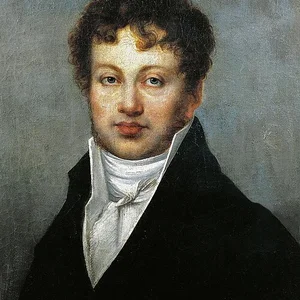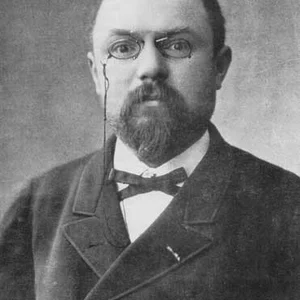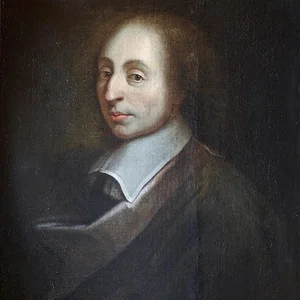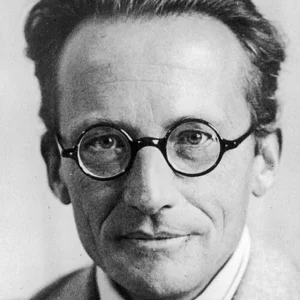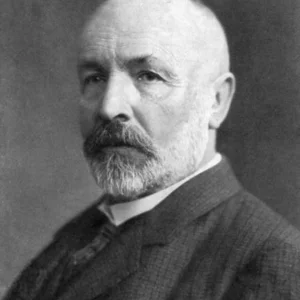

German mathematician (1845–1918), founder of set theory. He proved the existence of multiple sizes of infinity and introduced transfinite numbers, revolutionizing the foundations of mathematics.
Georg Cantor(1845 — 1918)
Georg Cantor
Empire allemand, Reich allemand
8 min read
Frequently asked questions
Famous Quotes
« The essence of mathematics lies in its freedom.»
« I see it, but I don't believe it.»
Key Facts
- 1845: Born in Saint Petersburg
- 1874: Publication of the founding paper of set theory
- 1878: Proof that countable infinity and the continuum are of different sizes
- 1883: Introduction of transfinite numbers and the arithmetic of infinities
- 1918: Death in Halle, following repeated hospitalizations due to depression
Works & Achievements
The founding article of set theory: Cantor proves that the real numbers cannot be put into a one-to-one correspondence with the natural integers, establishing the existence of different sizes of infinity.
A series of articles progressively developing set theory, introducing transfinite ordinal numbers and the concepts of cardinality — forming the core of Cantor's life's work.
A systematic and philosophically argued exposition of set theory and transfinite numbers; Cantor makes the case that actual infinity is mathematically legitimate, pushing back against the Aristotelian tradition.
An elegant and general proof that the power set of any set always has strictly greater cardinality than the set itself, implying an infinite hierarchy of sizes of infinity.
A definitive two-part synthesis of set theory, presenting transfinite cardinal and ordinal numbers within their complete arithmetical framework; translated into several languages and widely disseminated internationally.
Anecdotes
Georg Cantor demonstrated in 1874 that there are multiple sizes of infinity, a result so unsettling that even his fellow mathematicians refused to believe it. To prove that real numbers are “more numerous” than integers, he invented the diagonal argument: an elegant method consisting of constructing a real number that differs from every other number in at least one decimal place, thereby proving that no list can contain them all.
The mathematician Leopold Kronecker, a dominant figure of the era, waged a relentless campaign against Cantor, calling him a “corrupter of youth” and declaring that “God made the integers, all else is the work of man.” This repeated hostility greatly contributed to the severe depressions Cantor suffered throughout his life, forcing him to spend time in sanatoria on several occasions.
Cantor maintained a fascinating correspondence with Catholic theologians, notably with Cardinal Johannes Frantz. He feared that his theory of infinity might contradict Christian theology. Pope Leo XIII indirectly reassured him through intermediary cardinals: Cantor’s mathematical infinities did not encroach upon God’s absolute Infinity, which remained unique and transcendent.
In 1891, Cantor published his famous “diagonal argument” in generalized form, proving that the power set of any set is always strictly larger than the set itself. This proof, of bewildering simplicity, implies that there exists an infinite hierarchy of infinities, each greater than the last — a dizzying idea that David Hilbert described as “a paradise from which no one shall expel us.”
Cantor died on January 6, 1918, in the Halle sanatorium where he had spent his final years, suffering from malnutrition caused by the food shortages of the First World War. He had never managed to prove his continuum hypothesis — the question remained open until 1963, when Paul Cohen proved it was undecidable within the standard axioms of mathematics.
Primary Sources
I will now show that the multiplicity of all real algebraic numbers can be put into one-to-one correspondence with the multiplicity of all positive natural integers. [...] By contrast, the multiplicity of all real numbers cannot be put into correspondence in this way with that of the integers.
By the 'power' or 'cardinal number' of a set M, I mean the general concept which, by abstraction, results from M when one abstracts from the nature of its various elements and from the order in which they are given.
We call a 'set' any collection M into a whole of definite and well-distinguished objects m of our intuition or thought. These objects are called the 'elements' of M.
Here is a question that has interested me for some time and which I cannot answer; perhaps you can, and would be so kind as to write me your opinion: Can a surface (for example a square including its boundary) be put into one-to-one correspondence with a line (for example a line segment including its endpoints)?
The transfinite numbers ω, ω+1, ω+2, … , 2ω, … are not mere symbols, but well-defined mathematical concepts, as legitimate as finite whole numbers, and subject to precise arithmetical laws.
Key Places
Georg Cantor's birthplace, born on **March 3, 1845**. His family moved to Germany in **1856** for health reasons, but Cantor retained a quiet pride in his Russian origins throughout his life.
Cantor studied here from **1863** to **1867**, attending lectures by **Weierstrass** and **Kronecker**. He earned his doctorate with a thesis in number theory and built the rigorous mathematical foundations that would define his later work.
The site of Cantor's entire academic career, from **1869** until his death. It was here that he developed his complete theory of sets, despite his lasting frustration at never securing a chair in Berlin.
The sanatorium where Cantor was admitted on several occasions from **1884** onward, suffering from severe depression. He died there on **January 6, 1918**, following a final stay that had begun in **1917**.
The leading mathematical center in Europe at the time, where **David Hilbert** — one of Cantor's most prominent champions — held his chair. It was in Göttingen that Cantorian ideas were woven into the foundations of modern mathematics.
Typical Objects

Professor Cantor's daily working tool at Halle, on which he developed his demonstrations on infinite sets before his students. It was on this surface that he drew his famous diagonal arguments.

Cantor maintained an extensive correspondence with Richard Dedekind, David Hilbert, and Catholic theologians. These letters constitute an essential primary source for understanding the gradual development of his set theory.

A prestigious scientific journal in which Cantor published his foundational work on sets between 1879 and 1897, giving it international reach despite the reluctance of some editors.

Cantor read medieval theologians, particularly Saint Thomas Aquinas, to philosophically justify the concept of actual infinity. He sought to reconcile his mathematical theory with the Christian tradition.

A common possession among the German bourgeoisie of the late 19th century, a symbol of regulated time and disciplined academic work that Cantor, despite his crises, strove to maintain between hospitalizations.

Cantor was hospitalized numerous times at the Nervenklinik in Halle from 1884 onward. These repeated stays bear witness to the psychological suffering caused by his peers' failure to understand his work and his inability to prove the continuum hypothesis.
School Curriculum
Vocabulary & Tags
Key Vocabulary
Daily Life
Morning
Cantor began his day early, following the habits of nineteenth-century German academics. He prepared his courses at the University of Halle in the morning, reviewed his manuscripts, and wrote letters to his mathematical correspondents, notably Dedekind and Mittag-Leffler.
Afternoon
His afternoons were devoted to teaching at the university and to mathematical work sessions in his office. During his periods of good health, he wrote his articles and filled notebooks with calculations and philosophical reflections on the nature of infinity.
Evening
In the evenings, Cantor returned to his bourgeois home in Halle, where he lived with his wife Vally and their six children. He read philosophy and theological texts, particularly the Church Fathers, seeking to place his theory within a broader intellectual tradition.
Food
Like provincial professors of the German middle class, Cantor ate traditional meals of meat, potatoes, bread, and beer. During World War I, food shortages worsened his already fragile health during his stays at the sanatorium.
Clothing
Cantor dressed as a respectable bourgeois professor: a dark suit with a long jacket, waistcoat, cravat or lavallière, and a stiff white collar. He wore a neat beard and round glasses, in keeping with the image of the Germanic scholar of the Belle Époque.
Housing
Cantor lived in a comfortable professor's house in Halle, reflecting his status as a middle-class academic. He had a well-stocked library, a private study, and a garden. His repeated stays at the sanatorium forced him to temporarily leave this family setting.
Historical Timeline
Period Vocabulary
Liens externes & ressources
Références
Œuvres
Über eine Eigenschaft des Inbegriffes aller reellen algebraischen Zahlen
1874
Über unendliche, lineare Punktmannigfaltigkeiten (6 articles)
1879-1884
Grundlagen einer allgemeinen Mannigfaltigkeitslehre
1883
Argument diagonal (Sur un problème de la théorie des ensembles)
1891
Beiträge zur Begründung der transfiniten Mengenlehre
1895-1897