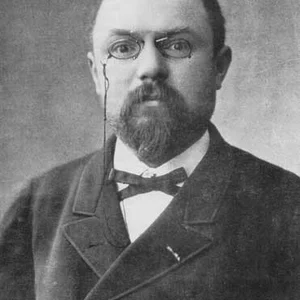

French mathematician, physicist and philosopher (1854-1912), considered the last universal genius of science. He founded algebraic topology, laid the foundations of special relativity, and discovered deterministic chaos.
Henri Poincaré(1854 — 1912)
Henri Poincaré
France
9 min read
Frequently asked questions
Famous Quotes
« Mathematics is the art of giving the same name to different things.»
« Logic is the hygiene of the mathematician, it is not his source of nourishment.»
Key Facts
- 1854: Born in Nancy into a family of the French intellectual elite
- 1881: Discovery of Fuchsian functions, founding hyperbolic geometry
- 1890: Discovery of deterministic chaos while studying the three-body problem
- 1904: Formulation of the Poincaré conjecture (proved by Perelman in 2003)
- 1905: Parallel publications to Einstein on the mathematical foundations of relativity
Works & Achievements
A memoir awarded the prize of King Oscar II of Sweden, in which Poincaré accidentally discovered deterministic chaos: small variations in initial conditions can produce radically different trajectories. This work laid the foundations of modern dynamical systems theory.
The founding memoir of algebraic topology, the branch of mathematics that studies the properties of shapes independently of distances and angles. Poincaré introduces essential topological invariants such as the fundamental group, which remain in use today.
A philosophical essay on the nature of scientific reasoning and the role of conventions in physics and mathematics. Translated into numerous languages, this book profoundly influenced Albert Einstein and European intellectual circles at the turn of the twentieth century.
A continuation of his philosophical reflections on what it means to "know" in science. Poincaré develops the idea that science does not give us access to things in themselves, but only to the relations between phenomena.
A work in which Poincaré describes his own creative process with great precision, giving a central place to intuition and the unconscious in mathematical invention. This text remains a key reference in the psychology of scientific discovery.
A topological conjecture stating that every compact, simply connected three-dimensional manifold is homeomorphic to a sphere. Left unresolved for a century, it was proved by the Russian mathematician Grigori Perelman in 2003, earning Poincaré worldwide posthumous fame.
Papers in which Poincaré reformulates the Lorentz transformations and states the principle of relativity just weeks before Einstein. Although the two scientists arrived at similar results, their conceptual approaches differed profoundly.
Anecdotes
Henri Poincaré was famous for his legendary absent-mindedness. He would sometimes wander through a room with no apparent purpose, or turn around and head back home right after arriving at his office, lost in thought. His colleagues at the Sorbonne would sometimes find him standing motionless in a hallway, staring blankly, mentally working through a complex problem.
In 1889, Poincaré submitted a paper to King Oscar II of Sweden's mathematical competition on the three-body problem. He won the prize, but during proofreading before publication, he discovered a fundamental flaw in his reasoning. In correcting that error, he uncovered an entirely new phenomenon: chaotic trajectories. His correction grew so substantial that it ended up longer than the original paper.
Poincaré worked only in two-hour sessions, morning and evening, convinced that his brain could not function effectively beyond that. He would then let his unconscious mind do the work. In *Science and Method* he describes how the solution to a problem came to him in a flash as he was stepping onto an omnibus, while thinking about something else entirely.
Although he is regarded as the last universal genius of mathematics, Poincaré performed poorly on the spatial visualization tests that psychologists administered to him. He compensated for this weakness with an extraordinary abstract intuition and a near-photographic memory for formulas and logical structures.
In 1904, Poincaré formulated a conjecture about the topology of three-dimensional spheres that would stand as one of the most famous unsolved problems in mathematics for an entire century. It was not until 2003 that Russian mathematician Grigori Perelman provided the proof — then declined both the Fields Medal and the one-million-dollar prize attached to the solution.
Primary Sources
If one tries to picture the shape formed by these two curves and their intersections [...] these intersections form a kind of lattice, a fabric, a network with infinitely tight meshes. One will be struck by the complexity of this figure.
The geometry of position, or Analysis Situs, is a mathematical science whose object is the qualitative study of geometric figures. Its aim is to reveal the mutual positional relationships of the various parts of a figure, independently of their shapes and sizes.
Facts do not speak. It is theories that speak in their place and give them meaning. [...] An experiment can never contradict a theory; it can only oblige us to change our convention.
Thought is only a flash in the midst of a long night. But it is this flash that is everything. [...] Science does not teach us the truth about things in themselves, but only about their relationships.
Invention consists in discriminating, in choosing. It suffices to examine the facts in a little detail to be convinced of this. The scientist must bring order; science is built up of facts as a house is built of stones; but an accumulation of facts is no more a science than a heap of stones is a house.
Key Places
Poincaré's birthplace, where he grew up in a prosperous intellectual family. His father Léon Poincaré was a professor of medicine; the cultivated family atmosphere nurtured his early passion for the sciences.
Poincaré entered as top of his class in 1873 and received an elite scientific education there. He later taught celestial mechanics at the institution, training several generations of French scientists.
Poincaré's principal place of work from 1881 onward, where he held several successive chairs: physical mechanics, mathematical physics, and mathematical astronomy. It was here that he developed the bulk of his life's work.
The institution where Poincaré worked on the international synchronization of clocks and the precise measurement of time. This research led him directly to reflect on the problem of simultaneity, a cornerstone of relativity.
Poincaré's first university post in 1879, where he taught mathematical analysis for two years before being called to Paris. It was at Caen that he published his first major papers on Fuchsian functions.
The burial place of Henri Poincaré, interred here following his death on 17 July 1912. His grave has become a site of remembrance for the global mathematical community.
Typical Objects

Poincaré would think standing in front of a large blackboard, covering the slate with formulas at a remarkable speed. Unlike many mathematicians, he rarely copied things over and made few corrections, reflecting a mind that had already worked everything out before putting chalk to board.

A symbol of time mastered, the pocket watch marked the two-hour work sessions he imposed on himself. It also evokes his interest in the question of simultaneity and the measurement of time, central to his reflections on relativity.

It was in this international journal, founded by Gösta Mittag-Leffler, that Poincaré published his groundbreaking paper on deterministic chaos in 1890. The journal symbolizes the international exchange of mathematical ideas during the Belle Époque.

Poincaré worked for several years at the Bureau des longitudes on the synchronization of clocks via telegraph — a question directly tied to railway networks. Train timetables concretely illustrate his reflections on the convention of time.

Tools of classical geometry that Poincaré transcended by inventing a qualitative geometry of shapes (topology). He used them to illustrate his lectures, but his revolution consisted precisely in freeing himself from exact measurements.

Poincaré would write his articles directly, almost without crossing anything out, as though the final form were already complete in his mind. His notebooks bear witness to a lightning-fast mind in which intuition consistently preceded formal proof.
School Curriculum
Vocabulary & Tags
Key Vocabulary
Daily Life
Morning
Poincaré rose early and devoted a first two-hour session to pure mathematical work, without interruption. He believed his mind was sharpest in the morning and refused to waste that window of peak efficiency on meetings or correspondence. After this session, he would walk or take a carriage to the Sorbonne or the Bureau des Longitudes.
Afternoon
The afternoon was devoted to lectures, seminars, reading scientific publications, and corresponding with European colleagues. He was an active participant in the sessions of the Académie des sciences and responded to the many philosophical and journalistic requests he received.
Evening
A second two-hour work session allowed him to revisit, refine, or develop the intuitions of the morning. In the evenings, he returned to his family — he was the father of four children — in a comfortable Parisian bourgeois setting. He read widely, with an interest in literature and philosophy, and avoided social obligations that ate too heavily into his time.
Food
Poincaré's table was that of a Parisian bourgeois of the *Belle Époque*: structured meals, classic French cuisine with vegetables, meats, and pastries. He made no mention of any particular dietary eccentricities, in contrast to his intellectual habits. Like many scholars of his era, he paid little attention to meals, sometimes drifting into thought at the table.
Clothing
Poincaré wore the standard dress of professors and academicians of the Third Republic: a dark suit, starched white collar, tie, and top hat for official occasions. He wore the Légion d'honneur at ceremonies and academic sessions. His appearance was neat without being vain.
Housing
Poincaré lived in a bourgeois Parisian apartment in the 5th arrondissement, close to the Sorbonne. The apartment was furnished in the classic style of a cultured *Belle Époque* family: a well-stocked library, a piano, and dark wooden furniture. He also owned a country house where he enjoyed retreating during university holidays.
Historical Timeline
Period Vocabulary
Liens externes & ressources
Références
Œuvres
Sur le problème des trois corps et les équations de la dynamique
1890
Analysis Situs
1895
La Science et l'Hypothèse
1902
La Valeur de la Science
1905
Science et Méthode
1908
La conjecture de Poincaré
1904
Travaux sur la relativité restreinte
1905