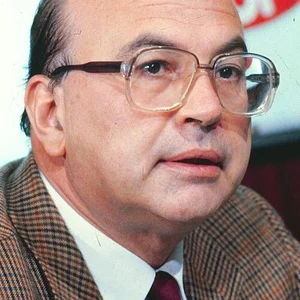

Italian statesman, secretary of the Italian Socialist Party (PSI) and then Prime Minister from 1983 to 1987. A major figure in Italian political life, his career ended in the “Mani pulite” corruption scandal.
Bettino Craxi(1934 — 2000)
Bettino Craxi
Italie, royaume d'Italie
6 min read
Frequently asked questions
Key Facts
- Becomes national secretary of the Italian Socialist Party (PSI) in 1976
- First socialist to become Italian Prime Minister, from 1983 to 1987
- Manages the Sigonella crisis with the United States in 1985 (the hijacking of the Achille Lauro)
- Implicated in the Tangentopoli corruption scandal exposed by the Mani pulite investigation from 1992 onward
- Goes into exile in Hammamet, Tunisia, to escape his convictions and dies there in 2000
Works & Achievements
Craxi modernized and reoriented the PSI, turning it into a central player in government coalitions and clearly setting it apart from the Communist Party.
The first socialist to lead Italy, he headed the longest-serving government of the Republic up to that point, during a period of economic growth.
A historic reform ending Catholicism's status as the state religion and redefining the relationship between Italy and the Church.
A diplomatic assertion of Italian independence from the United States during the standoff at Sigonella.
His government reduced the automatic indexation of wages (the “scala mobile”) to combat inflation, a measure confirmed by referendum in 1985.
A famous address in which he denounced the widespread illegal financing of political parties, defying the entire political establishment.
Anecdotes
In 1985, during the Achille Lauro crisis, Craxi stood up to the United States: an Italian cruise ship was hijacked by Palestinian militants and an American passenger was killed. When American fighter jets forced the hijackers' plane to land at the Italian air base of Sigonella, Craxi refused to hand them over to the United States, triggering a tense standoff between Italian carabinieri and American soldiers on the tarmac.
Craxi wanted the Socialist Party to set itself apart from the communists: he had the traditional hammer and sickle symbol replaced with a red carnation, a flower associated with European social democracy. This change of emblem symbolized his determination to modernize and “de-communize” the Italian left.
Nicknamed “il Cinghialone” (the big wild boar) by his opponents, Craxi was known for his authoritarian character and his imposing stature. In 1993, after the Mani pulite scandal, protesters threw coins in front of his Roman hotel, the Hotel Raphaël, shouting “Bettino, do you want these too?” to denounce corruption.
Rather than face his trials in Italy, Craxi went into exile in 1994 at his villa in Hammamet, Tunisia, where he lived out his final years. Convicted in absentia, he always refused to return, presenting himself as a political victim, and he died there in 2000 without having served his sentences.
In 1984, Craxi negotiated a revision of the 1929 Concordat with the Vatican: the agreement ended the status of Catholicism as the state religion in Italy, a major reform championed by this socialist and secular head of government.
Primary Sources
Let anyone in this assembly who has never received irregular or illegal funding for their party rise to their feet. A large part of political funding is irregular or illegal.
The principle of the Catholic religion as the sole religion of the Italian State, originally affirmed by the Lateran Pacts, is considered to be no longer in force.
I am not a fugitive, I am an exile. They wanted to make me the scapegoat for a system that everyone knew about and that many took part in.
Key Places
Craxi's birthplace and the cradle of his political rise. It was also here that the Mani pulite investigation began, the inquiry that brought about his downfall.
Seat of the Italian Prime Minister's office, where Craxi governed from 1983 to 1987. The center of the Republic's executive power.
Craxi's Roman residence, the site in 1993 of the famous scene in which protesters pelted him with coins. A symbol of his public disgrace.
Site of the 1985 standoff between Italian carabinieri and American soldiers during the Achille Lauro crisis. An assertion of Italian sovereignty.
Tunisian seaside resort where Craxi lived in exile from 1994 to 2000. He died there without ever returning to face Italian justice.
Typical Objects

Floral emblem adopted by the Italian Socialist Party under Craxi to replace the hammer and sickle. It symbolized the party's social-democratic roots and its distancing from communism.

Currency thrown by protesters outside the Roman hotel where Craxi was staying in 1993. A gesture of protest that became a symbol of popular defiance toward corruption.

Agreement signed in 1984 between the Italian State and the Holy See, amending the 1929 Lateran Pacts. A legal document that ended Catholicism's status as the state religion.

Instruments of Craxi's great speeches in the Chamber of Deputies, notably his self-defense in 1992. Symbols of the political eloquence of the First Republic.

Voluminous judicial files from the anti-corruption inquiry led by the pool of Milanese magistrates. They exposed the system of covert party financing.

Tunisian residence where Craxi lived in exile from 1994 until his death. A place that became an emblem of his flight from Italian justice.
School Curriculum
Vocabulary & Tags
Key Vocabulary
Daily Life
Morning
As head of government, Craxi began his days by reading the Italian and international press, of which he was an avid consumer. His mornings were structured around meetings at the Palazzo Chigi and cabinet councils.
Afternoon
His afternoons combined audiences, negotiations with coalition partners (notably the Christian Democrats) and the preparation of parliamentary files. A man of power, he devoted a great deal of time to building and maintaining networks of alliances.
Evening
His evenings were often spent at political dinners or receptions, where the compromises of Italian public life were forged. During his Tunisian exile, by contrast, his evenings became solitary ones, dedicated to writing and correspondence.
Food
Craxi enjoyed traditional Italian cuisine, and his stoutness earned him the mocking nickname of the “fat wild boar.” In Tunisia, his declining health (diabetes) forced him onto a more closely monitored diet.
Clothing
He wore the dark suits and classic ties of the statesmen of his time, cultivating an image of authority and respectability. His imposing stature reinforced his physical presence on the political stage.
Housing
In Rome, he notably stayed at the Hotel Raphaël, near the parliament. From 1994 onward, his villa in Hammamet, Tunisia, became his place of exile until his death.
Historical Timeline
Period Vocabulary
Liens externes & ressources
Références
Œuvres
Direction du Parti socialiste italien
1976-1993
Présidence du Conseil des ministres
1983-1987
Révision du Concordat avec le Vatican
1984
Gestion de la crise de l'Achille Lauro
1985
Lutte contre l'inflation (échelle mobile des salaires)
1984-1985
Discours d'autodéfense devant la Chambre
1992