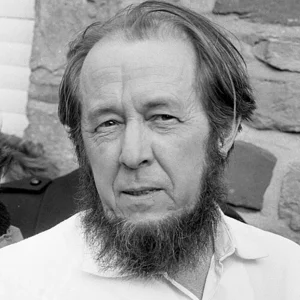

Russian writer and dissident, a former Gulag prisoner. His work denounces the Soviet prison-camp system and totalitarianism. Winner of the 1970 Nobel Prize in Literature, he was expelled from the USSR in 1974 before returning in 1994.
Aleksandr Solzhenitsyn(1918 — 2008)
Aleksandr Solzhenitsyn
Russie, Union soviétique, apatride, Russie soviétique
7 min read
Frequently asked questions
Famous Quotes
« The line dividing good and evil cuts through the heart of every human being.»
« A great literature is the second memory of a nation.»
Key Facts
- Arrested in 1945 and sent to the Gulag for eight years for criticizing Stalin in a letter
- Published *One Day in the Life of Ivan Denisovich* in 1962 with Khrushchev's approval
- Received the Nobel Prize in Literature in 1970
- *The Gulag Archipelago* was published in the West in 1973, followed by his expulsion from the USSR in 1974
- Returned to Russia in 1994 after the collapse of the USSR; died in 2008
Works & Achievements
An account of an ordinary day in the life of a prisoner in a labor camp; the first text about the Gulag officially published in the USSR, it landed like an earthquake.
A short story portraying the wretched life of a Russian peasant woman, a tribute to the simple goodness of the humble.
A novel inspired by the “sharashka,” a prison-laboratory where imprisoned scientists worked for the State. First published abroad.
A novel inspired by his own illness, in which the hospital becomes an image of an ailing Soviet society.
A plea for the power of literature and truth against violence and lies.
A vast literary and historical investigation into the Soviet camps, built from hundreds of testimonies. His most famous work.
A brief moral appeal urging everyone to refuse to take part in the official lie, published on the day of his arrest.
An immense novelistic fresco on the origins of the Russian revolution, to which he devoted decades.
Anecdotes
In February 1945, while commanding an artillery battery on the German front, Solzhenitsyn was arrested by Soviet counter-intelligence: military censors had read his letters to a friend, in which he criticized Stalin by calling him a mocking nickname. This earned him eight years in a labor camp.
Deprived of paper and pencil in the camp, Solzhenitsyn composed thousands of lines of verse in his head and learned them by heart. So as to forget nothing, he made a rosary out of hardened pellets of breadcrumb: each bead helped him count the stanzas he recited mentally every day.
In 1962, the short story *One Day in the Life of Ivan Denisovich* was published in the USSR with Khrushchev's personal authorization: it was the first time a text openly described the camps. The issue of the journal *Novy Mir* was impossible to find within hours and was passed eagerly from hand to hand.
When he was awarded the Nobel Prize in Literature in 1970, Solzhenitsyn refused to travel to Stockholm to collect it: he feared the USSR would never let him return. He would not officially receive it until 1974, after his expulsion.
In 1974, on the very day the police came to arrest him, Solzhenitsyn published an appeal entitled *Live Not by Lies*. The next day, he was stripped of his citizenship and flown out of the USSR, not knowing where he was being taken: the plane landed in West Germany.
Primary Sources
Gradually it was disclosed to me that the line separating good and evil passes not between states, nor between classes, nor between political parties — but right through every human heart.
A Russian proverb says: “One word of truth shall outweigh the whole world.”
Let the lie cover everything, let it rule over everything, but let us hold firm on this one small point: let it not rule through me.
From the first bell to the last, his day had passed without a single cloud. He had spent many days like that one: three thousand six hundred and fifty-three of them, on account of the leap years.
Key Places
Spa town in the Russian Caucasus where Solzhenitsyn was born in December 1918, shortly after the revolution.
Solzhenitsyn studied mathematics and physics here before the war; he would later become a maths teacher.
Headquarters of the Soviet secret police where Solzhenitsyn was interrogated after his arrest in 1945.
Special-regime labour camp where Solzhenitsyn was imprisoned and worked as a bricklayer; from it he drew the material for “One Day in the Life of Ivan Denisovich.”
Village where Solzhenitsyn lived for nearly twenty years after his expulsion, writing far from the world behind a fence.
After his return to Russia in 1994, he settled near Moscow, where he died in 2008.
Typical Objects

A cotton jacket stuffed with wadding worn by Gulag inmates to withstand the extreme cold of Siberia and Kazakhstan. It was worn out, patched up and marked with the prisoner's number.

In the camp, every inmate lost his name: a number was sewn onto his jacket, his cap and his trousers. Solzhenitsyn wore the registration number “Щ-262”.

To memorize his poems without leaving any written trace, Solzhenitsyn fashioned a rosary from pellets of hardened bread. Each bead helped him count and recite his verses from memory.

A metal bowl in which inmates received their meager ration of soup (the “balanda”) and gruel. Survival often depended on the contents of this bowl.

A daily portion of black bread, weighed to the gram according to the work accomplished. Receiving a full or reduced ration could decide whether a prisoner lived or died.

Once free, Solzhenitsyn typed his texts in secret, distributing copies among trusted friends to evade the KGB. These manuscripts circulated clandestinely (samizdat).
School Curriculum
Vocabulary & Tags
Key Vocabulary
Daily Life
Morning
In exile, Solzhenitsyn led a life of relentless, disciplined work. Rising early, he would head to his study and write for hours on end, faithful to a discipline forged in the labor camp where every minute counted. He could work twelve to fourteen hours a day.
Afternoon
The afternoon was devoted to research: he combed through archives, read testimonies from former prisoners, and organized his thousands of index cards. His family shielded his solitude so that he could write without interruption.
Evening
In the evening, he would reread, revise, and dictate, sometimes helped by his wife Natalia, who typed and filed his manuscripts. He avoided social life, considering it a waste of time given the work he had to accomplish.
Food
Marked by the hunger of the gulag, where the smallest ration of bread was precious, he kept a frugal, unostentatious diet all his life. In the camp, daily fare amounted to thin soup (*balanda*), black bread, and gruel.
Clothing
In the camp, he wore the convict's uniform: a quilted jacket, cap, and boots, all marked with his prisoner number. Once free, he dressed simply, often sporting a beard and an austere bearing that earned him the nickname the “prophet.”
Housing
His life was made up of overcrowded camp barracks, then a humble schoolteacher's lodging in exile, and finally an isolated house in Vermont surrounded by a fence, where he lived in seclusion to write in peace before returning to Russia.
Historical Timeline
Period Vocabulary
Liens externes & ressources
Références
Œuvres
Une journée d'Ivan Denissovitch
1962
La Maison de Matriona
1963
Le Premier Cercle
1968
Le Pavillon des cancéreux
1968
Discours de réception du prix Nobel
1970
L'Archipel du Goulag
1973
Vivre sans mentir
1974