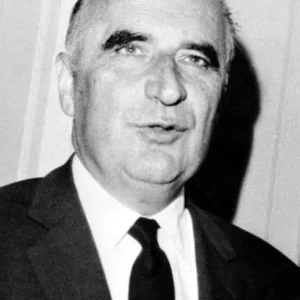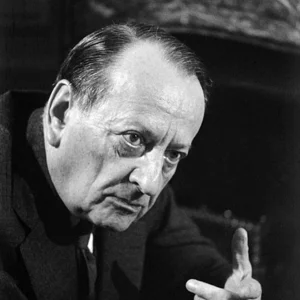

French novelist, Resistance fighter, and statesman (1901–1976). Author of La Condition humaine, he served as Minister of Cultural Affairs under General de Gaulle from 1959 to 1969 and was a theorist of art.
André Malraux(1901 — 1976)
André Malraux
France
8 min read
Frequently asked questions
Famous Quotes
« Art is an anti-destiny.»
« Culture is not inherited, it is conquered.»
« France cannot be France without greatness.»
Key Facts
- 1933: Prix Goncourt for La Condition humaine
- 1936–1937: Fought alongside the Spanish Republicans during the Civil War
- 1944: Led the Alsace-Lorraine Brigade in the Resistance
- 1959–1969: First Minister of Cultural Affairs of the Fifth Republic under de Gaulle
- 1964: Transfer of Jean Moulin's ashes to the Panthéon — celebrated speech
Works & Achievements
A novel set during the Communist uprising in Shanghai in 1927, awarded the Prix Goncourt. A masterpiece of engaged literature, it explores themes of death, brotherhood, and the absurd through the lives of doomed revolutionaries.
A novel written during and after the Spanish Civil War, in which Malraux fought personally. It portrays the aerial battles and moral dilemmas faced by the Republicans in the face of rising fascism with striking realism.
Malraux's first major novel, depicting the Canton Uprising of 1925 in China. It establishes his signature style and themes: adventure, political commitment, and confrontation with death.
A monumental essay on the history of art in which Malraux develops the concept of the imaginary museum: through photographic reproduction, all the artworks of humanity can be mentally brought together and made to speak to one another.
An unconventional autobiographical work in which Malraux rejects chronological narrative to weave together personal memories, encounters with world leaders (de Gaulle, Nehru, Mao), and philosophical meditations on death and the meaning of existence.
The first major French cultural policy, spearheaded by Malraux with the aim of making culture accessible to all French citizens. He established *Maisons de la Culture* in provincial cities and launched a campaign to clean and restore Paris's historic monuments.
Anecdotes
In 1923, the young Malraux, barely twenty-two years old, traveled to Cambodia with his wife Clara and attempted to cut bas-reliefs from the temple of Angkor Wat to sell them. Arrested by the French colonial authorities, he was tried in Phnom Penh and sentenced to three years in prison, suspended. This swashbuckling adventure inspired his first novels about Asia and cemented his reputation as an adventurer.
During the Spanish Civil War (1936–1937), Malraux actively fought on the side of the Republicans. He organized and commanded the Escuadra España, an air squadron made up of mercenary pilots and antifascist volunteers. He personally took part in around sixty combat missions before returning to France to write *Man's Hope*, a novel born directly from that experience.
In August 1944, Colonel Berger — Malraux's Resistance name — was captured by the Gestapo in the Dordogne. Miraculously, he survived the collapse of a wall during a bombing raid and managed to escape. A few weeks later, he took command of the Brigade Alsace-Lorraine and took part in the liberation of Alsace alongside the forces of General Leclerc.
In 1964, Malraux delivered the speech at the pantheonization of Jean Moulin's ashes — a text considered one of the greatest masterpieces of twentieth-century French oratory. His closing line — "Enter here, Jean Moulin, with your terrible procession" — has since been memorized by generations of schoolchildren. He was on the verge of tears as he finished his speech.
As Minister of Cultural Affairs from 1959 to 1969, Malraux launched an unprecedented initiative: cleaning and restoring the blackened façades of Paris. Notre-Dame, the Palais-Royal, and the Opéra Garnier all recovered their original whiteness thanks to his efforts. The program, initially mocked as "Malraux's whitewash
permanently transformed the face of the French capital.
Primary Sources
"The point was to keep alive in him, to the very end, the awareness that he was dying for something." Malraux here depicts the state of mind of the revolutionary Katow as he offers his cyanide to his comrades before being thrown alive into the boiler of a locomotive.
"Enter here, Jean Moulin, with your terrible procession. With those who died in the cellars without having spoken, like you; and even — which is perhaps more atrocious — having spoken."
"I seek the crucial region of the soul where absolute Evil confronts brotherhood." Malraux offers a meditation on adventure, death, and the meaning of commitment, weaving together personal memories and philosophical reflections.
"One must always know what one wants. When one wants victory, one must do what it takes. No other policy." This line captures the tension between revolutionary idealism and military effectiveness that runs throughout the novel.
"Art is an anti-destiny." Malraux develops his theory of the imaginary museum: through photographic reproduction, humanity can now bring together artworks from every age and civilization within a single universal mental space.
Key Places
Malraux was born in Paris in 1901 and spent much of his life in the French capital. The city was the center of his intellectual, political, and cultural life, particularly under the Fifth Republic.
In 1923, the young Malraux attempted to remove bas-reliefs from this Khmer temple and was arrested. This defining adventure marked the beginning of his fascination with non-Western civilizations and inspired his early novels.
From 1936 to 1937, Malraux fought alongside the Spanish Republicans against Franco, organizing and flying missions with the Escuadra España. This direct experience of anti-fascist combat left a deep mark on his work and his political commitment.
Malraux was arrested by the Gestapo in the Dordogne in August 1944, then led the Alsace-Lorraine Brigade during the Liberation of Alsace. These regions were the setting for his concrete involvement in the Resistance.
In December 1964, Malraux delivered the most celebrated speech of his career on the steps of the Panthéon, marking the transfer of Jean Moulin's ashes. His own ashes were transferred there in 1996, cementing his status as a national figure.
Typical Objects

Malraux worked on an American mechanical typewriter, a symbol of the committed writer of the 20th century. His manuscripts were often written at night, in a creative fever accompanied by cigarettes.

Fascinated by Asian art from an early age, Malraux collected artworks from Southeast Asia, particularly Khmer sculptures. This passion for non-Western art fed into his theory of the imaginary museum.

Under the name Colonel Berger, Malraux wore a makeshift military uniform during the Liberation fighting in the Dordogne and Alsace. This outfit symbolizes his physical commitment to the struggle against Nazism.

A political ally of De Gaulle from 1945, Malraux joined the RPF and became one of Gaullism's most brilliant propagandists. This card embodies his transition from literary commitment to political action.

As minister, Malraux signed the decrees founding the Maisons de la Culture in provincial cities, with the aim of "making culture accessible to all." These institutions, in Bourges, Grenoble, and Le Havre, are the tangible legacy of his cultural policy.

To develop his concept of the imaginary museum in *The Voices of Silence*, Malraux worked with thousands of photographic reproductions of artworks from around the world. Photography lies at the heart of his theory of universal art.
School Curriculum
Vocabulary & Tags
Key Vocabulary
Daily Life
Morning
Malraux rose late, having worked for much of the night. He would drink a very strong black coffee and begin his morning by reading the newspapers, particularly to follow world political news. He sometimes received colleagues at his home first thing in the morning.
Afternoon
As Minister of Cultural Affairs, he devoted his afternoons to ministerial meetings, visits to cultural institutions, or audiences with artists and intellectuals. He was known for his brilliant monologues and his nervous mannerisms — he frequently rubbed his face while speaking.
Evening
Evenings were his preferred time for writing and reflection. Malraux worked late into the night, cigarette after cigarette, on his manuscripts or speeches. He frequented Parisian literary and political dinner parties, dazzling his interlocutors with the breadth of his references and the speed of his associations of ideas.
Food
Malraux had an irregular diet, often neglected in favor of work and intellectual discussion. A heavy smoker throughout his life, he drank a great deal of black coffee. He appreciated traditional French cuisine at the official dinners tied to his ministerial duties.
Clothing
As a minister and public figure, Malraux wore dark, elegantly cut suits, typically paired with a tie. His polished appearance contrasted with the intensity of his nervous mannerisms and his feverish gaze. During the Resistance, he wore a makeshift military uniform under the name Colonel Berger.
Housing
Malraux lived for many years in Parisian apartments. He resided notably in Boulogne-Billancourt, then owned the property of Verrières-le-Buisson in the Essonne, where he worked on his major essays on art. There he kept a collection of Asian art objects.
Historical Timeline
Period Vocabulary
Liens externes & ressources
Références
Œuvres
La Condition humaine
1933
L'Espoir
1937
Les Conquérants
1928
Les Voix du silence
1951
Antimémoires
1967
Création du ministère des Affaires culturelles et lancement des Maisons de la Culture
1959-1969