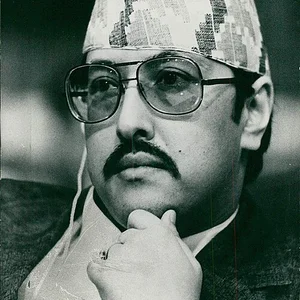

King of Nepal from 1972 to 2001, Birendra established a constitutional monarchy in 1990 under pressure from a popular democratic movement. He perished in the royal massacre of June 2001, which decimated the Nepalese royal family.
Birendra
Birendra
8 min read
Frequently asked questions
Key Facts
- Born on December 28, 1945, in Kathmandu
- Crowned King of Nepal in 1975
- Enacted a new democratic constitution in 1990 following the Jana Andolan movement
- Assassinated on June 1, 2001, during the Narayanhity royal massacre
- His reign marked Nepal's transition to a constitutional monarchy
Works & Achievements
A diplomatic initiative by Birendra aimed at securing official recognition of Nepal's neutrality between India and China. More than a hundred countries supported this proposal, affirming the kingdom's pacifist vocation in the context of the Cold War.
A foundational text born out of dialogue between the monarchy and democratic forces, establishing a constitutional monarchy with an elected Parliament and guaranteed fundamental rights. It brought an end to the Panchayat system and opened Nepal to multiparty politics.
Faced with popular protests, Birendra chose negotiation over repression and legalized political parties. This peaceful transition to democracy stood as a remarkable example in the region and was praised by the international community.
Under Birendra's reign, Nepal opened up extensively to mountain tourism and Himalayan expeditions, turning Everest into an international symbol of the country and generating vital revenue for the Nepalese economy.
Birendra launched several rural development programs to connect remote mountain villages and improve living conditions for Nepal's most isolated populations, particularly in the areas of education and healthcare.
Anecdotes
Birendra completed an exceptional international education: after his studies in Nepal, he attended the prestigious Eton College in England, then the University of Tokyo, and finally Harvard in the United States, where he studied economics and political science in the 1960s. This elite training gave him an open worldview that was rare among Asian rulers of the era, and profoundly shaped his approach to governance.
In 1975, Birendra proposed making Nepal an international “Zone of Peace” — a neutral state recognized by the world community, along the lines of Switzerland or Austria. This original diplomatic initiative, driven by Nepal’s delicate position sandwiched between India and China, received support from more than a hundred countries, even though it was never formally adopted by the United Nations.
In 1990, faced with a powerful popular protest movement — the Jana Andolan, or “People’s Movement” — Birendra made a courageous choice: rather than suppressing the demonstrators, he agreed to transform the absolute monarchy into a constitutional monarchy, legalizing political parties and calling free elections. This decision earned him widespread popularity and was widely praised as a remarkably peaceful transition for the region.
Birendra was regarded by a large part of the Nepali people as an earthly incarnation of the god Vishnu, in keeping with a very ancient Hindu tradition that cast the King of Nepal as a sacred figure. Each year during Dashain, the great Hindu festival, thousands of subjects gathered at the palace to receive from his hand the tika, a vermilion mark on the forehead symbolizing royal and divine blessing.
On the night of June 1, 2001, an unprecedented tragedy struck the royal family at Narayanhiti Palace in Kathmandu. During a family gathering, Crown Prince Dipendra, following a dispute, opened fire on his relatives, killing King Birendra, Queen Aishwarya, and several other members of the royal family before turning a weapon on himself. Dipendra died three days later without regaining consciousness, leaving the country in a state of profound shock.
Primary Sources
Nepal is an independent, sovereign, indivisible and multiparty Hindu Kingdom. The sovereignty of Nepal is vested in the Nepalese people and shall be exercised in accordance with the provisions of this Constitution.
Nepal, situated between two great nations, wishes to be recognized as a Zone of Peace by the international community in order to preserve its sovereignty and contribute to regional stability in Asia.
Our goal is to guarantee multiparty democracy and the fundamental rights of all Nepali citizens. This constitution is the fruit of dialogue between the people and the monarchy, and it will guide our nation toward a future of peace and prosperity.
The commission concluded that Crown Prince Dipendra was responsible for the deaths of King Birendra, Queen Aishwarya, and seven other members of the royal family on the night of 1 June 2001 at the Narayanhiti Palace in Kathmandu.
Key Places
The official residence of the Nepalese royal family and the seat of Birendra's power throughout his reign. It was in this palace that the tragic royal massacre of June 1, 2001 took place; it has since been converted into a museum open to the public.
The prestigious British boarding school where Birendra completed part of his secondary education in the 1960s. This elite schooling opened him to Western culture and democratic systems of governance.
Birendra studied economics and political science here, rounding out an international education that had a lasting influence on his vision of governance and the relationship between monarchy and democracy.
A major Hindu temple dedicated to Shiva and the holiest pilgrimage site in Nepal. As king-deity and protector of Hinduism, Birendra officiated there during major national religious ceremonies, and his cremation took place on its grounds after his death.
The capital of Nepal and the political, religious, and cultural heart of the kingdom throughout Birendra's reign. It was here that the institutions of state, Parliament, and the principal national ceremonies were concentrated.
Nepal's second city and the gateway to the Annapurnas, Pokhara experienced significant tourism growth during Birendra's reign. The development of high-altitude tourism was one of the monarchy's major economic policies.
Typical Objects

Ceremonial headdress adorned with birds-of-paradise feathers and jewels, worn by Birendra on major state occasions and coronations. It symbolized the continuity of the Shah dynasty and the sacred dimension of the Nepalese monarchy.

Traditional curved Nepalese knife, the emblematic weapon of Gurkha soldiers and a national symbol of Nepal. Birendra wore it during military ceremonies, affirming the unbreakable bond between the monarchy and the armed forces.

Traditional Nepalese male attire consisting of a cross-fastened tunic and ankle-fitted trousers, topped with the woven *Dhaka topi* cap — a symbol of national identity. Birendra wore it during national holidays to express his attachment to Nepalese traditions.

Mark of red powder applied to the forehead during Hindu ceremonies, most notably Dashain. As a god-king incarnating Vishnu, Birendra distributed the tika to thousands of subjects who came to the palace — a fundamental ritual act reaffirming the sacred bond between the sovereign and his people.

Landmark document promulgated by Birendra that transformed Nepal into a constitutional monarchy following the Jana Andolan. This text, the product of a historic compromise between the palace and democratic forces, remains one of the most significant political legacies of his reign.

Symbol of Birendra's diplomatic travels around the world as part of his policy of neutrality and his proposal for a Peace Zone. He met numerous heads of state and actively represented Nepal on the international stage.
School Curriculum
Vocabulary & Tags
Key Vocabulary
Daily Life
Morning
Birendra began his days with Hindu religious rituals — prayers, offerings, and meditations in the private chapels of Narayanhiti Palace. As an incarnation of Vishnu, the spiritual dimension profoundly shaped his daily life. He would then receive his advisors and secretaries of state for the first matters of the day.
Afternoon
Afternoons were devoted to official audiences, meetings with government ministers, and diplomatic obligations. Birendra regularly received foreign delegations and representatives from the various regions of Nepal. After 1990, with his direct executive role reduced, he focused more on his representational and mediation functions.
Evening
Royal evenings blended family life in the palace's private apartments with formal protocol obligations at official receptions. During major Hindu festivals such as Dashain or Tihar, Birendra presided over public ceremonies attended by thousands of subjects who came to receive his blessing.
Food
The palace kitchen drew on high-caste Nepalese culinary tradition: rice (dal bhat), lentils, vegetables, and mutton or chicken on special occasions. As a high-caste Hindu, Birendra never consumed beef, the animal being sacred in Nepal. Royal meals were prepared according to strict food purity rites.
Clothing
In official settings, Birendra wore a military uniform adorned with decorations or the traditional Nepalese costume (daura-suruwal) topped with the Dhaka topi, the national woven hat. For major ceremonies, he donned the full royal regalia, including the bird-of-paradise feather crown, the distinctive emblem of the Shah dynasty's monarchs.
Housing
Birendra officially resided in Narayanhiti Palace, a vast architectural complex in the heart of Kathmandu, surrounded by gardens and protected by the royal guard. The palace blended richly decorated state rooms in the European style with intimate spaces rooted in Nepalese tradition, reflecting the cultural mix that defined the royal court.
Historical Timeline
Period Vocabulary
Liens externes & ressources
Références
Œuvres
Déclaration du Népal comme Zone de paix
1975
Constitution du Royaume du Népal
9 novembre 1990
Transition démocratique pacifique (Jana Andolan)
1990
Développement du tourisme d'altitude et ouverture internationale
Années 1970-2000
Politiques de développement rural et infrastructures
Années 1970-1990