 flip
flipSujata's Rice Pudding (Madhu-Payasa)
Sujata's Rice Pudding (Madhu-Payasa)
Why this dish? On the banks of the Nairanjana River near Bodhgaya, after years of extreme fasting that had reduced him to skin and bones, Siddhartha accepted from the young Sujata a bowl of rice cooked in milk and honey. This meal restored his strength; that very evening, seated under the Bodhi tree, he attained Enlightenment. This is the dish that marks the abandonment of asceticism and the birth of the Middle Way.
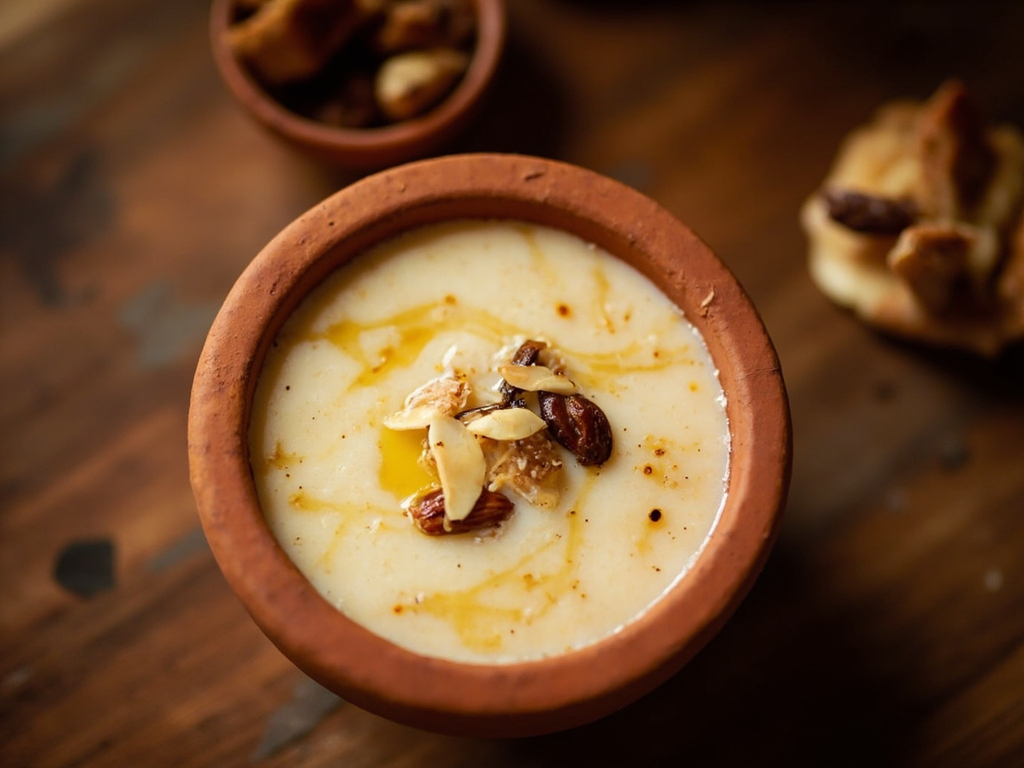
A creamy rice slowly simmered in reduced milk, sweetened with cane sugar and scented with cardamom — smooth, warm, comforting. The sweetness that brings an exhausted body back to life.
Approach, and look at this bowl that Sujata offered me. I had thought that by starving this body I would free the spirit: I had only gained a trembling carcass, unable to meditate. The lute too tight breaks, the lute too loose does not sing — there must be the right tension. This rice cooked in cow's milk and sweetened with honey restored my strength, and that night, under the fig tree, I saw clearly. Eat without greed, eat without disgust: only nourish what must walk toward awakening.
- •White round-grain rice — a handful (base of the payasa)
- •Fresh cow's milk — plenty, reduced by half (creamy cooking medium)
- •Wild honey — to taste (sweetness (added off the heat))
- •Unrefined cane sugar (jaggery) — a piece (base sweetness)
- •Green cardamom — a few crushed pods (fragrance)
Sujata's Rice Pudding (Madhu-Payasa)
A creamy rice slowly simmered in reduced milk, sweetened with cane sugar and scented with cardamom — smooth, warm, comforting. The sweetness that brings an exhausted body back to life.
Why this dish? On the banks of the Nairanjana River near Bodhgaya, after years of extreme fasting that had reduced him to skin and bones, Siddhartha accepted from the young Sujata a bowl of rice cooked in milk and honey. This meal restored his strength; that very evening, seated under the Bodhi tree, he attained Enlightenment. This is the dish that marks the abandonment of asceticism and the birth of the Middle Way.
Approach, and look at this bowl that Sujata offered me. I had thought that by starving this body I would free the spirit: I had only gained a trembling carcass, unable to meditate. The lute too tight breaks, the lute too loose does not sing — there must be the right tension. This rice cooked in cow's milk and sweetened with honey restored my strength, and that night, under the fig tree, I saw clearly. Eat without greed, eat without disgust: only nourish what must walk toward awakening.
Ingredients (period version)
- White round-grain rice — a handful (base of the payasa)
- Fresh cow's milk — plenty, reduced by half (creamy cooking medium)
- Wild honey — to taste (sweetness (added off the heat))
- Unrefined cane sugar (jaggery) — a piece (base sweetness)
- Green cardamom — a few crushed pods (fragrance)
Ingredients
- Round rice (pudding rice) — 80 g (base of the payasa)
- Whole milk — 1 liter (cooking medium)
- Jaggery or whole cane sugar — 70 g (base sweetness)
- Honey — 1 tbsp (final sweetness, off the heat)
- Green cardamom — 4 pods (fragrance)
- Slivered almonds and raisins — a handful (garnish (optional))
Method
- Rinse the rice in clear water until the water runs clear.
- Bring the milk to a simmer in a heavy-bottomed pot, add crushed cardamom seeds.
- Add the rice and cook over low heat for 35–45 minutes, stirring often, until the milk thickens and the rice breaks down.
- Add the jaggery, let it melt for 5 minutes.
- Remove from heat, let cool slightly, then stir in the honey (never while boiling, to respect the spirit of the raw gift and preserve its fragrance).
- Serve warm, sprinkled with almonds and raisins.
How it was made : The 'honey milk-rice' (madhupayasa) is mentioned in accounts of the Enlightenment such as the Lalitavistara. It was prepared with the milk of several cows, long reduced, a sign of a precious gift. Rice and milk were the most noble foods of the Ganges plain.
The contemporary twist : Served in a small terracotta bowl with a drizzle of honey and an edible gold leaf: 'the Bowl of Enlightenment'.
Sources : Lalitavistara (episode of Sujata's offering) · Buddhist tradition of the Enlightenment at Bodhgaya
Buddha · Charactorium