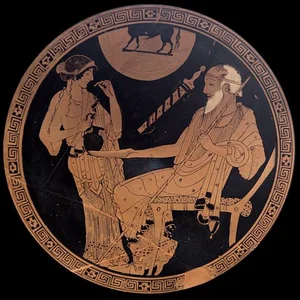

Briseis is a figure from Greek mythology, a war captive whose possession sparks the famous quarrel between Achilles and Agamemnon in Homer's Iliad. Her seizure by Agamemnon drives Achilles to withdraw from the fighting, a pivotal event in the tale of the Trojan War.
Briseis
Briseis
6 min read
Frequently asked questions
Key Facts
- A character in the Iliad, the epic attributed to Homer and composed around the 8th century BC
- Daughter of Briseus, priest of the city of Lyrnessus, taken as war spoils by Achilles
- Her removal by Agamemnon provokes the wrath of Achilles, the guiding thread of the Iliad
- Her return to Achilles takes place after the death of Patroclus, in Book XIX of the Iliad
Works & Achievements
Briseis is not an author but the dramatic mainspring of the epic: her seizure triggers the wrath of Achilles, the subject announced in the very first line of the poem.
The character's only major speech, one of the most moving thrênoi (funeral laments) of the epic, which reveals her humanity and her personal story.
A Latin epistolary poem that imagines the intimate voice of Briseis pleading with Achilles; it became a major literary reference for the character.
A famous Roman wall painting depicting Briseis's departure from Achilles's tent, a testament to the popularity of the scene in ancient art.
A successful contemporary novel that revisits the story of Achilles and gives an important place to Briseis, illustrating the modern legacy of the character.
Anecdotes
In the Iliad, Briseis is the starting point of the entire plot: when Agamemnon has to give back his own captive Chryseis, he takes Briseis from Achilles as compensation. Enraged at having been dishonored, Achilles withdraws from battle, and the Greeks suffer defeat after defeat.
Briseis delivers only one long speech in the Iliad: in Book XIX, standing before the body of the dead Patroclus, she weeps and recounts that Achilles had promised to make her his lawful wife in Phthia, his homeland.
According to tradition, Briseis had lost her husband and her brothers, killed by Achilles himself during the sack of her city, Lyrnessos. She therefore lived as a captive in the household of the man who had murdered her family — a tragic situation typical of the women of the Trojan War.
Her name, Briseis, is a patronymic meaning “daughter of Briseus”: in the Homeric epic, she is rarely called by a personal name, which underscores the status of captives, defined by their lineage or their master rather than by their own identity.
The Latin poet Ovid devotes a fictional letter to her in the Heroides: in it, Briseis begs Achilles to take her back and not abandon her, giving an intimate voice for the first time to this long-silent character.
Primary Sources
The herald took fair-cheeked Briseis by the hand and led her away; she went unwillingly. And Achilles, weeping, sat apart from his companions, on the shore of the grey sea.
Patroclus, you who were so dear to my wretched heart! I left you alive when I went from the tent, and now on my return I find you dead, leader of men.
The letter you read comes from the stolen Briseis; my Greek is barely legible beneath my barbarian hand. Take me back, and may your valour return with me to battle.
Achilles took Lyrnessus and there captured Briseis. When Agamemnon took her from him, Achilles withdrew from the fighting.
Key Places
City of the Troad, homeland of Briseis, captured and destroyed by Achilles; it is there that she loses her family and becomes a captive.
Encampment of the Achaeans on the shore of the Aegean Sea, near Troy; Briseis lives there in Achilles' tent during the war.
City besieged by the Greeks; the backdrop of the war in which Briseis is one of the most famous stakes.
Achilles' kingdom in Thessaly where he had promised to take Briseis as his lawful wife, according to the lament she delivers over Patroclus.
The specific space in the camp where the confiscation of Briseis and then her lament over the body of Patroclus take place.
Typical Objects

The hero's emblematic weapon, the man who destroyed the city of Briseis; a symbol of the Greek warrior might of which she is both victim and spoil.

A reward granted to Greek warriors after a victory, often a captive woman or a precious object; Briseis is precisely Achilles' geras, which makes her removal scandalous.

An everyday tool of the captive women in the tents of the Greek camp; weaving was the main occupation assigned to women like Briseis.

A long draped tunic worn by Greek women, fastened at the shoulders with brooches; the garment Briseis wore in ancient depictions.

The hero's shelter by the ships, where Briseis lived as a captive; the central setting of the scenes concerning her in the Iliad.

A bronze or gold clasp used to fasten the peplos on the shoulder; a practical piece of jewelry worn by women of the heroic age.
School Curriculum
Vocabulary & Tags
Key Vocabulary
Tags
Daily Life
Morning
A captive in Achilles' tent, Briseis rises in the Greek camp to the rhythm of the sounds of forges and horses. Like the women of the heroic age, her day begins with domestic tasks in the service of her master.
Afternoon
Her days are divided between weaving wool, preparing meals, and tending the tent. The loom and the distaff are the typical occupations of women, free or captive, in the Homeric world.
Evening
In the evening, the captive women serve wine and food at the warriors' meals. Briseis takes part in the life of the camp without being mistress of it, entirely dependent on the fortunes of battle.
Food
The camp's diet relies on roasted meats (mutton, beef, pork), barley or wheat bread, cheese, and wine mixed with water. The Homeric heroes are described feasting on great cuts of grilled meat.
Clothing
Briseis wears the *peplos*, a long woolen robe draped and fastened with fibulae, sometimes covered by a veil. High-ranking captives kept well-made garments recalling their former princely status.
Housing
She lives in a tent of cloth and wood pitched near the ships beached on the shore, not in a house. The Greek camp is a temporary town of huts, exposed to the wind and the sea.
Historical Timeline
Period Vocabulary
Liens externes & ressources
Références
Œuvres
Iliade d'Homère (rôle de Briséis)
vers le VIIIe siècle av. J.-C.
Lamentation de Briséis sur Patrocle (Iliade, chant XIX)
vers le VIIIe siècle av. J.-C.
Héroïde III d'Ovide : Lettre de Briséis à Achille
vers 20-10 av. J.-C.
Fresque de Briséis emmenée (Maison du Poète tragique, Pompéi)
Ier siècle apr. J.-C.
Le Chant d'Achille (Madeline Miller)
2011