
Calliope, in Greek mythology, is the eldest of the nine Muses, daughters of Zeus and the Titaness Mnemosyne. She presides over epic poetry and eloquence, and is reputed to be the mother of the poet Orpheus. Her name means “she of the beautiful voice.”
Calliope
Calliope
6 min read
Frequently asked questions
Key Facts
- The eldest and most distinguished of the nine Muses in Greek mythology
- Daughter of Zeus and the Titaness Mnemosyne (Memory)
- Presented as the Muse of epic poetry and eloquence
- Regarded as the mother of Orpheus, the legendary poet and musician
- Described by Hesiod in the Theogony (8th-7th century BC) as the foremost of the Muses
Works & Achievements
Calliope presides over the great heroic poems; the bards invoke her to sing of the exploits of gods and heroes.
As the Muse of epic song, she embodies the goddess invoked at the opening of the Homeric poems.
Mother of the poet-musician Orpheus, she is said to have passed on to him the gift of song that charmed all of nature.
According to Hesiod, Calliope inspires just kings with the gentle, persuasive words that soothe quarrels.
Chosen as judge between Aphrodite and Persephone, she divides Adonis's time between the two goddesses.
In Ovid's Metamorphoses, Calliope wins the contest against the Pierides by singing of the abduction of Proserpina.
Anecdotes
Calliope is the eldest of the nine Muses, and she is the one poets invoked first to sing of great tales of war. When Homer opens the *Iliad* with "Sing, goddess, the wrath of Achilles
it is a Muse like Calliope whom he calls to his aid.
According to tradition, Calliope is said to be the mother of Orpheus, the legendary musician whose song charmed wild beasts and even stones. She is believed to have passed on to her son this gift of song that made the gods of the Underworld weep.
Hesiod, in his *Theogony*, gives Calliope a place apart: he names her "the most eminent of all" the Muses, for she attends upon worthy kings and inspires in them the skillful words needed to render justice.
One legend tells that Calliope was chosen to arbitrate the quarrel that set Aphrodite against Persephone over the handsome Adonis. To settle the matter, she decided that the young man would spend part of the year with each of the two goddesses.
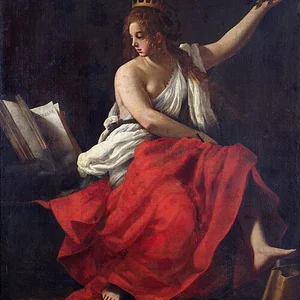
In ancient and Renaissance art, Calliope is recognized by her attributes: a writing tablet and a stylus, or sometimes a papyrus scroll, symbols of the epic poetry she inspires.
Primary Sources
Calliope, who is the most eminent of them all, for she attends upon venerable kings.
Clio, Euterpe, Thalia, Melpomene, Terpsichore, Erato, Polyhymnia, Urania and Calliope, the daughters whom Mnemosyne bore to Zeus.
Calliope had by Oeagrus — or, as some say, by Apollo — a son, Orpheus, who by his song could move stones and trees.
Calliope rose, the greatest of the sisters, and, having bound up her loosened hair with ivy, she tuned the plaintive strings of her lyre, then began this song.
Calliope, venerable, and you, queen Clio, and all you goddesses, hear my prayer.
Key Places
Sacred mountain of the Muses where, according to Hesiod, they danced around the Hippocrene and Aganippe springs before inspiring the poets.
Massif consecrated to Apollo and the Muses, towering over the sanctuary of Delphi; a place of poetic inspiration with the Castalian spring.
Home of the gods where the Muses, daughters of Zeus, come to sing to delight the assembly of the Olympians.
A region at the foot of Olympus, the traditional birthplace of the Muses, which earns them the epithet "Pierides."
Land of Oeagrus and homeland of Orpheus, son of Calliope; a country associated with song and the Orphic mysteries.
Typical Objects

Calliope's main attribute in ancient art, the wax tablet and stylus symbolize the epic poetry she inspires and the writing down of great tales.

Sometimes held by Calliope, the scroll evokes the great epics such as the *Iliad* and the *Odyssey*, placed under the patronage of the Muses.

A stringed instrument associated with song and poetry; Ovid shows Calliope tuning her lyre before striking up her song, and she is said to have passed it on to her son Orpheus.

The laurel, a plant sacred to Apollo and to poets, crowns Calliope's brow to mark poetic glory and excellence.

In some later depictions, Calliope carries a trumpet, an echo of the heroic poetry and war songs of which she is the patron.

A spring on Mount Helicon, born from a strike of Pegasus's hoof, where the Muses came to bathe and dance; its water was believed to grant poetic inspiration.
School Curriculum
Vocabulary & Tags
Key Vocabulary
Daily Life
Morning
At daybreak, Calliope joins her eight sisters on the slopes of Mount Helicon. They bathe in the pure waters of the Hippocrene spring, said to cleanse the mind and sharpen inspiration before singing.
Afternoon
In the afternoon, the Muses form choruses and dance in a circle around the altars. Calliope, the eldest, often leads the song and tunes her lyre to strike up tales of the world's origins and the great deeds of heroes.
Evening
In the evening, the Muses ascend Mount Olympus to delight the assembly of the gods. Their song accompanies the divine banquets, and along the way Calliope inspires the mortal poets asleep at the foot of the mountain.
Food
Being a divinity, Calliope does not eat as humans do: she tastes ambrosia and nectar, the food and drink of immortality reserved for the gods of Olympus, which sustain their eternal youth.
Clothing
She is depicted wearing a long chiton draped in the Greek style, sometimes enhanced with a cloak (himation). A laurel wreath or a headband adorns her hair, the mark of her dignity as the Muse of poetry.
Housing
Calliope knows no mortal home: she dwells on the sacred mountains of Helicon and Parnassus, and frequents the palace of the gods on Olympus, among the springs, groves, and altars consecrated to her.
Historical Timeline
Period Vocabulary
Liens externes & ressources
Références
Œuvres
Patronage de la poésie épique
Antiquité grecque
Inspiration de l'Iliade et de l'Odyssée
VIIIe siècle av. J.-C.
Éducation d'Orphée
Temps mythique
Don de l'éloquence aux rois
VIIIe-VIIe siècle av. J.-C.
Arbitrage de la querelle d'Adonis
Temps mythique
Le chant du rapt de Proserpine
8 apr. J.-C.