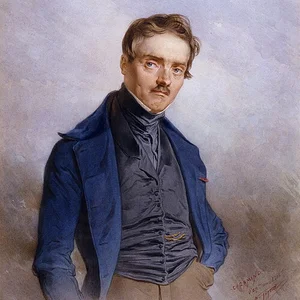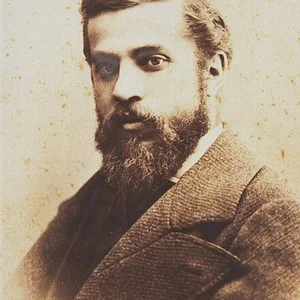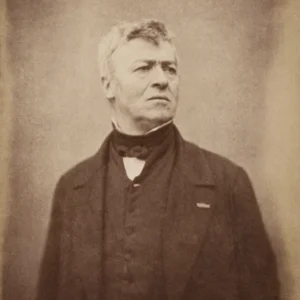

French painter and printmaker (1796–1875), Corot is one of the leading figures of 19th-century landscape painting. A forerunner of Impressionism, he was a prominent member of the Barbizon school and profoundly influenced the generations that followed.
Camille Corot(1796 — 1875)
Camille Corot
France
8 min read
Frequently asked questions
Famous Quotes
« There is only one master for all of art: nature.»
« Beauty in art is truth bathed in the impression received before nature.»
Key Facts
- 1796: Born in Paris on 16 July
- 1822: First stay in Italy, a decisive encounter with Mediterranean light
- 1830s: Regular visits to the Forest of Fontainebleau and the village of Barbizon
- 1855: Success at the Paris Universal Exhibition, official consecration
- 1875: Died in Paris on 22 February, leaving a body of work of more than 3,000 paintings
Works & Achievements
A monumental view of the cathedral from the surrounding fields, this canvas reveals Corot's mastery in rendering architecture and natural light. It is held in the Musée du Louvre.
An open-air study made during his first stay in Italy, depicting the ancient bridge at Narni in the Umbrian countryside. This painting bears witness to the rigor of his training and his sensitivity to Mediterranean light.
A large symbolic composition showing nymphs dancing in a silvery woodland. This canvas illustrates the lyrical turning point in Corot's work, poised between realistic observation of nature and poetic vision.
A masterpiece of Corot's mature period, this painting depicts a lakeside landscape bathed in a golden haze, with the silhouettes of women gathering flowers. Purchased by the French state at the Salon of 1864, it is held in the Musée du Louvre.
A series of canvases depicting the ponds near Corot's family estate. These landscapes, with their silvery tones and shimmering reflections, are among his most personal works and directly foreshadow Impressionism.
A portrait of a young Italian woman, demonstrating Corot's ability to excel in figure painting beyond landscape alone. This canvas, now at the National Gallery of Art in Washington, reveals a subtle psychology and a luminous touch.
Anecdotes
Corot did not become a professional painter until the age of 26, after several years spent in the family cloth trade. It was in 1822 that his father finally granted him an annual allowance so he could devote himself entirely to painting, won over by his son's tenacious passion.
In 1867, Corot learned that his friend the caricaturist Honoré Daumier was about to be evicted from his house in Valmondois for failing to pay his rent. Without hesitation, he bought the property and gave it to Daumier, illustrating the legendary generosity that earned him the nickname 'Père Corot' among younger artists.
During his travels in Italy, Corot would rise before dawn to capture the morning light. He worked standing for hours, even in intense heat, refusing to leave a site until he had captured the exact quality of light he was seeking. His Roman study notebooks, preserved at the Louvre, bear witness to this rigorous discipline.
Corot was renowned for his great modesty despite his growing success. When poor young painters asked him to authenticate their copies, he would sometimes sign them with his own name to help them sell, which explains the extraordinary number of fake Corots that circulated during his lifetime.
Impressionist painters such as Camille Pissarro and Berthe Morisot regarded Corot as their direct forerunner and paid homage to him during his lifetime. Corot, though trained in the academic tradition, appreciated these young artists without ever claiming to belong to their movement, simply declaring: “Nature is the only master.”
Primary Sources
I have but one goal in life that I wish to pursue with tenacity: to paint landscapes. Beauty in art is truth bathed in the impression we received at the sight of nature.
He would rise before dawn, and when his companions joined him in the countryside, he had already set up his easel and begun capturing the silver tone of morning. He would say: “One must catch nature in the act.”
M. Corot is the poet of landscape. His canvases possess that hazy softness, that luminous *sfumato* that no other painter can achieve. He paints not what he sees, but what he feels upon seeing.
Rome, 1826. The Colosseum at dusk. The light falls in a sheet of gold upon the ancient stones. I must note the values before everything tips into the violet of evening. I shall never forget this hour.
Key Places
Corot was born at 125 rue du Bac in Paris in 1796. He spent his youth there and later set up his studio in the Faubourg-Poissonnière district, which became his base for painting expeditions around the Paris region.
The Corot family estate was located in Ville-d'Avray, on the banks of its famous ponds. Corot returned there throughout his life and made it the subject of several of his best-known works.
A landmark of the Barbizon School, this forest was an essential hunting ground for Corot and his contemporaries. From the 1820s onward, he painted numerous studies of its undergrowth and clearings there.
During his three stays in Italy (1825–1828, 1834, 1843), Corot painted Rome, Tivoli, and the Umbrian countryside. These Italian years were decisive in shaping his sense of light and composition.
In 1830, Corot painted the cathedral from the surrounding fields in a celebrated work renowned for its architectural precision and luminous sky, showcasing his ability to blend accuracy with poetry.
Corot visited Normandy on several occasions, drawn by the distinctive light of its coastlines and estuaries. These northern landscapes influenced his silvery palette and made him a forerunner of Norman Impressionism.
Typical Objects

A small portable box holding paints and securing a small canvas or panel, indispensable for plein air painting. Corot would take it out at dawn into the countryside to capture fleeting light effects.

Light and collapsible, this easel allowed the painter to work standing upright before his subject in nature. Corot used it daily in the forests of Fontainebleau and along the ponds of Ville-d'Avray.

The surface on which Corot mixed his oil colors, characterized by a range of silvery greens, pearly grays, and luminous whites that define his distinctive style.

Corot filled dozens of sketchbooks with drawings and notes taken on the spot during his travels in Italy, Normandy, and the French countryside, leaving a precious record of his working method.

An instrument Corot played with great passion in his leisure hours. Music was for him inseparable from painting: he often sang while working and likened his landscapes to visual melodies.

A large parasol attached to the easel to shield the canvas from direct sunlight, essential during plein air sessions. It allowed Corot to work without harsh light skewing his tonal values.
School Curriculum
Vocabulary & Tags
Key Vocabulary
Daily Life
Morning
Corot rose before dawn, often at five in the morning, to go and paint in the countryside or by the ponds of Ville-d'Avray. He carried his pochade box and a light easel, seeking to capture the effects of mist and the silvery light of early morning, which he considered the most beautiful moments for painting.
Afternoon
After a simple meal taken on location or at a village inn, Corot resumed work in the studio or continued his studies en plein air. He worked in silent concentration, correcting and reworking his canvases with patience, and occasionally welcomed young painters who came to seek his advice.
Evening
Corot's evenings were often devoted to music and friendship. He played the flute, sang with his friends, and frequented Parisian bourgeois salons. He also enjoyed rereading his travel notebooks and planning his next excursions, jotting down the places and lighting effects he wished to explore.
Food
Corot appreciated the simple, unpretentious cuisine of his era: soup, stew, roast poultry, cheese, and bread. During his painting outings, he was happy to eat at the tables of country innkeepers — sober and moderate, preferring good company to fine dining.
Clothing
In the studio and outdoors, Corot wore a grey or blue painter's smock, dark trousers, and a wide-brimmed hat to shield himself from the sun. In town, he adopted the understated bourgeois dress of his social circle — frock coat, waistcoat, cravat — with no trace of bohemian affectation.
Housing
Corot divided his entire life between his Paris studio-apartment (on the rue du Faubourg-Poissonnière) and the family home in Ville-d'Avray. His Parisian studio was cluttered with canvases, studies, and notebooks, but also enlivened by musical instruments and souvenirs brought back from Italy.
Historical Timeline
Period Vocabulary
Liens externes & ressources
Références
Œuvres
La Cathédrale de Chartres
1830
La Danse des nymphes
1850
L'Étang de Ville-d'Avray
vers 1855-1865
Agostina
1866