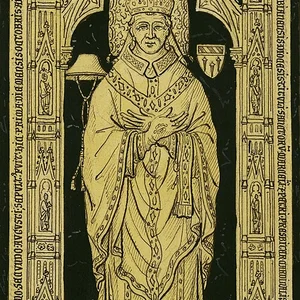

French cardinal (c. 1250–1313), renowned canonist and papal legate, he founded the Collège du Cardinal Lemoine in Paris in 1302 to train young clerics from Picardy. Close to Popes Boniface VIII and Clement V, he played a key role at the Roman Curia during the transfer of the papacy to Avignon.
Cardinal Jean Lemoine
Jean Lemoine
9 min read
Frequently asked questions
Key Facts
- Born around 1250 in Crécy-en-Ponthieu (Picardy)
- Made cardinal by Pope Boniface VIII in 1294
- Founded the Collège du Cardinal Lemoine in Paris in 1302 for students from Picardy
- Author of the Glossa Ordinaria on the Liber Sextus, a landmark reference work of canon law
- Died in Avignon in 1313, shortly before the definitive establishment of the papacy in Avignon (1309)
Works & Achievements
A legal masterpiece by Jean Lemoine, this gloss comments line by line on the Liber Sextus of Boniface VIII (1298). It became an indispensable reference in the teaching of canon law at all European universities until the sixteenth century.
The founding document by which Jean Lemoine endowed a Parisian college to house poor clerical students from Picardy. This legal and charitable document illustrates the ideal of social advancement through education, a hallmark of the great medieval foundations.
Alongside his major gloss, Jean Lemoine left various commentaries on earlier canonical collections. These legal texts reveal a rigorous mind, intent on reconciling the tradition of the Church Fathers with the practical needs of ecclesiastical governance.
As a papal legate, Jean Lemoine drafted official acts and reports for the Roman Curia, accounting for his missions in France and England. These administrative documents shed light on the complex negotiations between the Holy See and the crowns of northern Europe.
Anecdotes
In 1302, Jean Lemoine founded the Collège du Cardinal Lemoine in Paris to welcome young clerks from the diocese of Arras and Picardy. He endowed the institution generously so that poor students could receive training in theology and canon law, without poverty standing in the way of their education. That college still exists today as the lycée Henri-IV — a living legacy of his patronage, over seven centuries old.
Jean Lemoine was one of the leading canonists of his time: he wrote a celebrated gloss on the *Liber Sextus*, the collection of decretals promulgated by Boniface VIII in 1298. This dense and precise legal commentary was studied at universities across Europe for two centuries. Thanks to his work, the rules governing the Church were better understood and more consistently applied by ecclesiastical judges.
During the violent conflict between Boniface VIII and Philip IV the Fair, Jean Lemoine found himself at the center of a major political crisis. In 1303, Guillaume de Nogaret, an envoy of the king, publicly humiliated the pope at Anagni — an act of breathtaking brutality for the era. Loyal to the curia, Jean Lemoine witnessed the pontiff's distress firsthand and worked to restore papal authority in the aftermath of this defining trauma.
Appointed as a papal legate, Jean Lemoine was dispatched on diplomatic missions to France and England to represent the interests of the Holy See. These legations granted him exceptional authority: he could settle disputes, lift excommunications, and convene local councils. This role as a travelling ambassador reflects the absolute trust placed in him by popes Boniface VIII and then Clement V.
Jean Lemoine witnessed the transfer of the papacy to Avignon under Clement V in 1309, an event that shook Christendom and whose consequences lasted until 1377. He spent his final years in that city of the Comtat Venaissin, where he died in 1313. His memory is lastingly honored by the Parisian college he had founded, which continues to educate generation after generation of students.
Primary Sources
Ego Joannes, miseratione divina tituli Sanctorum Marcellini et Petri presbyter cardinalis, volens pauperibus scholaribus de diocesi Atrebatensi et aliis in theologia et jure canonico studentibus providere, collegium in civitate Parisiensi instituo et perpetuis temporibus dotandum statuo.
Joannes Monachus, cardinalis, hunc textum interpretans, docet quod auctoritas papalis in rebus spiritualibus suprema est, et quod canones a Sede Apostolica promulgati vim legis universalis obtinent in tota Ecclesia.
Bonifacius episcopus, servus servorum Dei, dilecto filio nostro Joanni, presbytero cardinali tituli Sanctorum Marcellini et Petri, viro in jure canonico peritissimo et fidei apostolicae devotissimo, salutem et apostolicam benedictionem.
Rex pacificus gloriosus... Statuimus ut qui semel in jure succubuerit, eodem judicio amplius non audiatur. This canon is extensively commented upon by Jean Lemoine regarding its application in benefice cases and appeals to the Roman Curia.
Key Places
Presumed birthplace of Jean Lemoine, in Picardy. It is from this region that he drew his attachment to the dioceses of northern France, and it is for his fellow Picards that he founded and endowed his Parisian college.
Founded in 1302 on rue du Cardinal-Lemoine (in the current 5th arrondissement), this college welcomed scholarship students from Picardy studying at the University of Paris. Its name survives in the Latin Quarter, and its memory lives on in the neighboring lycée Henri-IV.
Jean Lemoine spent a large part of his career in the service of popes Boniface VIII and Clement V, participating in consistories and canonical reforms. It is here that he drafted most of his legal work and exercised his influence over the governance of the Church.
Jean Lemoine followed the papacy when it relocated to Avignon in 1309 and spent his final years there. He died there in 1313, leaving a lasting mark on the pontifical curia during the first Avignon period.
Jean Lemoine was close to the pontifical court during the dramatic “Outrage of Anagni” in 1303, when the envoys of Philip the Fair violated the person of Boniface VIII. This traumatic episode marked a turning point in the relations between the papacy and the monarchies of Europe.
Typical Objects

This large flat-brimmed hat with wide brims and red tasseled cords has been the distinctive sign of a cardinal since the 13th century. Jean Lemoine wore it during pontifical ceremonies and legations, signaling his rank in the hierarchy of the universal Church.

As a legate, Jean Lemoine had a lead or red wax seal that he affixed to his official acts to give them executive force. This seal typically depicted a religious figure and bore his Latinized name “Joannes Monachus.”

Jean Lemoine worked daily on hand-copied manuscripts compiling the texts of councils, popes, and earlier canonists. His gloss on the Liber Sextus enriched these volumes with marginal commentaries that guided Church judges in their decisions.

The ring adorned with a precious stone is presented to the cardinal at his elevation; it symbolizes his spiritual marriage to the Church. Jean Lemoine wore it on his right little finger and offered it to be kissed during liturgical ceremonies.

Papal bulls are authenticated by a lead disc (the “bulla”) bearing the effigies of the apostles Peter and Paul. Jean Lemoine, a close adviser to the popes, received and conveyed many bulls officially sanctioning his diplomatic missions.

This portable liturgical book contains the canonical hours that the cardinal is required to recite each day. Jean Lemoine's breviary, richly illustrated with gilded initials and miniatures, bears witness to the refinement of clerical culture at the turn of the 14th century.
School Curriculum
Vocabulary & Tags
Key Vocabulary
Daily Life
Morning
Jean Lemoine begins his day before dawn with the recitation of matins and lauds, the canonical hours required of every cleric. He then attends mass celebrated in the chapel of his palace or of the curia, surrounded by his household staff — secretaries and chaplains. The rest of the morning is devoted to studying canon law texts and drafting legal opinions.
Afternoon
In the afternoon, the cardinal takes part in consistories, official meetings of the College of Cardinals with the pope, where the major affairs of the Church are handled: episcopal appointments, conflicts between princes, doctrinal decisions. He also receives abbots, representatives of universities, or ambassadors who come seeking arbitration. His legation missions sometimes take him hundreds of kilometers by horse or litter.
Evening
In the evening, Jean Lemoine gathers with his household for supper, a communal meal accompanied by pious reading aloud in keeping with the clerical rule of life. He dictates his correspondence to his secretaries and reviews official documents to be sealed. The day ends with compline, the final evening prayer before rest.
Food
Like any high-ranking prelate of the 14th century, Jean Lemoine in theory follows the Church's prescriptions (abstinence on Fridays, fasting during Lent), but his table is rich and varied. Roasted meats, freshwater and saltwater fish, cooked vegetables, and white wheat bread make up his everyday meals. On feast days, Eastern spices — pepper, ginger, saffron — and wines from the Rhône or Burgundy attest to his elevated social standing.
Clothing
Jean Lemoine wears the red robe (cassock) and crimson mantle reserved for cardinals, symbols of dignity and of the blood they are prepared to shed for the faith. Over this, he wears the white linen rochet and the hooded mozzetta. While traveling or on legation, he wears plainer garments but always marked with the legate's cross.
Housing
In Rome or on legation, Jean Lemoine resides in a palace or bishop's residence made available by the local Church. In Avignon, he lodges in a private mansion in the upper town, close to the papal palace then under construction. These residences serve simultaneously as living quarters, administrative offices, and spaces for representation: a great hall for audiences, a private chapel, and a scriptorium for the secretaries.
Historical Timeline
Period Vocabulary
Liens externes & ressources
Références
Œuvres
Glossa ordinaria sur le Liber Sextus Decretalium
v. 1301-1310
Charte de fondation du Collège du Cardinal Lemoine
1302
Commentaires sur les Décrétales pontificales
fin XIIIe-début XIVe siècle
Rapports et actes de légation pontificale
v. 1295-1305