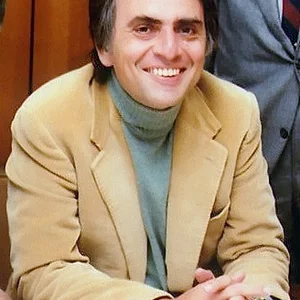

American astronomer and astrophysicist (1934–1996), Carl Sagan is celebrated for bringing science to the general public. His television series *Cosmos* (1980) reached hundreds of millions of viewers worldwide.
Carl Sagan(1934 — 1996)
Carl Sagan
États-Unis
9 min read
Frequently asked questions
Famous Quotes
« We are made of star-stuff.»
« Absence of evidence is not evidence of absence.»
« The Earth is a very small stage in a vast cosmic arena.»
Key Facts
- 1934: born in Brooklyn, New York
- 1968: professor at Cornell University, specialist in planetary atmospheres
- 1980: broadcast of the series *Cosmos: A Personal Voyage*, watched by 500 million people
- 1985: publication of the novel *Contact*, adapted for the cinema in 1997
- 1994: Pulitzer Prize for *The Demon-Haunted World* (a defense of rational thinking)
Works & Achievements
A popular science book on the evolution of the human brain, which earned Sagan the Pulitzer Prize in 1978. This book illustrates his ability to make complex scientific and philosophical questions accessible to a very wide audience.
A 13-episode documentary series co-written and hosted by Sagan, tracing the history of the universe and of human science. Watched by more than 500 million people in 60 countries, it remains one of the greatest works of science communication of the 20th century.
The companion book to the television series, weaving together astronomy, physics, and the history of science into a poetic and accessible narrative. It sold more than 5 million copies and remained at the top of bestseller lists in the United States for several years.
A science fiction novel in which an astronomer receives a message from an extraterrestrial civilization. Adapted for film in 1997, it explores themes of science, religion, and the search for extraterrestrial intelligence with a scientific rigor rare in the genre.
Inspired by the famous photograph of Earth taken by Voyager 1, this book makes the case for space exploration and argues that humanity must become a multi-planetary species in order to ensure its long-term survival.
Sagan's last major work, published a year before his death, defending scientific thinking and critiquing pseudoscience and superstition. Regarded as his intellectual testament and one of the defining texts in defense of reason in the 20th century.
Anecdotes
Carl Sagan was one of the designers of the Pioneer plaques (1972) and the Voyager Golden Records (1977), sent aboard space probes in the hope of contacting potential extraterrestrial civilizations. These objects contained information about humanity, its position in the universe, as well as sounds, music, and images of Earth.
In 1983, Sagan was one of the authors of the scientific study on “nuclear winter”: the researchers demonstrated that a nuclear conflict would generate dust clouds capable of blocking sunlight for years, threatening all life on Earth. This publication had a considerable impact on international disarmament negotiations.
His television series Cosmos: A Personal Voyage (1980) was watched by more than 500 million people in over 60 countries, becoming at the time the most widely broadcast documentary series in the history of American television. Sagan presented astronomy with a contagious passion that inspired entire generations of scientists.
In 1990, Sagan convinced NASA to turn the camera of the Voyager 1 probe — then more than 6 billion kilometers from Earth — to photograph our planet. In this image, Earth appears as nothing more than a tiny bluish dot in the vastness of space — what Sagan called the “Pale Blue Dot,” a symbol of humanity’s fragility and solitude in the cosmos.
Carl Sagan testified before the United States Congress on multiple occasions to advocate for space research funding and to warn lawmakers about the dangers of the nuclear arms race. He was also one of the co-founders of the Planetary Society in 1980, an organization dedicated to space exploration and the search for extraterrestrial life.
Primary Sources
The cosmos is all that is or ever was or ever will be. Our feeblest contemplations, our grandest loves, our most shattering religious ecstasies, our deepest thoughts — all are mere vibrations of air, atoms interacting in the dark recesses of your skull.
Look again at that dot. That's here. That's home. That's us. Everyone you love, everyone you know, everyone you ever heard of, every human being who ever was, lived out their lives on a mote of dust suspended in a sunbeam.
Calculations show that nuclear exchanges in the megaton range would plunge the Earth into prolonged darkness and cold, capable of destroying most agricultural crops in the Northern Hemisphere, with potentially catastrophic consequences for the world population.
Science is not perfect. It can be misused. It is only a tool. But it is by far the best tool we have, able to tell us the truth about the world — self-correcting, never finished.
We have produced weapons of mass destruction in quantities sufficient to destroy human civilization many times over. The most elementary prudence requires that we seriously consider the long-term consequences of our nuclear arsenal.
Key Places
Carl Sagan was born on November 9, 1934, in Brooklyn, into a Jewish immigrant family. It was during a childhood visit to the Hayden Planetarium in Manhattan that he developed his passion for astronomy and the universe.
Sagan joined Cornell in 1968 as a professor of astronomy and director of the Laboratory for Planetary Studies. Cornell became the center of his academic career, his research into extraterrestrial life, and his family life until his death.
Sagan worked closely with this NASA facility on the Pioneer, Viking, and Voyager missions. There he designed messages intended for extraterrestrial beings and took part in analyzing the planetary data returned by the probes.
Sagan earned his bachelor's degree, master's degree, and doctorate in astronomy and astrophysics here (1960). Trained by leading scientists, he developed his earliest insights into the possibility of life elsewhere in the universe.
Carl Sagan died on December 20, 1996, in Seattle at the Fred Hutchinson Cancer Research Center, from pneumonia complications related to myelodysplasia diagnosed in 1994.
Typical Objects

From childhood, Sagan was fascinated by astronomy and the stars after a visit to the Hayden Planetarium in New York. The telescope symbolizes his calling to observe and understand the universe — a passion that shaped his entire career.

Designed in 1972 by Sagan and Frank Drake, this anodized aluminum plaque attached to Pioneer 10 depicts a man and a woman, the position of our solar system, and data about humanity, intended for any extraterrestrial beings that might one day encounter it.

In 1977, Sagan oversaw the creation of this gold-plated copper phonograph record, containing 116 images, natural sounds, music from various cultures, and greetings in 55 languages, carried aboard the Voyager probes into interstellar space.

Sagan was a pioneer in SETI (Search for Extraterrestrial Intelligence) research, using radio telescopes in attempts to detect signals from potential distant extraterrestrial civilizations.

A prolific author, Sagan wrote dozens of books and scientific articles. These writing tools were central to his mission of translating scientific complexity into language accessible to a worldwide general audience.

It was through this instrument that Sagan obtained the “Pale Blue Dot” photograph in 1990, after persuading NASA to turn the probe's camera back toward Earth from the far reaches of the solar system.
School Curriculum
Vocabulary & Tags
Key Vocabulary
Tags
Daily Life
Morning
Carl Sagan started his days early, spending the first hours reading scientific journals and writing. As a professor at Cornell, he prepared his lectures and responded to a steady stream of mail — receiving thousands of letters from readers and students around the world drawn by his television fame.
Afternoon
His afternoons were divided between research meetings with his doctoral students and colleagues, exchanges with NASA about ongoing missions, and the writing of scientific articles. He was known for his ability to balance academic rigor with public communication without ever sacrificing one for the other.
Evening
In the evenings, Sagan enjoyed gathering friends and colleagues for lively discussions blending science, philosophy, and politics. He often worked late into the night on his books and television scripts, and would sometimes gaze at the starry sky from his property in Ithaca, New York.
Food
Sagan followed a simple, no-frills diet, preferring quick meals so as not to interrupt his working hours. A devoted coffee drinker, he relied on it to fuel his long nights of writing; he paid little attention to gastronomic pleasures, far more absorbed by ideas than by what was on the table.
Clothing
Sagan favored a relaxed, functional style: a turtleneck or open-collared shirt under a tweed jacket, paired with neutral-colored trousers. His understated look reflected a personality centered on ideas rather than appearances, though the dark turtleneck became something of a visual signature during the *Cosmos* series.
Housing
Sagan lived with his family in a large house in Ithaca, New York, near the Cornell campus, surrounded by the lush natural setting typical of the Finger Lakes region. The house was filled with books, planetary models, and space-related objects; he regularly welcomed students, colleagues, and figures from the scientific world.
Historical Timeline
Period Vocabulary
Liens externes & ressources
Références
Œuvres
The Dragons of Eden: Speculations on the Evolution of Human Intelligence
1977
Cosmos : A Personal Voyage (série télévisée)
1980
Cosmos (livre)
1980
Pale Blue Dot: A Vision of the Human Future in Space
1994
The Demon-Haunted World: Science as a Candle in the Dark
1995