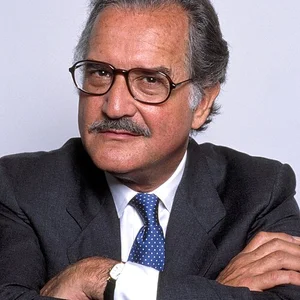

Carlos Fuentes (1928-2012) was a Mexican novelist, essayist, and diplomat, a major figure of the Latin American literary “boom.” His work examines Mexican identity and the legacy of the conquest through modern, richly layered writing.
Carlos Fuentes(1928 — 2012)
Carlos Fuentes
Mexique
6 min read
Frequently asked questions
Key Facts
- Born on November 11, 1928, in Panama into a family of Mexican diplomats
- Published “Where the Air Is Clear” (La región más transparente) in 1958, a sweeping portrait of Mexico City
- Released “The Death of Artemio Cruz” in 1962, a critical reckoning with the Mexican Revolution
- Received the Cervantes Prize in 1987, the highest honor in Hispanic letters
- Died on May 15, 2012, in Mexico City
Works & Achievements
First novel, an ambitious fresco of modern Mexico City that revealed Fuentes as a major voice in Mexican literature.
A masterpiece in which a dying man relives his life; a critical portrait of the compromises of the Mexican Revolution.
A short fantastical novel written in the second person, now a classic studied for its narrative boldness.
A vast total novel about the history of the Hispanic world, which earned him the Rómulo Gallegos Prize in 1977.
A novel inspired by the disappearance of the writer Ambrose Bierce during the Mexican Revolution, adapted for the screen in 1989.
An essay on Hispanic identity and cultural blending, accompanied by a documentary series marking the fifth centenary of 1492.
Anecdotes
Carlos Fuentes was born in Panama in 1928 because his father was a Mexican diplomat. As a child, he followed his parents from one capital to the next and learned English in Washington. When Mexico nationalized its oil in 1938, his American classmates turned their backs on him: that, he said, was the moment he suddenly realized he was Mexican.
In 1962, Fuentes published “Aura,” a short fantastical novel written entirely in the second-person singular (“You read this advertisement…”). This rare technique pulls readers in by turning them into a character in the story, and made the book a classic studied all over the world.
His novel “The Old Gringo” (1985) became the first Mexican novel to make the New York Times bestseller list. Hollywood adapted it in 1989 into a film starring Gregory Peck and Jane Fonda.
Appointed Mexico's ambassador to France in 1975, Fuentes resigned with a bang in 1977 to protest the appointment of former president Díaz Ordaz — held responsible for the 1968 Tlatelolco student massacre — as ambassador to Spain.
A member of the Latin American “Boom,” Fuentes helped bring recognition to his friends Gabriel García Márquez and Julio Cortázar. Awarded the prestigious Cervantes Prize in 1987, he was long mentioned as a candidate for the Nobel Prize in Literature, which he never won.
Primary Sources
“You're reading the advertisement: an offer like this isn't made every day. You read it, and read it again.” — the opening sentence of the novel, written in the second person.
“Yo despierto…” (“I awaken…”): the novel opens on the monologue of the dying Artemio Cruz, who relives his life by alternating between the voices of “I,” “you,” and “he.”
The title echoes the phrase “the most transparent region of the air,” an expression applied to the Valley of Mexico, and Fuentes makes the capital itself the true central character of the novel.
In this essay, Fuentes explores the Hispanic identity born of the encounter, often violent, between Spain, the indigenous world, and the racial blending of the New World.
Key Places
Birthplace of Fuentes in 1928, where his father served as a Mexican diplomat.
The city of his childhood, where he learned English and became aware of his Mexican identity.
Where the young Fuentes studied international relations at the Graduate Institute of International Studies.
The capital where he served as Mexico's ambassador from 1975 to 1977 and a vital center of literary life.
The heart of his work and his life, the city-character of his novels, where he lived and died in 2012.
Liens externes & ressources
Références
Œuvres
La Plus Limpide Région (La región más transparente)
1958
La Mort d'Artemio Cruz
1962
Terra Nostra
1975
Le Miroir enterré (El espejo enterrado)
1992